
Before the rings of Saturn, before trees, before dinosaurs and long before grass, there were sharks. They are still here. There are over 540 species of them. They live in all of our planet’s oceans.
Over a dozen species of shark may be found in Willapa Bay. Sharks have always been an important component of Willapa Bay. Past human interactions with sharks in the Willapa have been highly destructive to sharks. Despite this, many sharks still dwell in Willapa Bay.
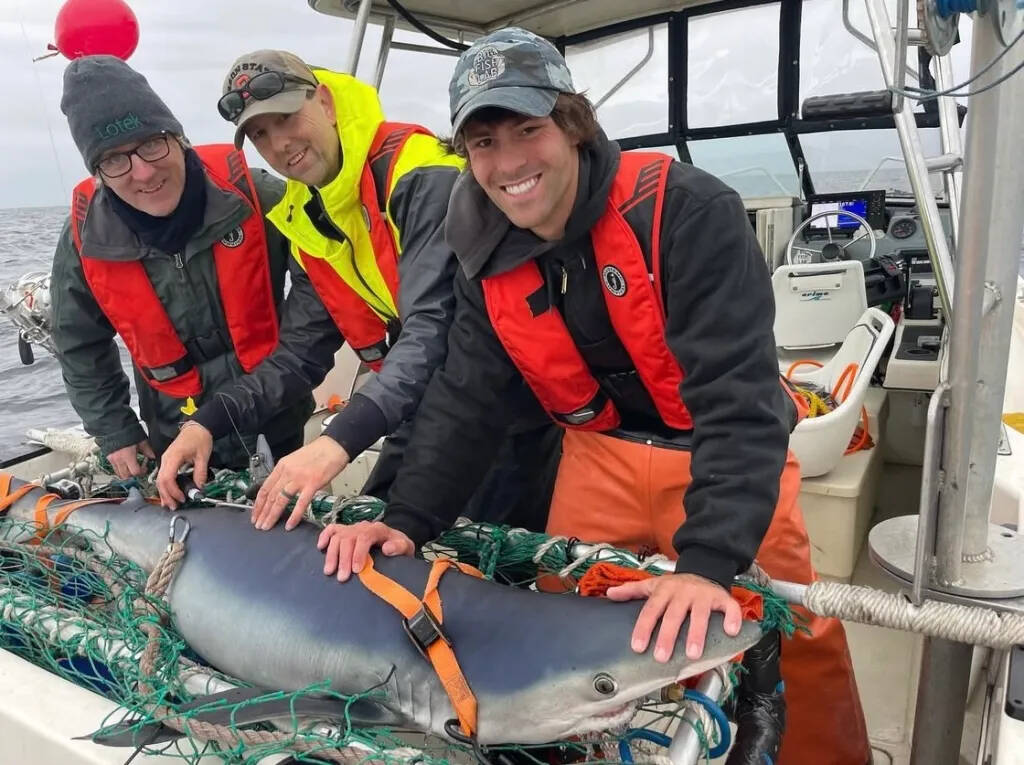
“There is a seasonal abundance of sharks in Willapa Bay,” said Taylor Chapple, founder and head of Oregon State University’s Big Fish Lab (BFL). “Every summer, a robust number of sharks can be found in the bay, and numerous species. I think it’s a true testament to the health of the bay as well as how people and sharks can coexist productively.”
Chapple has dedicated his career to studying sharks and other large marine predators around the world.
He utilizes electronic tagging to gain insight on sharks’ movements, social behaviors and population dynamics across diverse locations including South Africa, Australia, Florida, the West Coast, Hawaii, and, since 2019, Willapa Bay.
“When I started doing research of the Willapa in 2019, Aaron Carlisle at the University of Delaware suggested that sevengill sharks were a fairly unstudied species along the coast,” Chapple said.
He found just two studies for the whole Pacific Northwest on sevengills. He contacted Camrin Braun, who was at the time at University of Washington and is now at the Woods Hole Oceanographic institute.
“We met here and with their boat and my gear, we did a trip out to see what was in the bay. We caught a lot of sharks that day,” Chapple recalled.
Chapple’s work has included developing methods to estimate and assess shark species with limited data, a crucial step for conservation efforts. His research contributed to the first robust estimate of white sharks in the Northeast Pacific.
Chapple’s research highlights the vital role sharks play as apex predators in maintaining healthy and balanced marine ecosystems. He emphasizes that robust fisheries rely on a healthy ecosystem supported by these top predators.
Misplaced fear
When most people learn there are sharks in the Willapa, their first reaction is fear. According to Psychology Today, 51% of Americans admit they are scared of sharks and 38% are so terrified of them that they won’t even go in the water.
It’s not impossible that a great white, salmon shark, tope shark, blue shark, mako or sevengill might someday attack a human swimming in Willapa Bay. However, if there were to be a salmon shark or tope shark attack in Willapa Bay, it would be the first confirmed attack ever by these species anywhere in the world.
Should people not swim in Willapa Bay because of fear of shark attacks? A quick and adamant “no” is Chapple’s answer. Chapple is highly committed to shifting the current mantra from fear and apprehension of sharks to one of awe and inspiration.
“I think that when you look statistically at getting in the water, sharks should be the least of your concerns. The drive to the beach is much more likely to be deadly than it is to get in the water. You don’t stick around for 400 million years if you kind of bumble through life. They’re incredibly discerning. They know what they want. They’ve owned that for 400 million years. If they are sevengill, they’re looking for harbor seals. They’re not looking for people. What we have to remember is that we’re just not on their menu. They’re not evolutionarily predisposed to go after us because if they were, there’d be a lot less surfers in the water.”
“The fear of sharks is mostly a fear of the unknown,” Chapple continued, “and being in a medium that you’re not as comfortable in — especially if you’re in a place like Willapa Bay, where the water is pretty murky. … We have fear of the unknown and having a lack of control. … In the water, we are not the ones in control of that situation.”
Sharks come and go
Scientists think that all sharks visiting the Willapa are migratory. Harm done to sharks in Willapa affects sharks throughout the Northeast Pacific Ocean and harm done to sharks throughout the Northeast Pacific affects sharks in Willapa.
According to Washington State Fisheries, more than 250,000 pounds of shark were landed in Willapa Bay between 1937 and 1949. During that era more than 800,000 tope sharks were killed throughout the West Coast of the U.S. and Canada. Tope shark is noted for its high concentration of vitamin A in its liver.
Demand for vitamin A from tope sharks skyrocketed when the Atlantic cod fishery was closed due to World War II. West Coast shark fisheries pretty much came to an end by 1950 due to the depletion of shark populations and commercial quantities of artificial Vitamin A becoming available in 1948.
Willapa Bay used to be regularly visited by “gentle giant” basking sharks, which can reach lengths of up to 40 feet but filter feed on microscopic plants and animals like whales. While efforts were made in Willapa Bay to eliminate basking sharks, actions by Canada’s Department of Fisheries and Oceans (DFO) might be the most responsible for basking sharks no longer making regular visits to Willapa.
DFO declared basking sharks a “destructive pest” in 1949, adding them to a list of animals that could be killed on sight. In 1955, the agency equipped a fisheries patrol vessel with a giant blade on the prow. This vessel would slice straight through basking sharks as they fed peacefully on the surface of the water. By the time the eradication program ended in 1969, 413 basking sharks in Barkley Sound alone had been killed with the device; 34 sharks perished on the single deadliest day of DFO’s use of its basking shark blade.
Basking shark populations in the Pacific still haven’t recovered.
‘Incredibly pristine’
Some of the work BFL is doing is looking at contaminant levels in the sediment, water, in the animals and comparing that to other places along the coast.
“What we’re seeing is interesting because it shows that the Willapa is incredibly pristine comparatively,” Chapple said. “We’re trying to understand why instead of staying just here, they’re going down to San Francisco and other places and they’re picking up contaminants there. No matter how rich and vibrant and healthy this system is, if you go somewhere that has really crappy water, that might still affect here. We don’t have the baseline. We don’t know where we started. And that’s what we’re trying to understand now. Are we at a healthy level for them? We don’t know because we don’t know where we started.”
Though Willapa Bay has been very much altered by human activity, it is still the most pristine estuary on the West Coast.
“Right in our backyard, there’s a really complex, but healthy ecosystem, that starts at the top with these big predators,” says Chapple. “We should be thinking about how lucky we are to have that, as opposed to ‘Oh my gosh, there’s sharks in the bay. I’m terrified!’”
When asked how long he plans to continue his shark studies, Chapple replied, “As long as we can. As long as funding holds out. These sharks are long-lived like us. You’re not going to understand people by watching somebody a couple times in a year. The same is true with sharks. So we’re trying to keep this research going.”