
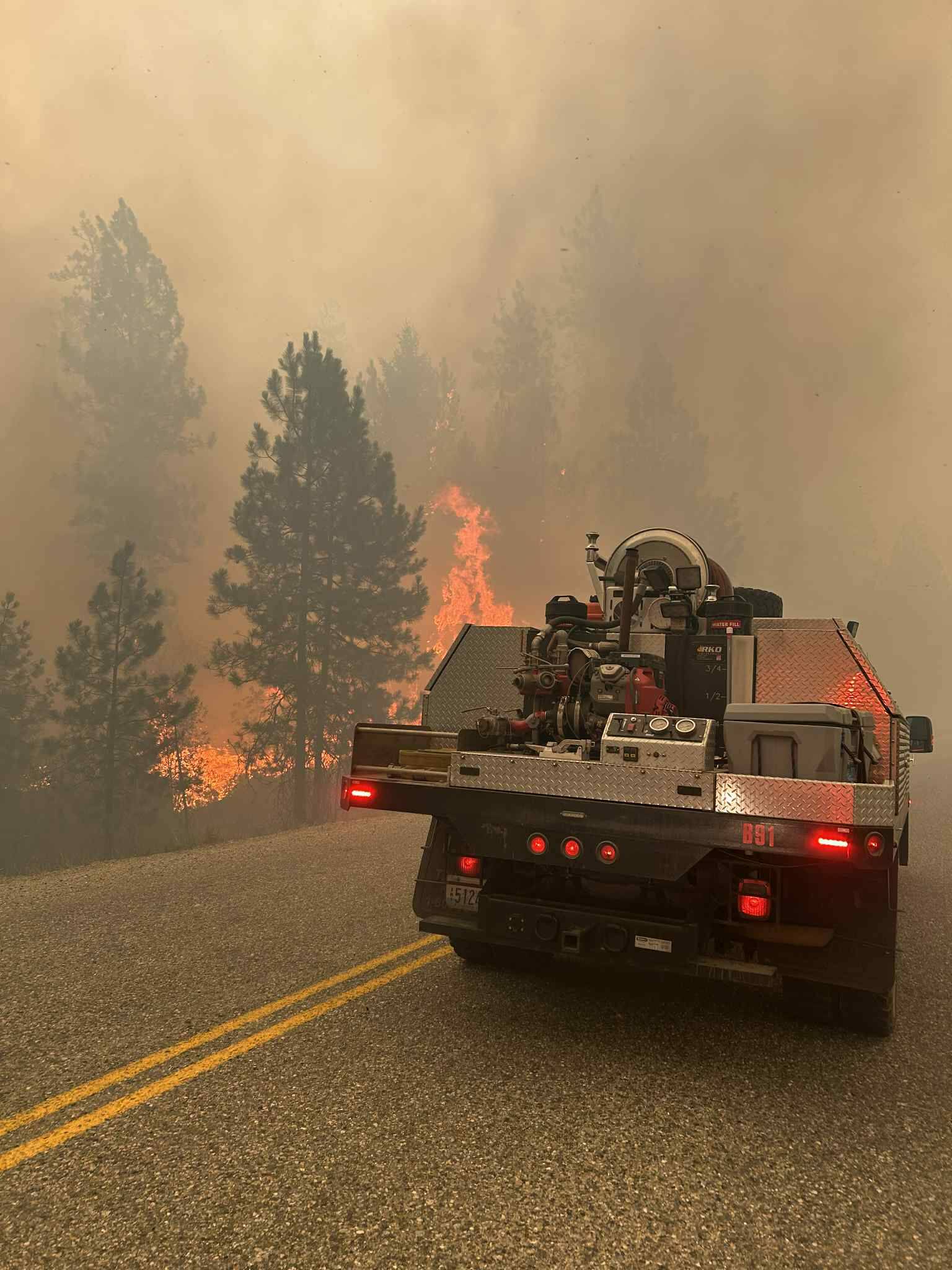
The Bear Gulch fire in July. A wildfire outside of Yelm in August. And the Crown Creek fire in Stevens County at the end of Sept. This summer, Montesano Fire Department’s Brush 91 traveled around the state, providing support for ongoing wildfires. This is the specific role of “outbrush” units. Firefighters who volunteered for this duty included Daylon Schroeder, Michael Neal, Asher Holcomb, and Gabe Bodwell. Currently, Daylon Schroeder and Michael Neal are on the Lower Sugarloaf fire that is 55% contained as of Sunday morning.
The Montesano Fire Department is a member of the Central Region Strike Team overseen by the McLean Black Lake Fire Department, which is based in Olympia. Every Sunday, the participating fire departments can sign up to be deployed on a fire if there is a need.
The support we provide is structure-related, said Neal. “When the local resources get too exhausted, they need other outside resources to come in and help, so we get called out a little bit on these bigger-scale fires.”
Once the Brush 91 crew reports for duty, they become part of an extensive network of resources overseen by the incident management team. Their specific contact is the strike team leader, who oversees all the crews with the Central Region Strike Team.
Usually, their assigned work is structural preparation.
“We go into level 2 and level 3 evacuation zones of the structures and try to get them prepared for if fire were to possibly come to those structures,” Neal said. “That means cleaning up brush around the houses, putting a hand line around houses, just really getting the structures prepared. And if there’s fire next to the houses, we’re obviously going to put it out.”
Neal continued, adding, “And if it’s still hot all around the houses, we’ll be mopping up, which is just digging up all hot dirt around the houses, hot roots, getting rid of all those to make sure it doesn’t reignite. … Even though it’s not on fire, in a couple of days, the house has a higher chance to reignite.”
In some situations, the homeowners haven’t evacuated yet and will help the crews with their work. Other times, the crews may be on a rescue mission, such as what happened this year on the Hope fire in Stevens County.
“Our strike team tried to get [a homeowner] out of his house when we were on a hillside and it just erupted,” Schroeder said. “And the guy ended up crashing [his truck] and fire all ran him and our strike team leader ended up pulling him out of his truck, leaving his truck there, and we got him down to where there was no fire.”
As is expected, there are differences between structure fires and wildfires that the Brush 91 crews have to consider.
“In a structure fire, it only burns with how much fuel it has, and so you can leave it with fuel, but if you just take away the oxygen, then it’s fine,” Holcomb said, adding that with a wildfire, “You’re in the outdoors. There’s air everywhere. There’s wind.”
“Lots of situational awareness,” added Bodwell.
“I would say humidity and wind gusts are definitely a huge difference out here on wildfires,” Neal said.
One thing that Neal has noticed being deployed with other local fire departments on the Central Region Strike Team is a strengthened connection when the crews return home to their respective fire departments and respond to incidents closer to home.
“We learn how to work together a lot better,” Neal said. “Like local fires, most of these guys on our strike team aren’t going to come and help us, unless it’s massive. But when we get those large-scale MCIs [mass casualty incident] and we know who is coming out to help us, it really makes a difference. We’re like, ‘Oh yeah, I know this guy. I know he can do this.’ … And I wouldn’t have been able to know that if I didn’t come out and fight these fires with them.”
For Holcomb, he’s only been with the department for two months and the Crown Creek fire was the first wildfire he’s been deployed to. In spite of the work involved and the resulting tiredness, “when you go back here and you go back to your regular job and you look back and you think about it, it’s pretty fun out there.”
And as Bodwell said with learning about situational awareness, Holcomb found himself noticing the weather more.
“I was walking downtown and a breeze picked up and I was looking at the trees blowing back toward me,” Holcomb said. “And in my head, I was, ‘Oh, fire activity is going to be big today.’ And [then] I was, ‘I’m in town. There’s no fires around here. What am I saying?’”