The fire of 2018: Aberdeen Museum of History in limbo
Published 1:30 am Friday, December 5, 2025
It takes a lot of time, energy, money, knowledge and stick-to-itiveness to curate artifacts, design exhibits, and manage and maintain a museum.
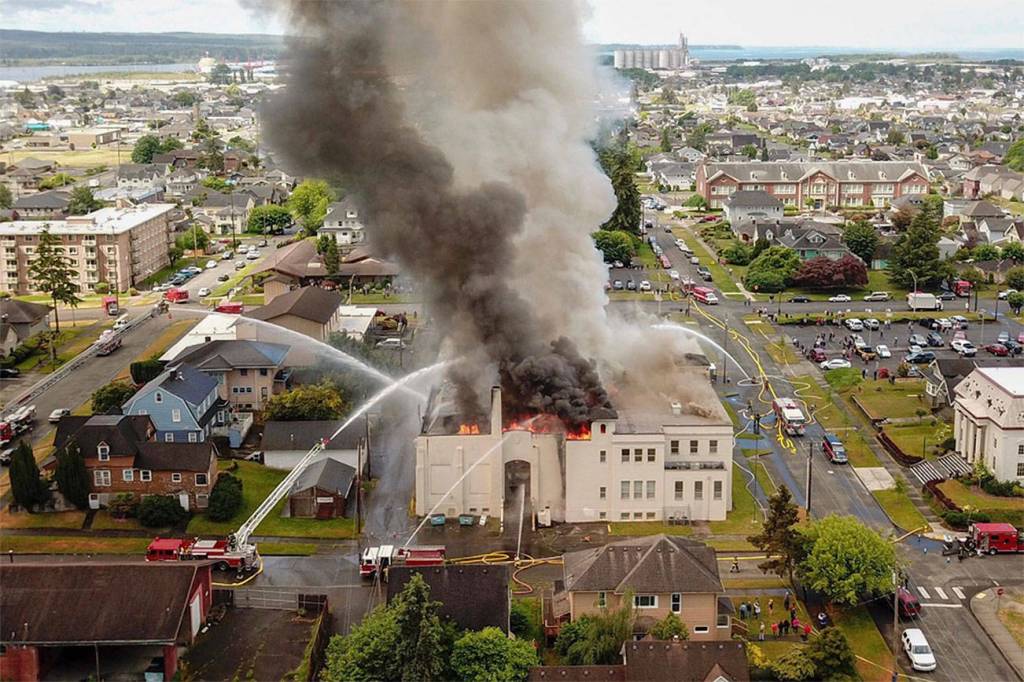
And, it takes a lot of time, energy, money and know-how to preserve, conserve and restore historical artifacts even in the best of situations. The Aberdeen Museum of History has been at the center of a Venn diagram of all of these factors since its location at the Armory Building was destroyed by fire in June 2018.
Some of the headlines in the last seven-plus years have read “one step closer,” “saga nears closure” and “still in limbo.” The latter is currently the most accurate.
According to city of Aberdeen Parks and Recreation Director Stacie Barnum, the city re-formed the Board of Museum and History in September 2018 (and dissolved it in 2023) and started the process of finding a new home for the museum.
“They went through a process to determine what the city would like their collection to look like. They also reviewed some potential locations to open a public museum. They had a site selection committee. One of the locations they considered was the old Boeing building owned by Larry Goldberg. Once a review was done of that and the cost estimates needed to improve the building were determined it was more than what the city was prepared for at the time,” Barnum said. “In late 2019, we acquired a lease with MB Electric for what we call the museum warehouse on the (Port of Grays Harbor) dock where we store all of the artifacts currently and where the volunteers are updating the inventory from the fire of what survived the fire, as well as removing items from the inventory that didn’t survive the fire, and then any new items that have been added to the collection since.”
During this time, the Museum has not had a location while surviving artifacts have been stored at a cost of $5,000 per month to the city of Aberdeen. According to Barnum, the artifacts saved after the fire have not been fully restored.
“After the fire, the company that we hired to recover the property, Restoration Management Company, did some initial restoration, but not full restoration work so that the artifacts wouldn’t continue to deteriorate over time,” Barnum said. “But since then, no, we have not contracted with anyone to do professional restoration of any of the artifacts.”
In October 2020, the city received a $23 million insurance settlement for the building and its contents. Barnum says that while a considerable sum went to museum and artifact collection expenses, some of the money was used for other purposes.
“We had spent about $4 million by the time we received the final settlement check. When you have a fire like that, an insurance company sends you money to help cover your expenses while the final settlement is being determined. A considerable amount of that money was spent to the benefit of the collection,” Barnum said. “When we hired Restoration Management Company, which was our largest expense related to the fire, their main job was to get the artifacts out and to get them to a place where they wouldn’t continue to deteriorate, to inventory it, put it in boxes, store it for us, and then transport it. Then we also had to spend money on engineering and securing the building while the artifacts were being retrieved because the walls were obviously unstable. Then we transferred $1 million into Museum Fund 125 to be used to the benefit of the collection. Most of that money, unfortunately, has been spent on our monthly lease for the warehouse space. I think the council also decided to use some of that money to cover some city operational expenses. We earmarked $7 million toward the levee project.”
Information provided by the city indicates that $14 million is left of the insurance settlement, $8,078,109 was spent between 2018–2022, $7 million has been set aside for the North Shore levee project, and another $532,000 has been committed via resolution 2022-14. In the 2020 Supplemental Budget, $942,461 was used to cover overages in general fund accounts, and in 2022, $1 million was used to cover the Gateway Project overages, $991,150 was transferred to Museum Fund 125, part of 2020 Supplemental Budget transfer (to be used to the benefit of the collection), and was used to pay for museum warehouse storage, insurance, LeMay waste disposal services, gas, electricity, wifi, the purchase of the building at 118 W. Wishkah Street, and miscellaneous museum related bills. Meanwhile, $425,000 was spent in 2024 for police and fire asset replacement, $798,808 was spent in 2025 for asset replacement, $350,000 was also spent in 2025 as part of a budget amendment for a fire engine. Currently, roughly $6.5 remains available for allocation.
In February 2022, the city did purchase the former Salvation Army property at 118 W. Wishkah Street for $350,000 with the intent of turning the building into a new museum space. However, there has been spirited debate about the suitability of that property for such a purpose.
“Some museum board members, along with the mayor at the time, Mayor Pete Schave, had identified that building as a location just for storage. In their opinion, the building wasn’t set up well to have both storage and a public museum,” Barnum said. “And we were trying to get the artifacts out of the lease space because we’re spending about $5,000 a month. So the idea was the city could own a building, they wouldn’t be paying the $5,000 a month, and we could move all the artifacts in there for storage. Once the city completed the purchase of the building in ‘22 and we got in there and took a look at it, having a structural engineer and staff go through … it wasn’t as simple as just moving the artifacts into the building. We went through a fire, so of course we want to have fire monitoring and security. As the person responsible for it I don’t want to explain to the community why their artifacts went through a second fire.”
One of the benefits of the Armory building was the presence of an “anchor” tenant, much like a mall, in this case, the Coastal Community Action Program (CCAP) and the rent it paid.
“As a parks director and knowing what it costs to operate the building, we gave information to the council to have them make some important decisions about the future, because there is a cost to operating a museum in a building that doesn’t have a tenant,” Barnum said. “When we had the Armory building, we had (CCAP) as a tenant, and they brought in about $9,000 a month. We were able to use that money to provide a public museum at really no cost to the city.”
In April 2023, the total repair estimate for 118 W. Wishkah Street was $924,878.
In March, it was reported that Harbor Architects was to present construction drawings for the project by May 1 with some funding and grant money hanging in the balance. That design would have included a remodel of the first floor for use as a public museum, parks department office space, a Visitors Information Center and museum storage.
After conducting a recent museum workshop, the city has since decided to abandon the plans for 118 W. Wishkah Street and possibly sell the building. At the Oct. 22 Aberdeen City Council meeting, City Administrator Ruth Clemens said, “Staff needed some direction on how we were going to move forward. The direction we received from the Council was to determine the best path forward to transfer the collection to a non-profit to display. We’ll come back to the Council at a later time to determine what we’re going to do with the building.”
The Council then voted unanimously not to ratify the agreements signed by Mayor Douglas Orr on May 20, 2024 for Washington State Department of Commerce Community Capital Facilities funding projects S20084 and S1801A in the amounts of $490,000 and $1.7 million.
Barnum said, “We put in a request to have those funds reappropriated for 2026 through 2028, which we were approved for. They reappropriated that money.”
“This is the funds to do the remodel to 118 (W Wishkah), which we decided at the workshop we were not going to do,” City Councilor Carrie Hubbard said.
City Councilor Liz Ellis added, “I would just like to reiterate that at our workshop we talked about how in many ways this building is not appropriate for a museum and it suffers a lot of safety concerns. It would be frightfully expensive to get it into working condition and even then wouldn’t really suit what our needs are, and yet it does represent a city asset. It is a city-owned building.”
Also, up to $240,000 for the museum was to be reimbursed by a Capital Heritage Grant. Barnum said, “The Capital Heritage Grant that we received for the architectural and engineering and then the cost estimates, we spent that and completed that project.”
According to the Grays Harbor County Assessor’s website, the current market value for the property at 118 W. Wishkah is $881,333.
After more than one workshop, and discussion with the City Council, as much as the city of Aberdeen needs and wants a museum, Clemens and Barnum indicated that the city decided it didn’t want to be in the museum business.
“The council a couple years ago had created a strategic plan and they knew that they
wanted to be stewards of our history. They had put that even in their mission. They were conflicted in understanding the city’s financial state … is this the right use of public funds at this time right now? We kept hearing from certain council members,” Clemens said. “The council was pretty divided on whether or not we should operate a museum. Because Stacie and I really didn’t have an answer and we were starting to move towards actually constructing or renovating this building, I wanted to be absolutely sure that the council was on the same page that they actually wanted us to use this allocated funding from the state to renovate the building. Because if we use that funding and then down the road, we decide, ‘Oh, we don’t want to operate or we can’t afford to operate a museum anymore,’ we would have to pay that money back. So Stacey and I, through a couple workshops, were able to pull out of the council, what direction do you want us to head?”
Barnum added, “I think that Ruth and I would agree the message we received was we want to support a nonprofit historical group and their efforts to have a public museum. But I don’t think the council wants that to include the responsibility of ownership of the building. I think their preference would be to not actually own the collection but figure out ways that they can support this organization so that the city can have a public museum, because as Ruth pointed out, it is important to the council.”
Over the past several months, numerous Aberdeen residents, including members of History98520, also known as The Friends of the Aberdeen Museum, have attended City Council meetings and spoken about the importance of resurrecting the museum during the public comment periods. According to Clemens, many of the people who advocate for and champion the city’s history have deep seated roots.
“Well, I think you have people who have lived here for generations or, you know, their
families pioneered Aberdeen. It’s important to share that history. History is an important aspect of any culture of any city to understand those who came before them and made the city into what it is today. It’s important to share that,” Clemens said. “I can see why it’s emotionally charged because (many) of these people have donated relics of their families. We have a very rich culture. From some of the things I’ve heard is that our timber industry was responsible for rebuilding the city of San Francisco after its great fire. Aberdeen has played an important role, not only locally here in Grays Harbor, but at a national level, we played an important role in building America. That’s an important story to tell.”
As for the Friends of the Aberdeen Museum, acting secretary Nancy Cuyle said via email, “While the city is essentially abandoning the idea of replacing the Armory museum, History98520 is running full steam ahead to assure the community history will be preserved and tourists will have another reason to visit the community.”
Cuyle added that History98520 received some display cases from Seattle’s Museum of Pop Culture.
“These cases were expensive,” she said. “Something we could probably not afford on our own. They are round with clear acrylic tops on a round base. They are various circumferences and heights.”
In an article for The Daily World in June, Les Bolton wrote, “Since the fire, History98520 (formerly the Friends of the Aberdeen Museum) has been working under contract with the city to catalog what remains of the collection. So far, this all-volunteer organization has catalogued more than 3,000 items including the ‘Old Tiger’ hand pumper, and the horse drawn Metropolitan steam pumper, Aberdeen’s first and second fire engines. The city’s 1928 Ahrens Fox Fire engine also survived the fire, and thankfully, all three are restorable.”
Ruth Hamilton, the president of History98520, said roughly a dozen volunteers have been working one day per week at the warehouse located on Port Industrial Road sifting through hundreds of boxes since 2022.
“The city contracted with a restoration company to pull things out of the Armory post-fire and they wiped things off, boxed ‘em up, wrapped ‘em and we got over 600 boxes full of stuff. So we’ve been working on the collection since January of ‘22, opening those boxes, unwrapping them, seeing what’s in there, and then trying to determine if this is something we want in the collection, is this just junk, has it been catalogued,” Hamilton said. “It’s kind of an expedition through documents and artifacts and computers to figure out what’s been catalogued, what hasn’t been catalogued. In the early years there were well-meaning volunteers who attempted to catalogue but they had no training. Sometimes the quality of the records isn’t very good. We use PastPerfect (museum software), which is widely used in the museum industry.”
The Friends of the Aberdeen Museum formed in 1976 to specifically operate a museum, became a 501(c)(3) nonprofit in 1978, and ran the museum from its opening in 1983 until the 2018 fire.
Hamilton, who earned her Bachelor of Fine Arts (Studio Art) degree from the University of Manitoba in Winnipeg and a Master of Museum Studies from John F. Kennedy University Center for Museum Studies in Orinda, California, said that History98520 has a contract with the city to perform work on the collection.
“We have a no-fee contract with the city to do the work that we’re doing here at the warehouse. Initially the city museum board oversaw operations here and we worked under one of the board members. When the previous mayor dissolved the museum board, then we requested a written contract,” Hamilton said. “We’ve tried to encourage the city to extend the management contract to allow us to globally manage the collection. So far we’ve not been successful in that. Our goal is to either be named managers or have the transfer of the collection come to us so that we would have standing to raise funds, write grants, that kind of thing. Right now, we don’t have the authority to do that. We don’t own the collection, we don’t officially manage the collection.”
While History98520 continues its work on the collection, the vision for and the future of an actual physical museum facility remains nothing short of opaque.
“We were glad that a building had been designated for a museum but we knew the stuff wouldn’t fit in there,” Hamilton said. “All along we were thinking we’re going to have to find an auxiliary space to accommodate the fire equipment and of the other large pieces because that’s the heart of the collection. Our approach has always been we’ll do the best we can with what we have.”
Hamilton said even though the building wasn’t ideal, plans were moving forward with turning 118 W. Wishkah into a museum space until the city decided to pull the plug.
“It’s frustrating because it has taken so long to get where we are,” Hamilton said. “On the other hand it wasn’t an ideal building. We’re looking for a better solution.”
Hamilton believes that a strategically located museum could give Aberdeen a much needed shot in the economic arm.
“We think that we could revitalize downtown, basically. It’s just incredibly frustrating. We feel like we’ve been held back at every turn but the museum could be a huge driver for tourism, for downtown development,” Hamilton said. “We will have to raise money to acquire a new building. We have one or two options in mind. We’re kind of waiting on the city and we’ve been told that in January something will happen. We don’t know what it is.”
Further clouding the issue is the imminent departure of Stacie Barnum, whose position as Parks and Recreation Director has been eliminated due to budget cuts.
“It never made sense to me to have the museum under the parks department, I know that other municipalities do that but it just seems like Parks has enough to do on their own they don’t need to be running museums,” Hamilton said. “Stacie has freely admitted that she’s not a history person. She’s a great parks director, she doesn’t want to be a museum director. That’s fair. We have not been her top priority, but we haven’t been anybody’s top priority.”
The Aberdeen Museum of History, or lack thereof, is an emotional topic and residents have been frustrated with the lack of movement on resurrecting a historical museum experience.
“I think people loved the old museum. I think people are very angry that the city received a large insurance settlement and there’s no museum,” Hamilton said. “A little under a million went into the museum fund after the fire. We think there probably should’ve been more but we’re not in charge so it’s not up to us. This is the history of the community, it’s the community culture. The history is the heart of the community. If there is no place for the history, then it disappears.”