
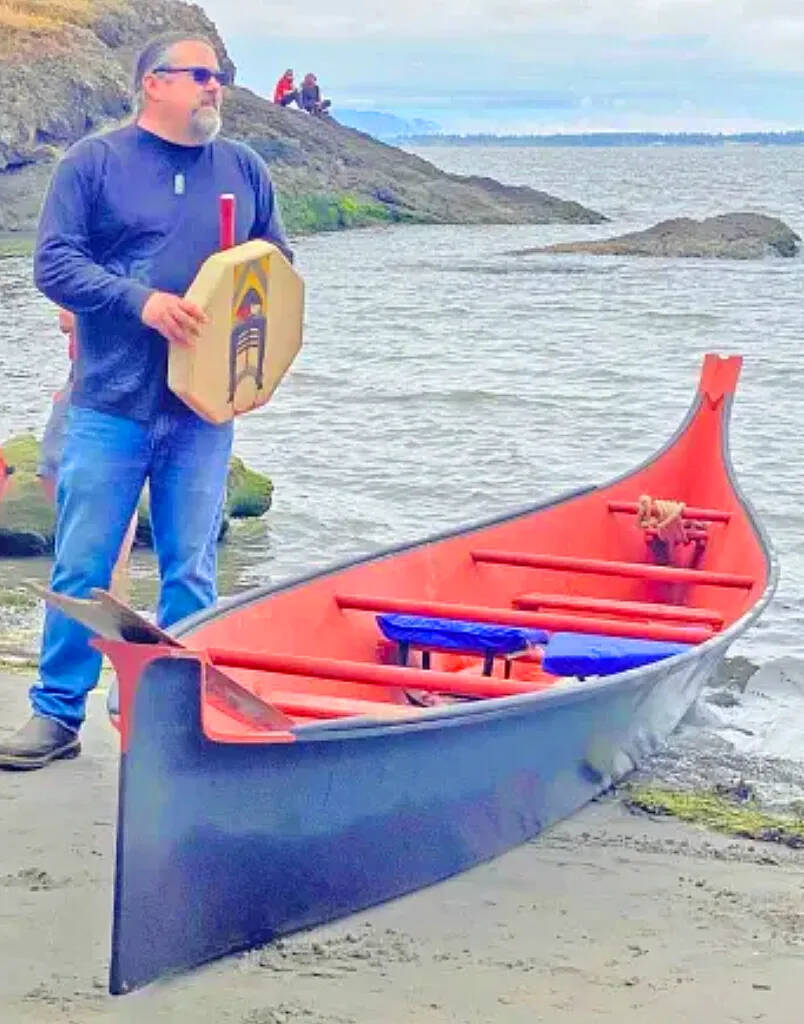
Tony A. (naschio) Johnson, chairman of the Chinook Indian Nation, who was honored this summer with Ecotrust’s 2025 Indigenous Leadership Award, said in an interview that this recognition goes beyond personal accolades.
To him it serves as a powerful symbol of the Chinook Indian Nation’s enduring struggle for sovereignty, a battle that has spanned generations and shaped the history of the nation.
“When I reflect on receiving this award, I don’t think of it as my recognition alone,” Johnson said. “It’s for the generations of Chinook people who have carried our sovereignty forward, despite the federal government’s repeated failure to honor it. This award honors those who came before me, the elders and warriors who fought to protect our land, our rights and our way of life.”
The battle for federal recognition has been long and arduous. Despite the nation’s deep roots at the mouth of the Columbia River, where their culture, language and traditions thrive, the nation has been denied the recognition afforded to other tribes. Johnson, who has served as chairman since 2014, remains steadfast in his leadership role, working relentlessly to ensure the Chinook people’s rightful place within the framework of the U.S. government.
“It’s about so much more than just paperwork,” Johnson said. “It’s about preserving our culture, our language, our songs and stories. These teachings ground us in who we are as Chinook people. Federal recognition is the key to ensuring that these elements of our identity continue to flourish for future generations.”
As chairman, Johnson’s primary goal remains clear: securing federal recognition for the Chinook Indian Nation. This recognition is not just a matter of acknowledgment, it is the key to ensuring the nation’s sovereignty and the survival of its culture in the face of centuries of adversity.
“We will accept no excuses,” Johnson said. “The lawmakers in Washington and Oregon, including Sens. Patty Murray, Maria Cantwell, Ron Wyden and Jeffrey Alan Merkley and Reps. Suzanne Bonamici, Marie Gluesenkamp Perez, and Emily Randall, have the power to introduce the Chinook Indian Nation Recognition Act. It’s time for them to step up and make it happen.”
For Johnson, the issue is personal. “The harm deepens with every day Congress fails to act. This isn’t just politics; it’s about justice. It’s about righting a historical wrong.”
Despite the gravity of his work, Johnson remains grounded in the values that shaped him.
“I am humbled by this award, but it’s not about me,” he said. “What moves me is what this award means for our people, for my teachers, my family, and for all the men and women who have fought this battle for far too long.”
Johnson emphasizes that the wisdom he shares is not his own, but the collective knowledge passed down by the elders who taught him.
“Every day, I’m inspired by our ancestors who stayed at the mouth of the Columbia, despite every attempt to erase us,” he said. “We fight for the future generations of Chinook people who deserve to grow up in a federally recognized Chinook Indian Nation. That’s the real legacy.”
The award, then, is less about individual recognition and more about amplifying the call for justice. It offers a renewed opportunity to shed light on the injustices that still persist due to the nation’s lack of federal recognition, and to press those in power to finally do what is right.
While Johnson is deeply proud of his role, he is quick to point out that the Chinook Indian Nation’s achievements are a collective effort.
“Every citizen of the Chinook Nation plays their part in our story,” he said. “Each person’s existence is an act of sovereignty. To live as Chinook people in our homeland is the ultimate act of resistance.”
That sentiment was powerfully demonstrated in a recent legal victory. After years of litigation, the federal government acknowledged the Chinook Nation’s legal heirship in Docket 234, affirming the tribe’s claim to ancestral lands on both sides of the Columbia River. This victory was a crucial moment in the ongoing fight for federal recognition.
“This decision was years in the making,” Johnson said. “It clarifies a century-long legal battle and solidifies that the Chinook Indian Nation is a legitimate, continuously sovereign people. It’s a reminder that we’ve always been here, and we always will be.”
As chairman, Johnson’s responsibilities are vast. His work requires a delicate balance of political strategy, cultural preservation and a deep commitment to the Nation’s future. But at the heart of it all is a relentless dedication to ensuring that the Chinook people’s sovereignty is upheld.
“My role is to protect our lands, our rights and our culture,” Johnson said. “But it’s also about making sure our people can live and thrive here — in our homeland. It’s about ensuring that we are recognized as a sovereign nation.”
His leadership is not limited to political advocacy. He is deeply involved in cultural work, from preserving the Chinook language, Chinuk Wawa, to sharing the stories that connect the Chinook people to their land.
“Political work can’t happen without our culture,” Johnson stressed. “Preserving our language, our teachings and our lifeways is what will ensure a bright future for the Chinook people, and for everyone who calls this land home.”
The Chinook Indian Nation’s fight for federal recognition is far from over, but Johnson believes this isn’t just a political issue but a moral one, “and we will keep fighting until it’s right.”