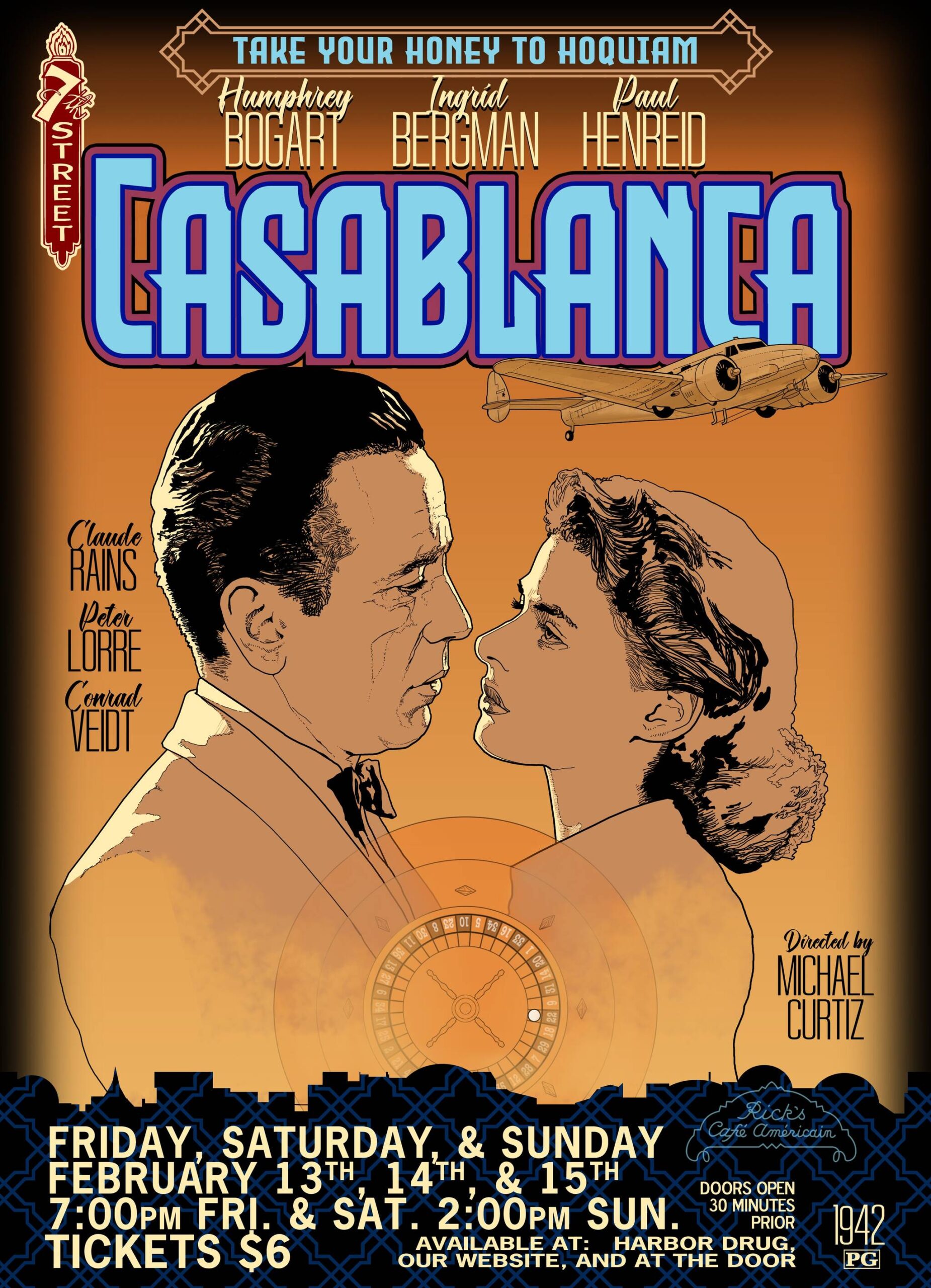
DEAR READER: I have the perfect cure for our winter of discontent. Mark your calendar for Feb. 13-15.
Casablanca, one of the greatest movies ever made, is coming to Hoquiam’s historic 7th Street Theatre.
I can think of no better Valentine’s Day date night than 102 minutes of cinematic magic in one of the few American theaters recognized by the National Register of Historic Places.
Last week, on opening night of the theater’s 2026 season, I purposely sat in the very last row, right next to the projection booth. I wanted to soak up the stunning panorama of an expansive Spanish garden under its dome of make-believe stars. The big crowd thrilled to Steven Spielberg’s 1984 swashbuckler, Indiana Jones and the Temple of Doom. Afterward in the lobby, I heard a kid tell a grownup, “It’s really cool to see a movie in a place like this.”
Now comes Casablanca, as cool as it gets if you love Hollywood’s golden age. It won Oscars in 1943 for best picture, director and screenplay.
Hard-boiled, heart-of-gold Humphrey Bogart and a ravishing 27-year-old Ingrid Bergman were inspired choices to portray two star-crossed wartime lovers. They are two sides of a triangle of impossible choices as World War II rages just beyond their fragile North African oasis of hope. America has not yet entered the fight.
Pearl Harbor, a rude awakening to a brutal two-front war, accelerated Hollywood’s production of war-themed movies. Casablanca was filmed in the spring and summer of 1942 on a Warner Bros. Burbank sound stage painstakingly transformed into French Morocco, where the Nazis control who comes and goes.
If timing is everything, the premiere of Casablanca that November, on the heels of the Allied invasion of North Africa, could not have been better. The film was released nationwide in January 1943, as Roosevelt and Churchill were having a strategy summit at Casablanca.
WHILE BOGART AND BERGMAN unquestionably are the stars of this stirring show, the supporting cast, notably Paul Henreid, Claude Rains, Conrad Veidt, Sydney Greenstreet and Peter Lorre, is equally wonderful. Likewise, the polyglot collection of other characters who find sanctuary at Rick’s Café Américain, the gambling den owned by Bogart’s Rick Blaine. More than Central Casting extras, many of the ensemble were real-life refugees from Nazi-controlled Europe. For sheer diversity and hubbub, the nightly crowd at Rick’s reminds me of the interplanetary cantina scene in Star Wars IV.
Bergman, gorgeously dressed, radiantly lit by director Michael Curtiz, portrays Ilsa Lund. Believing her husband — Czech resistance hero Victor Laszlo — dead at the hands of the Nazis, Ilsa falls in love with Rick in the summer of 1940 with the Germans on the outskirts of Paris. They resolve to flee together. But in the rainy chaos of a frantic train station, a distraught Rick waits in vain, fedora and trenchcoat drenched, unaware Ilsa has just learned Victor is alive.
Now, 18 months later, Ilsa and Victor — portrayed with heroic verve by the tall, suave Austrian expatriate, Paul Henreid — arrive in Casablanca, hoping to secure a flight to freedom.
Ilsa is as stunned to encounter Rick as he she.
“Of all the gin joints in all the towns in all the world, she walks into mine,” Rick laments.
There are more memorable lines of crackling dialogue in Casablanca than in any other movie ever made:
“We’ll always have Paris,” Rick assures Ilsa, offering a toast, “Here’s looking at you, kid.”
Asked his nationality by Major Strasser, an especially creepy Nazi, Rick deadpans, “I’m a drunkard.”
“That makes Rick a citizen of the world!” says Captain Louis Renault, the jaunty, amoral Vichy France constable portrayed by Claude Rains. It is Renault who famously orders his deputies to “Round up the usual suspects!” in a climactic scene.
One of the many ironic, real-life back-stories in Casablanca is that Conrad Veidt, who portrays Major Strasser to a T, had fled Germany with his Jewish wife when the Nazis came to power. And the inimitable Peter Lorre, who portrays a reptilian petty crook scheming to acquire the coveted “letters of transit,” was a star of the German cinema before the Third Reich banned Jews from stage and screen.
I’VE SEEN Casablanca countless times since 1963 when I was in a Seattle theater full of UW college students. They stood and sang along to La Marseillaise as the denizens of Rick’s Café drown out a Nazi marching song with the stirring French national anthem. I didn’t know the words then. I do now. And it never gets old.
The musical score by Max Steiner, one of Hollywood’s finest composers, perfectly complements the production. He did not, however, write As Time Goes By. Journeyman songwriter Herman Hupfeld composed the film’s timeless love song, first heard in a 1931 Broadway musical. Steiner, in fact, initially wanted to use one of his own compositions. In Casablanca, Hupfeld’s tune is sung so memorably by Arthur “Dooley” Wilson as Sam, the piano man at Rick’s Café. A singer, drummer and versatile actor, Wilson was a breakout performer from the Negro Theatre, as it was then called. Casablanca trivia buffs would chastise me if I failed to note he faked playing piano in the movie.
The script, by all accounts, was a work in progress when filming began. The resourceful Epstein twins, Julius and Philip, cranked out new scenes overnight. Which meant the cast was sometimes improvising.
Bummed out by a stormy third marriage, Bogart was reportedly standoffish to his stunning co-star until Curtiz said, “Action!” Then, Bergman recalled, he was instantly in character.
No one knew who was going to get the girl — Rick or Victor — until the last days of filming. I’m not going to tell.
CASABLANCA was filmed in glorious black and white by Arthur Edeson, who shot The Maltese Falcon a year earlier. He was at the peak of his long, eventful career as an innovative cinematographer.
Few decisions in the history of cinema have been as abominable — and happily universally panned — as Ted Turner’s 1984 colorization of Casablanca.
Many film critics and other movie buffs regard Orson Welles’ Citizen Kane as the greatest film ever made, particularly in its innovative cinematography. I admire Citizen Kane. But, in my view, Welles has nothing on Edeson and Michael Curtiz when it comes to flashbacks, fluid tracking shots, closeups, evocative shadows and sheer pace of seamless storytelling. The lighting in Casablanca is astonishing.
Being able to see such a masterful movie in a landmark theater with an appreciative audience is an unforgettable experience. Don’t miss this opportunity.
Casablanca will be screened on Friday the 13th (a stroke of good luck for movie buffs) and Saturday, Valentine’s Day. Showtime is at 7 both nights. There’s a matinee at 2 p.m. on Sunday, Feb. 15. This is the 7th Street’s annual “Take Your Honey to Hoquiam” event boosted by most of the city’s restaurants. If you dine at a participating restaurant, you can snag free passes to the movie.
I’LL CLOSE WITH a plug for Rewind, my friend Rick Anderson’s 2023 book spotlighting “A half-century of classics, cult hits, and other must-see movies.” Rick’s eclectic collection intentionally omits Casablanca, Citizen Kane, and The Godfather, three of the truly great movies of all time. He avers that they “have been dissected so thoroughly” he doubts he could add anything new. I disagree. Rewind is filled with Rick’s unique insights into what makes a movie great — and how a near-great like The Caine Mutiny might have made the grade.
Rick and I have agreed to disagree about Fargo and Vertigo, which I love and he regards as overrated. Otherwise, to borrow a line from Casablanca, it is a beautiful friendship. And Rick’s list celebrates many films that we agree deserve more accolades, including Rear Window, Hitchcock’s masterpiece, and Twelve O’Clock High, the pitch-perfect saga of facing death daily in an unpressurized aluminum tube with wings. My Uncle Charles, who flew 32 missions as a waist gunner in an 8th Air Force B-17, said it was the only World War combat movie “that got everything right.”
You can buy Rick’s book at the Polson Museum. You’ll be glad you did.
John C. Hughes was chief historian for the Office of the Secretary of State for 17 years after retiring as editor and publisher of The Daily World in 2008.