
On Nov. 12, the Forest Practices Board will vote on a proposed change to buffers on non-fish, perennial (Type Np) waters. If adopted, the buffer width has the potential to increase from the current 50 feet to 75 feet, depending upon site conditions. Additionally, the length of the required buffer along the Type Np water would also increase, also depending upon site conditions.
Collectively, this proposed change decreases the acres of harvestable land, which has the cascading effect of decreased revenue from timber harvests and lower volumes of timber available to mills.
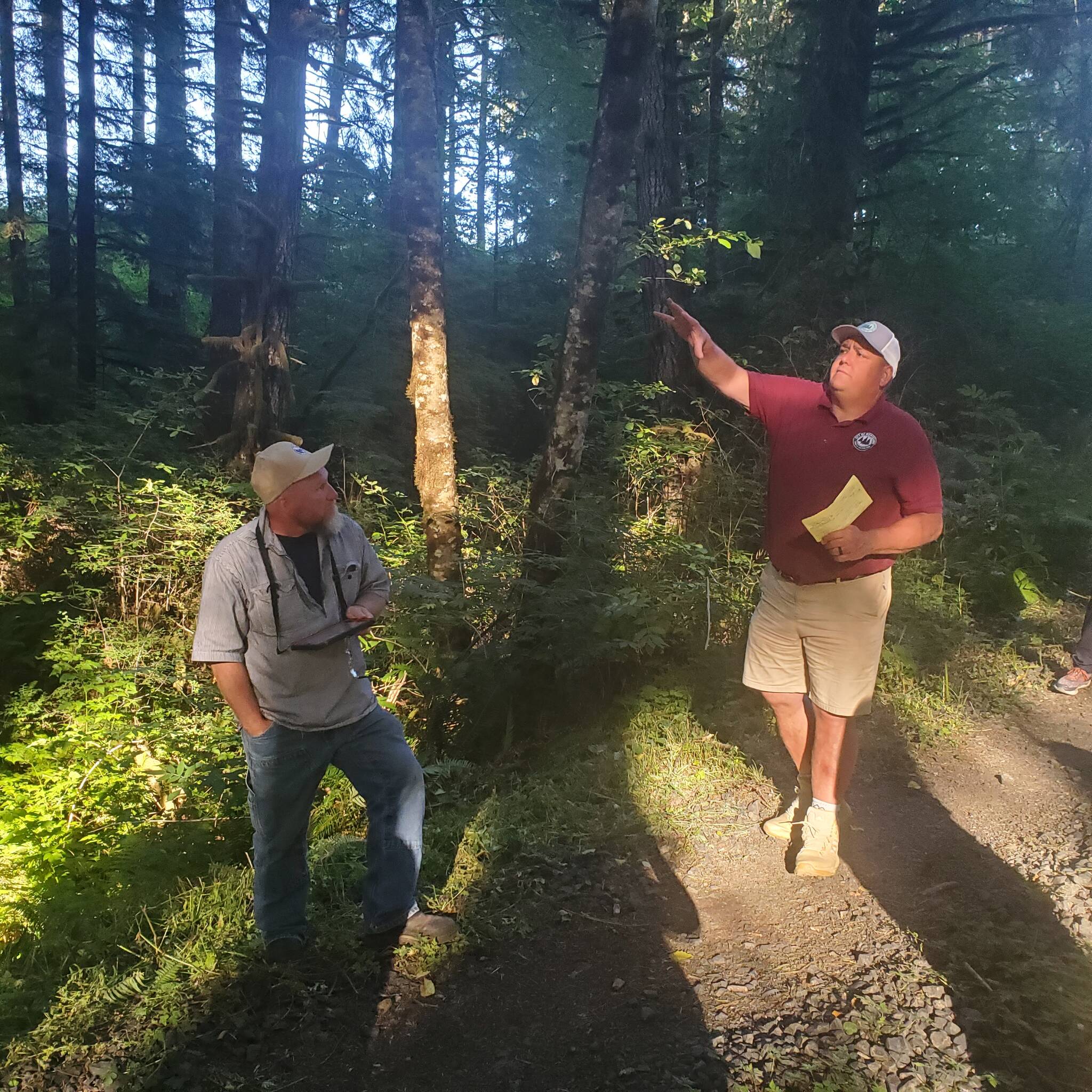
The potential impacts of the proposed change were the subject of a lengthy discussion during the Montesano City Forest Tour held on July 15. At a tour stop that featured a riparian buffer, City Forester John Bull discussed how he manages these buffers. On the fish-bearing (Type F) waters, Bull maintains a buffer of 150 feet instead of the 130 feet required by the Forest Practices Rules. A benefit of having “good, strong buffers” results in less blowdown, healthier buffers, and bigger, stronger trees, he told the tour attendees.
For the Type Np waters, he follows the Forest Practices Rules, which requires “a fifty foot, no-harvest buffer, measured horizontally from the outer edge of bankfull width, will be established along each side of the Type Np Water,” and the length of the buffer depends upon the length of the Type Np water from where the Type F water transitions to Type Np water — in other words, the length of stream where fish are no longer found.
For example, if the length of the Type Np water after the transition point is greater than 1,000 feet, 500 feet requires a 50-foot buffer. For Type Np waters that are less than 300 feet from the intersection point, its entire length must have a 50-foot buffer.
There are additional caveats to protect the Type Np water, including, “No timber harvest is permitted in an area within 50 feet of the outer perimeter of a soil zone perennially saturated from a headwall seep” and, “At least 50 percent of a Type Np Waters’ length must be protected by buffers on both sides of the stream.”
During the group discussion, Bull speculated how the proposed rule change could affect management of the City Forest, and by extension, the revenue generated from timber harvests. He has since calculated how much the city will lose in timber revenue if the proposed buffer rule is adopted by the Forest Practices Board.
Of the streams in the City Forest, many are Type Np because the Sylvia Falls is a naturally occurring barrier preventing salmonoids from moving upstream into the watershed. And where streams are fish-bearing, they contain upland trout or sculpin.
When scheduling timber harvests, Bull must plan ahead nearly two years because it takes time to cruise the harvest unit and submit the forest practices application to the Washington Department of Natural Resources for approval. For example, the units scheduled for harvest in 2026 are already approved, and Bull is working on applications for units to be harvested in 2027.
Since the Forest Practices Board will vote on the proposed rule change for Np streams on Nov. 12 and the city is developing their 2026 budget, Bull is planning for a harvest scenario where the buffers increase to 75 feet.
During the Oct. 14 city council meeting, Bull gave an overview of the Forest Fund.
“What I’m finding is that with all the new forest practice rules, what we had on the acreages for harvest is about 15 to 20% less because of the new regulation. … In the 2026, the differences would be $100,000 so I need to get more realistic as far as acreages and harvest schedules,” he said.
Although the proposed rule has two riparian buffer harvest scenarios for foresters to choose from, Bull said, “By the time that you do all the layout on the ground, it costs so much money and it’s so convoluted for the contractors and everything that most people just say, ‘Okay I know the fixed width buffer is X amount of feet. I’m going to that.’”
Bull contracts out the timber harvest layout because they are time consuming. And expensive.
“On a big harvest, it’s, it could be $6,000-$7000 for the layout,” he said.
Of the City Forest, 22 acres are in riparian buffers, and Bull calculated that proposed rule would add 11 more acres. Additionally, he will need to inventory and map where the streams start to determine where the buffers need placed.
“I don’t mind buffers, but these are non-significant streams,” said Bull. “They’re not playing a big role in fish protection.”
In a joint letter to the Forest Practices Board, Mayor Tyler Trimble of Montesano, Mayor Douglas Orr of Aberdeen, and Mayor Ben Winkelman shared their concern on the rule’s impact in managing their community forests.
“The newly proposed expansion of stream buffer zones would drastically reduce available harvest acreage across all three municipalities, effectively draining local revenue essential to maintain water, sewer and capital projects,” they wrote. “For small cities like ours, already committed to science-based stewardship and conservation, the proposal would cause severe economic harm — undermining the very systems that sustain clean water, habitat restoration, and forest health.”
They called for the Board to:
“Reject final adoption of the current Type Np rule.”
“Restart the process within the Adaptive Management framework, evaluating both the science and socio-economic impacts with stakeholder input.”
“Recognize the vital role local municipal forests play in maintaining clean water, resilient economies, and environmentally balanced land stewardship.”
Montesano City Councilor Ian Cope, and also a member of the forestry committee, said, “If we’re being limited into the amount of harvestable timber we’ve got because of this change going into effect, that impacts our water system. It impacts any of the projects that are directly funded by that income.”
The Natural Resources Spatial Informatics Group with the Precision Forestry Cooperative at the University of Washington published an “Economic Impact Analysis of the Proposed Forest Practices Riparian Buffer Rule Change for Type Np Streams in Western Washington” in May 2025. Their analysis found that the counties in Southwest Washington will be the most impacted by the proposed rule. Grays Harbor County will see a 6% decrease ($4.6 million) in harvestable standing volume.
“There is a good balance that’s being struck at this point between use of the forest and preservation of the [City] Forest and the watershed,” Cope said. “The fact that the experts that are in charge of managing this asset are the ones that are sounding the alarm bells on this and saying this may be going further than it needs to and it’s going to have a negative impact speaks volumes to me.”