
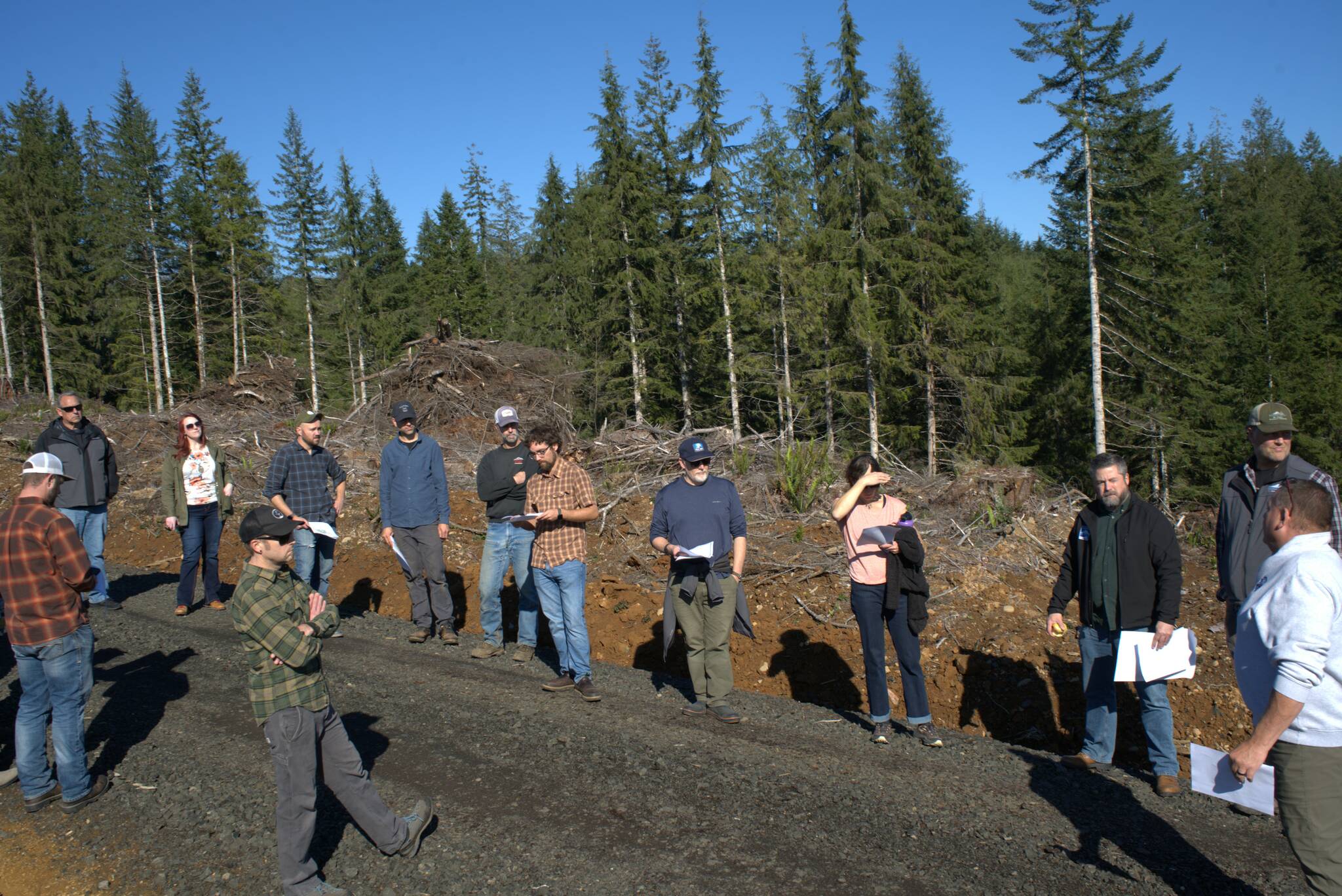
For this year’s Northwest Community Forest Coalition (NWCFC) fall meeting, the city of Montesano played host. The city of Montesano is a member of the NWCFC, having joined when Loren Hiner was the city forester, and John Bull, the current city forester, has striven to be more active with the organization. When the opportunity came to host the annual meeting in Montesano, he accepted it.
“I’m always an advocate for any kind of tour or any kind of promotion of our forest because I think we have a high standard here,” Bull said.
The NWCFC started in 2014 with 10 people and two or three community forests and has grown to 400 members and 50 community forests across the Pacific Northwest, said Daniel Wear, the senior forest program manager with Sustainable Northwest.
As described in its strategy and policy platform, NWCFC was “created in response to the growing pressure on Northwest forests from increasing population, development, and climate-related disturbances, Coalition members have a shared vision that the community forest model will help stem the tide of forest loss, fragmentation, and degradation, while supporting an array of ecological services and providing fuel, fiber, jobs, and recreation to surrounding communities.”
Bull said being involved with NWCFW “gives me a broad knowledge of what other people are doing and what’s working for them. The problems that they’re having, the ability to find different funding mechanisms for different projects; the ability to look at things a different way.”
On Tuesday afternoon, Bull led the attendees, who are involved in the community forest space from across the state, on a tour of the city of forest. Tour stops featured stands that had been logged earlier this year, stands slated for logging next year, and examples of riparian and recreation management. And as with all tours, the last stop provided attendees a scenic view that stretched to Mount Rainier and even Mount St. Helens.
Of the community forests in the state, the Montesano City Forest is an outlier because it is actively managed for revenue, along with recreation and the environment, rather than being solely managed for conservation or recreation.
“[The attendees] were super interested and pleased to see the community forest,” said Daniel Wear, the senior forest program manager with Sustainable Northwest. “The Montesano City Forest is an example of the more actively community forests so people seeing that and seeing that interplay with their trail systems and extended buffer zones.”
The following day, the group met at city hall for presentations on funding opportunities for establishing or maintaining a community forest, ongoing cross-boundary land management fuels mitigation and restoration work on the Stemilt-Squilchuck Community Forest, which is near the city of Wenatchee, and the economics of producing wood at the local scale.
Bull, along with Cody Wayland, a co-founder of Jefferson Timber Cooperative (JTC), Maloree Weinheimer, founder of Chickadee Forestry, and Jordan Zettle with Sustainable Northwest, spoke on the latter topic. A key point from the presenters was that milling infrastructure supports active management, even if the goal is not revenue, and small-scale forestry generates revenue that stays within the community.
“We can grow trees here because we have a huge opportunity with mills,” said Bull, naming off the mills that are located 20 to 30 miles away in Aberdeen, Centralia, Shelton, and Oakville. And each forest management activity, from planting to spraying, precommercial thinning and road and maintenance, has an economic impact.
“Harvest is broad based,” Bull said. “There are constant economic influences from our forest. Every time we do something up there, we’re creating income and adding value for the local economy.”
A priority of the recently formed JTC is connecting small-scale milling infrastructure with the low-value timber generated through thinning operations on private land and turning that wood into a high-value product, whether for mass timber or residential use that adds value to the local economy.
“We’re never going to replace big mills or big forestry; I’m trying to sell about 20 percent of wood to our local mills,” Weinheimer said. “But how do we value wood in our community and the big question for me is what is the true cost of this wood at the end user if Cody is being paid well, if the logger is being paid well, if I’m being paid well? If we want to keep more jobs in our community, what is the true cost of that to our community?”
Wayland shared that the goal of connecting landowners to the sawyers, and connecting the public to the milled product, is comparable to the local food movement since the public is wanting to know where their wood comes from. JTC is leasing 12 acres from the Port of Port Townsend where they will build a wood-processing center to build upon this vision.
Jordan Zettle, senior wood markets manager for Sustainable Northwest, provided an overview of their program, which is “we’re really trying to build a future that connects the built environment to healthy forests and people that produce wood products.” He shared how they’ve found buyers for lower grade wood and what was involved in sourcing wood from local forests in Washington and Oregon for use in the Portland Airport.
Erin McKay, forest health program manager for Chelan County Natural Resources, presented on the cross-boundary approach the county is undertaking to fund the forest health and wildfire resiliency work needed not only on the Stemilt-Squilchuck Community Forest but also on adjacent state, federal, and private ownership.
“It’s really important to work across ownerships because you need continuity across the landscape to have the benefits,” McKay said.
Over 3,000 acres have been treated, whether with thinning, prescribed fire, or fuel reduction treatments. McKay said that this work was accomplished because all the partners had a shared vision for the landscape, a range of funding sources that can be used on all ownership, and master agreements with all the partners.
“[Master agreements] make it really easy to come up with a project and have a small two- or three-page scope of work and budget included and have the payment mechanisms between the agencies already set up,” McKay sad. “So that every time we have a project, we just do a small scope of work agreement under the master agreement. That’s been critical for us.”
In his presentation on the cross-boundary land management work that The Nature Conservancy is undertaking along the Washington coast, Garrett Dalan, the Washington Coast community relations manager, also discussed the economic impacts of forestry in rural communities.
“The basic profit equation is revenue minuses expenses equals profit. When we’re talking in rural communities, especially, all expenses is someone else’s revenue,” Dalan said. “What can we do in trying to solve the problems about thinning and low-merc[hantable] timber and stuff like that? Where are these opportunities where it’s still an expense for one person but is there another spot in the community where that become revenue? Embracing a more robust of what our profit is, not just in the accounting books but truly the goals of the community forest.”
The meeting closed out the meeting with presentations on funding sources and policy considerations heading into the next legislation session.