
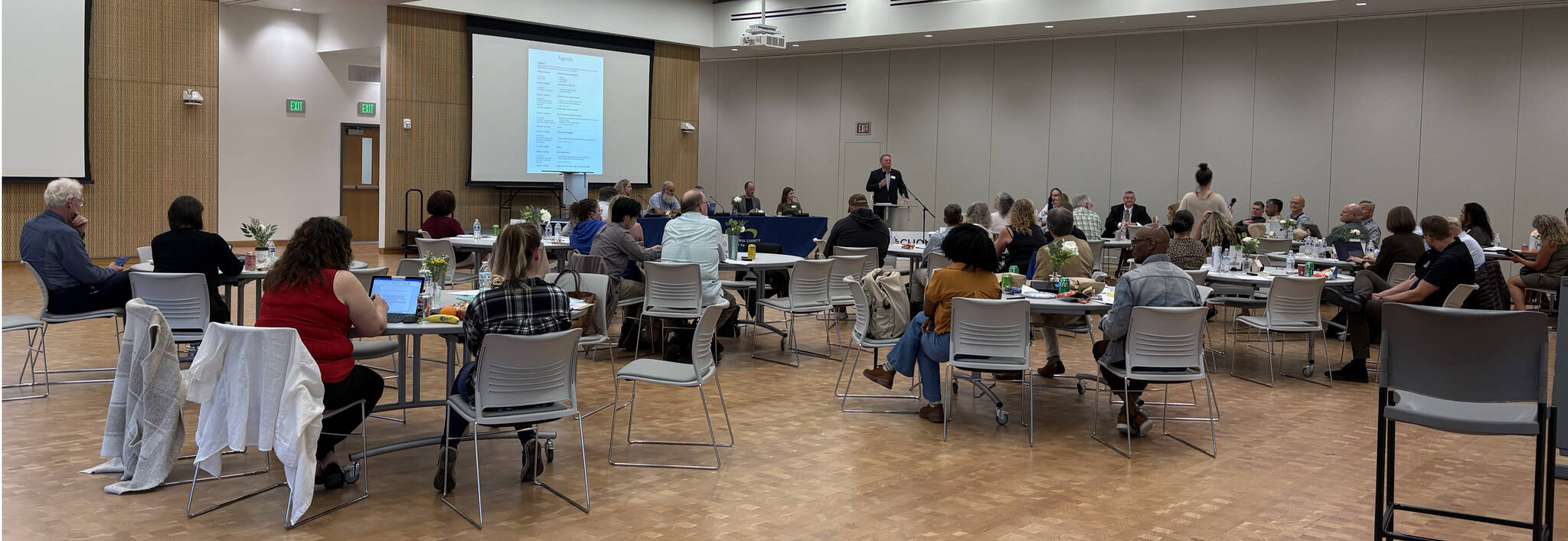
Spearheaded by District 1 County Commissioner Georgia Miller and presented by Grays Harbor County Public Health, the Inaugural Grays Harbor County Housing Summit took place at Grays Harbor College on Wednesday.
Sixty attendees, including elected officials, community leaders, builders, real estate professionals and city, county and state staff participated in panel discussions on a variety of relevant topics including affordable housing challenges, the permitting process, workforce housing and more.
The Grays Harbor County Board of Commissioners (BOCC) have officially proclaimed, “that housing is a priority issue for the county, and every effort shall be made to promote, support, and facilitate the creation of housing at all income levels and for all populations. The Board encourages collaboration with local municipalities, developers, service providers, as well as state and federal partners to increase housing availability and affordability. The Board calls upon the public, private, and nonprofit sectors to align resources and initiatives to address housing shortages through sustainable, equitable, and inclusive development strategies.”
According to Miller, the genesis of the summit came from the BOCC’s recent strategic planning retreats, with some of the meetings taking place at Summit Pacific Medical Center in Elma.
“It came about during strategic planning when (CEO) Josh Martin from Summit Pacific was giving a presentation talking about the needs of our community and he said housing was a great need. How about a housing summit?” Miller said. “Since our Board made a proclamation that housing would be one of our number one priorities, I thought that it would only be fitting to do a housing summit to get the brightest minds in Grays Harbor together, as many as I could, from different facets that have to do with housing, and see what the barriers are, what are some ideas for solutions and create a plan. This should be one of several get-togethers we have to try and formulate a plan to really move the needle on the housing shortage in Grays Harbor, all levels of housing.”
The Merriam-Webster Dictionary defines “affordable” as “able to be afforded: having a cost that is not too high” and its third example reads, “affordable housing [=housing that is not too expensive for people of limited means].”
The lack of affordable housing is a nationwide problem and Washington is certainly not immune. This fact was prevalent during Gov. Bob Ferguson’s March visit to Grays Harbor.
Martin discussed the lack of affordable housing and its implications for the community’s overall health and well-being during a round-table discussion with Gov. Ferguson.
“I’m an expert in healthcare, but I’m here talking about housing. Regarding healthcare, we want to set the stage for the importance of healthcare and the economy. There’s a direct correlation,” Martin said. “As a hospital, we’re very involved with housing, childcare, and workforce, interfacing with everybody here in the room to create jobs. The healthier the community, the healthier the hospital, and the healthier the hospital, the healthier the community. It’s a symbiotic relationship.”
Gov. Ferguson responded, “On the housing issues, when I was running for governor, I went to all 39 counties, housing, cost of housing, affordable housing, was the issue I heard the most,” Gov. Ferguson said. “Denny Heck, who’s our lieutenant governor, widely respected public servant, I asked him to lead our efforts on the housing front.”
In his proposed action plan sent to then-Governor-Elect Ferguson, Lt. Gov. Heck wrote, “There is no nook or cranny of Washington state exempt from the housing crisis — the phenomenon of demand far exceeding supply. The crisis exists in all 39 counties of our beloved state. Whether in rural, suburban, or urban communities, there is no escaping it. While it is true that the housing shortage is also a nationwide challenge, the sad fact is that Washington state has one of the biggest supply shortages. By one measure — the housing unit shortage as a percent of the total stock — Washington state is sixth from the bottom in America.”
Heck added if sufficient action isn’t taken, homelessness will increase, economic growth will slow, standards of living will decrease, retirement security will be reduced, racial disparity will increase and there will be environmental decline.
In May, Gov. Ferguson signed 10 housing related bills into law. According to a press release issued by the governor’s office, these bills cover everything from property tax relief for disabled veterans to encouraging construction of so-called “middle housing” options like condominiums.
“Washington needs more affordable housing — a lot more,” Gov. Ferguson said. “We must make it easier, faster and less expensive to build housing of all kinds. These bills will address this pressing need.”
According to Greater Grays Harbor Inc.’s (GGHI) 2025 Economic Vitality Index, “Home prices increased 3.39% compared to 2023’s 2.0% decrease. Unemployment rates dropped slightly, and employment rates continued to grow with a 1.67% increase in the past year.” Despite the decrease in unemployment, Grays Harbor County has the largest prime age employment gap (25-54) in Washington and is 15% above the national average.
The National Low Income Housing Coalition’s website states, “Nationally, there is a shortage of more than 7 million affordable homes for our nation’s 10.8 million plus extremely low-income families. There is no state or county where a renter working full-time at minimum wage can afford a two-bedroom apartment. Seventy percent of all extremely low-income families are severely cost-burdened, paying more than half their income on rent.”
According to Data USA, the median household income in Grays Harbor County is just over $63,000, while GGHI’s Economic Vitality Index states that annual average wages in the county are $54,329 across 25,579 employees in 20 industries, while the per capita income is $33,763.
When it comes to the retail market, a quick search of Realtor.com shows 862 homes (single-family, condo, townhouse, mobile) currently available for purchase in Grays Harbor County, with prices ranging from $14,000 for a small condo in Westport to a $3.6 million home in Pacific Beach. According to Realtor.com, the median home price in Grays Harbor County was $399,900 in July. Apartments.com lists all of 62 rental properties in the entire county ranging in monthly rent from $723 to $3,000.
NeighborWorks of Grays Harbor, the Housing Authority of Grays Harbor, Coastal Community Action Program and The Moore Wright Group are all involved in low-income housing efforts. Approximately 15% of the county’s nearly 78,000 residents live below the poverty line. However, according to Data USA, in 2023, 72.6% of the housing units in Grays Harbor County were occupied by their owner, yet in 2024, 14.2% of the population was living with severe housing problems. According to the Washington State Department of Commerce’s “annual point in time” count, there were just over 300 homeless people in the county in 2024.
Zillow’s affordability calculator indicates that a household income of $63,000 per year will net you a house at just over $240,000 with a $20,000 down payment before taking into account your monthly debts and bills. Start adding in car payments and the amount of house you can afford drops sharply.
One could reasonably conclude the majority of people in the county own their own home, and for those who don’t, purchasing is out of reach, and the reasonably affordable rental market, especially for families, is nearly non-existent.
The attendees at the housing summit aim to address the challenges regarding the housing shortage, whatever they may be. The first step was to get key stakeholders in a room and get them talking, and maybe more importantly, listening.
Eric Bjella is the executive director of NeighborWorks of Grays Harbor, an organization that works to “develop partnerships in the community between residents, businesses, and government to create safe and affordable housing for all residents of Grays Harbor County.”
“I came to listen. I wanted to hear the other organizations’ perspectives on what they felt the needs of our people are in the housing sector. I know what my clientele is looking for and what their struggles are,” Bjella said. “There is a little bit of a disagreement of where on the spectrum we need housing. Is it just anything and everything? Or should we be taking a more targeted approach? That has room for more discussion. It’s good to hear other people’s viewpoints. What happens between sessions is almost more important than what happens at the session. The connections I made today and the follow-ups we’ll make in the coming weeks will be important.”
Bjella, whose organization provides critical information about paths to housing for the citizens of Grays Harbor, says education in this realm goes beyond the individual.
“The education piece for the individual is important, to make sure that’s promoted and it’s known where to find the resource. Maybe we don’t do a good enough job of getting it out into the community,” Bjella said. “There’s another level of education for the community as a whole, what is going on inside our organizations and what are we doing to develop more housing and how are we approaching the community with our ideas and what we think the needs are and inviting them back into the conversation. How do we engage the community to help us help them?”
Kyle Pauley, who has filled many different roles in Grays Harbor County, including mayor and radio personality, is now the executive director of The Arc of Grays Harbor, a non-profit organization that advocates for and supports a better quality of life for people with intellectual and developmental disabilities. He says the issues with affordable housing stem from the region’s economic woes.
“It’s so multi-faceted, it’s not just a lack of housing. We lost that industry backbone and we haven’t had a replacement. The people who are here it’s a cost of living issue, which makes it hard for developers to come and develop because of the return on investment,” Pauley said. “Businesses leave because the people who are here are already stretched thin and can’t afford to support the businesses. We need a lot of things, housing is an incredible start and it’s a great jumping off point but it’s so much deeper than just housing.”
One of the inherent benefits of getting a group of people from different occupations and disciplines is the networking that naturally occurs.
“I think there were a lot of good ideas. The most important thing to come out of this is that it happened. There were so many great ideas in the room. There were people from different walks of life, we heard perspectives we might not hear in our own bubbles, in our own world, we have our own privilege of only knowing what we’ve been able to experience,” Pauley said. “I think this is a great idea to bring these new sparks and start that conversation. The biggest thing to come out of this I hope is that those conversations continue.”
Miller said public-private partnerships may be the key to solving the issue of supply.
“These public-private partnerships, it is so expensive to build in Washington state, when you’re talking about large scale housing units, no one developer is likely to invest on their own,” Miller said. “It’s most likely going to a public-private, maybe a non-profit entity, working together and even potentially the county and the cities.”
According to Miller, housing is just one piece of the community puzzle.
“If you take a holistic approach, this problem with housing isn’t just housing, we need to get people employed, we need jobs, we need houses, we need mental health treatment,” Miller said. “There’s so many things we need. We have to work on all of these problems simultaneously, together, as one Grays Harbor.”