
Members of Congress from Washington state are highlighting funding for local causes as part of a bundle of federal spending bills that were passed at the beginning of the year.
The state’s two longtime senators, Patty Murray and Maria Cantwell, as well as U.S. Rep. Marie Gluesenkamp Perez (D-Skamania), who represents Southwest Washington in Congress, hailed a number of provisions relevant to the Pacific County economy that were included in several bills to fund the federal government for the 2026 fiscal year. The bills were passed on wide bipartisan votes in January.
Murray serves as the top-ranking Democrat on the U.S. Senate Appropriations Committee, while Cantwell is the top Democrat on the senate’s commerce committee. Gluesenkamp Perez has served on the U.S. House Appropriations Committee since the beginning of 2025.
Sea lion removal, salmon recovery Trending Pacific County Superior Court Cannabis caper ends with chase, no charges Gluesenkamp Perez authored one of the provisions in the spending bill for the U.S. Department of Commerce and related agencies, which directs the National Oceanic and Atmospheric Administration (NOAA) — in consultation with state and tribal partners — to study better removal methods for sea lions that are damaging salmon and steelhead populations. This includes examining “more efficient direct-kill methods,” the congresswoman said.
In the past decade, the number of California sea lions in the Columbia River basin jumped from not even 500 to roughly 5,000. In 2025, a federal permit that allows states and some tribes to trap and kill sea lions in the Columbia River was reapproved with little opposition. The permit allows hundreds of sea lions that weren’t killed under a 2020 approval to be killed by 2030.
At a Dec. 3 hearing by the U.S. House Natural Resources Committee concerning sea lion predation in the Columbia River and Pacific Northwest, Gluesenkamp Perez questioned hearing witnesses about why more sea lions hadn’t been killed following that 2020 permit, which initially allowed for more than 600 to be killed along with others being removed via non-lethal measures.
“Ask yourself, why? Why are these numbers so small?” the congresswoman said during the hearing. “The arduous process of removal is a key feature […] the cost and the onerous back and forth of trapping the creature, identifying its threat, shaking a can of pennies at it, retrapping and then finally darting, contribute heavily.”
The spending bill also includes a $4 million increase for Mitchell Act Hatcheries to help support salmon and steelhead populations in the Columbia River basin, as well as $65 million for the Pacific Coastal Salmon Recovery Fund.
Passed in 1938, the Mitchell Act provides funding to produce salmon and steelhead in the Columbia River basin for harvest and conservation purposes. It currently supports one-third of all hatchery production in the Columbia River.
The salmon recovery fund provides funding for the protection, conservation and restoration of salmon and steelhead for the benefit of local and tribal communities. More than $1.8 billion has been appropriated from the fund to state and tribal recovery programs and projects, which have been leveraged for additional resources to implement about 16,000 salmon recovery projects on the West Coast.
Burrowing shrimp, EGC
Another provision from Gluesenkamp Perez that was included in the Commerce funding bill calls for NOAA to study control methods for excess populations of burrowing shrimp that damage bottom culture oyster beds in Willapa Bay.
Two native burrowing shrimp populations — mud shrimp and ghost shrimp — live in the muddy areas near the shorelines in saltwater tidal areas, according to the Washington Department of Ecology. Shellfish farmers in Willapa Bay and Grays Harbor grow oysters in the same area where burrowing shrimp live, and farmed oysters can sink, smother and die when the shrimp population is excessive.
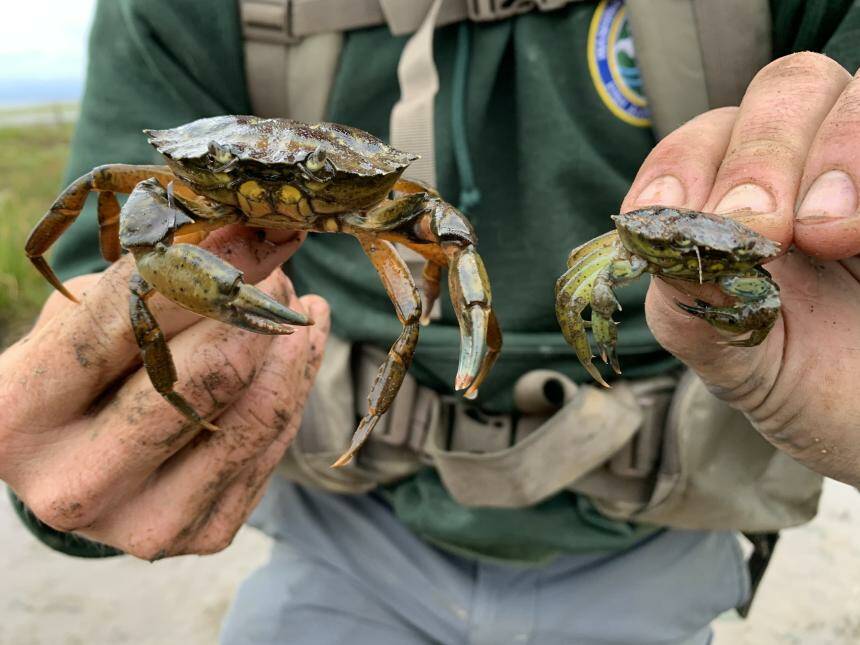
Murray highlighted the $1.5 million that was included in the Commerce funding bill for the management, intervention and mitigation of invasive European Green Crab (EGC), as well as $2.8 million in funding for the U.S. Bureau of Indian Affairs and U.S. Geological Survey to “coordinate and ensure a comprehensive federal approach to address the threat posed by [EGC], mitigate species harm, and protect salmon along with native crab and other shellfish populations.”
The invasive EGC are effective predators — they are adept at opening bivalve shells and also damage bed sediments, leading to the loss of eelgrass — and had already been blamed for collapsing the soft-shell clam industry in Maine before their numbers began surging on the West Coast in the late 2010s.
They could threaten not only oyster and clam fisheries and aquaculture operations in the Pacific Northwest, but Dungeness crab and salmon as well.
Shellfish growers have trapped millions of EGC in recent years, including 1.2 million in Willapa Bay and Grays Harbor in 2024 alone. They have recently been found further inland in Washington, including Skagit Bay.
Then-Gov. Jay Inslee issued an order declaring EGC an emergency in 2022 and urged the state Legislature to provide emergency funds to manage the species; that order remains in effect. The state Legislature most recently provided $12 million in the 2025-27 budget toward managing EGC, consistent from the previous biennial budget.