Dianna Moore
Grays Harbor Audubon Society
Despite this column being about the birds found in and around Grays Harbor, I will occasionally include a bird seldom seen in our region, perhaps because I am hoping enough people looking for it will assure a sighting, eventually. It’s more likely to happen if we know what to look for, so I continue to put this information out there. Plus, it’s another opportunity to learn about a bird we are likely to see on the east side of the Cascades, where I am assured the sun is shining and welcoming those of us from the west side craving more heat units! Any excuse in a pinch for a road trip.
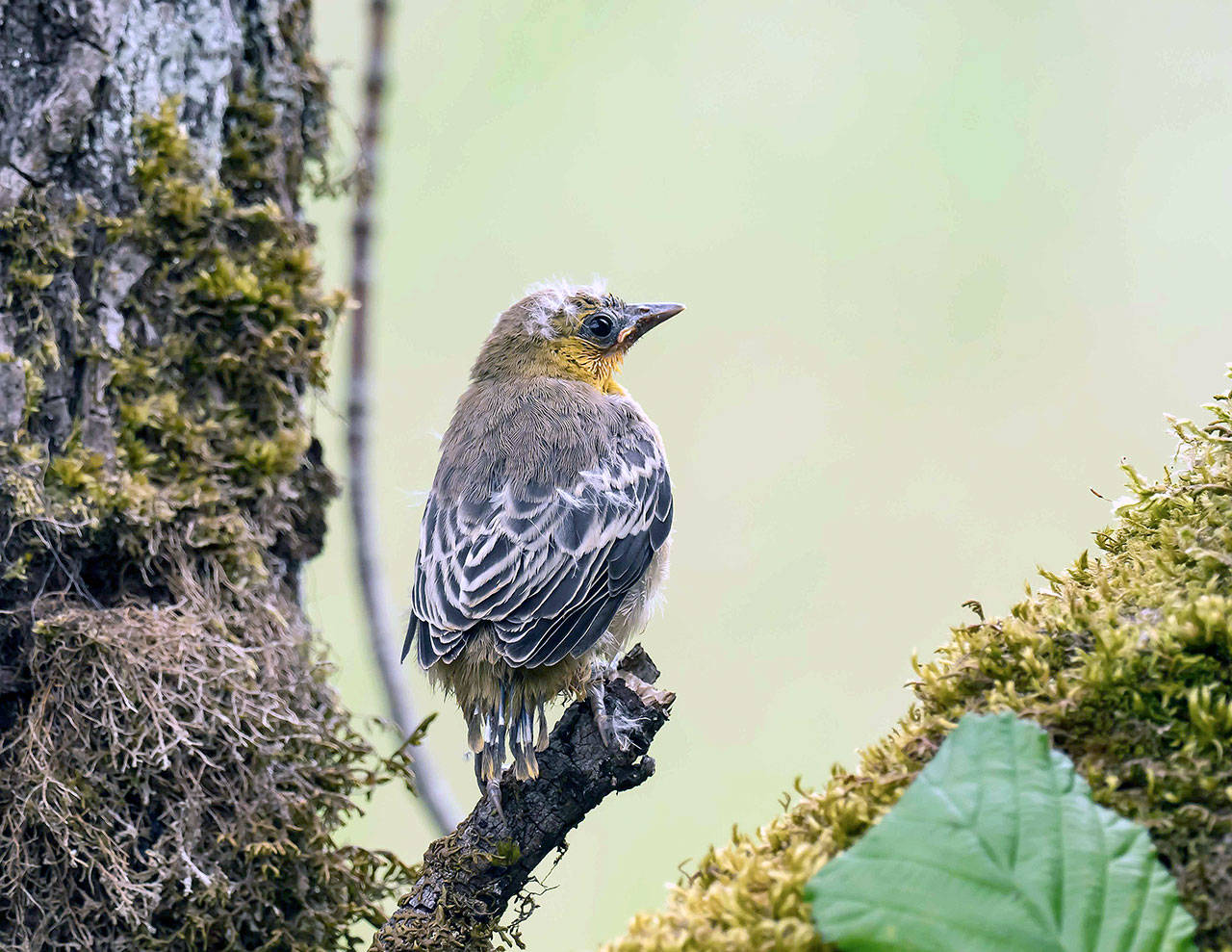
Photographer Gregg Thompson has been following this nest and documenting their behavior; the photo is one of the just-fledged nestlings.
General Description: Bullock’s orioles are medium-sized, slim but sturdy, with a blackbird-like bill, thickly based and sharply pointed. They are 6.7 to 7.5 inches long, with a wingspan of just over a foot, and weigh one to 1.5 ounces. The breeding male plumage is bright orange with white patches on their wings, an orange face, a black line through the eyes and a black throat. Females and immature birds are yellowish-orange on the head and tail, with a grayish back and white-edged wing coverts. Immature males show a black throat patch.
Habitat: The usual breeding habitat of Bullock’s orioles is along forest streams among hardwood trees like oaks, cottonwoods, and willows. Their choice of freshwater wetlands. irrigated farms, orchards, suburban areas and other edge habitats means east county to me, and the very real possibility of a sighting over there. One of the best ways to find a specific bird is to go where the experts say they should be, then hunker down, watch and wait. If nothing else occurs, you have just lowered your blood pressure and practiced a form of meditation. During migration they are seen in more open woodlands and urban settings, including parks and cemeteries. Their wintering habitat has not been widely studied, but we know they use similar habitat of big trees of pine, pine-oak, and fir.
Behavior: During winter and migration these birds may form small flocks but they generally forage alone. They can be found most often in the tree canopy, gleaning insects from the tips of the leaves and branches, often hanging upside down for long periods of time. They also fly out to catch aerial prey, known as “hawking”. They may also fly to the ground to hunt there for prey. Both sexes defend their territory with song and display.
Diet: Bullock’s orioles eat a lot of small invertebrates, especially caterpillars. They often use their bill to poke a hole in their prey, open their bill, and then slurp up the juices. They eat a lot of fruit, especially berries, and can often be coaxed to special feeders for slices of orange, cherries, and the nectars made of sugar water or fruit juices. A fuzzy caterpillar gets a beating against a hard surface to remove the skin before eating, and before eating a honeybee, they extract and dispose of the stinger.
Nesting: Pair bonds last throughout the single breeding season. The female picks the location and both work up to 15 days or so to build the nest. It is usually in a hardwood tree or willow, hanging from flexible branches to discourage predators, and hangs about 10 to 25 feet above the ground near water. It is a pendulous basket of woven hair, twine, grass and wool, and lined with plant down, hair and feathers. The female typically incubates four to five eggs for about 11 days then broods the young for about 14 days before they are able to branch, then fly. Both parents feed the young during this time and the family unit stays together even after the young leave the nest and are able to feed themselves. They often join other family units in post-breeding flocks.
Migration: Bullock’s rioles are neotropical migrants and travel at night between their breeding and wintering grounds. Almost all of the population winters in western Mexico. They leave for Mexico in July and August, then return between March and May.
Conservation Status: They are widespread and common in an appropriate habitat, but face possible future problems due to irrigation needs affecting streamside forest habitat and to the use of pesticides and herbicides. Despite significant, long-term population declines in western North America, Washington has not seen this happening. They were formerly rare breeders in western Washington but the proliferation of hardwood trees in residential areas has resulted in an increase in numbers in the western part of the state.
When and Where to Find in Grays Harbor: Bullock’s orioles are summer visitors to Washington, spending a mere 14 weeks here. They are shown in residence from May through July only, and very few make it over to the west side of the Cascades, but when they do they are most often seen along streams and in yards where fresh water is nearby. I keep thinking the Montesano/Brady/Elma should be where they can be seen nearby, so keep your eyes open and focused on the treetops.