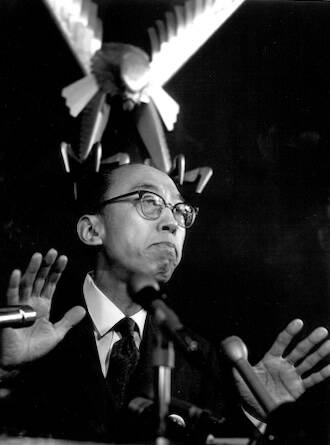
DEAR READER: At 17, impertinence propelled my college career to a rocky start. In the fall of 1961, the only Grays Harbor College faculty member with a Ph.D. was C.Y. Jesse Chiang, a political scientist who so revered Woodrow Wilson that he carried the president’s portrait from classroom to classroom.
Born in China in 1921, Jesse Chiang came to America “in search of opportunity,” enrolling at St. John’s University in New York during World War II. He received his master’s degree and doctorate from the University of Washington in the 1950s, and became a devout Christian.
The nobility of Woodrow Wilson’s famous “14 points” — an address to Congress in 1918 that outlined his hopes for a peaceful post-war world — resonated with Chiang. Wilson called for free trade, global disarmament, and universal self-determination through a League of Nations.
None of that happened. Instead, Wilson’s worst fears came true. He died a broken man after a devastating stroke. And the war he hoped would “end all wars,” having claimed 16 million lives, had its sequel only 21 years later.
“The Follies of the Victors, 1919-1929,” is the title of the first chapter in Winston S. Churchill’s landmark six-volume history of the Second World War, which I received as a 13th birthday present. Churchill gave us one of the greatest paragraphs ever written in the English language, observing that after the punitive Treaty of Versailles in 1919, “mighty forces were adrift; the void was open, and into that void after a pause there strode a maniac of ferocious genius, the repository and expression of the most virulent hatreds that have ever corroded the human breast — Corporal Hitler.”
WOODROW WILSON’S substantial legacy, unfortunately, is eroded by his racism. The first Southerner since 1848 to win the presidency, he took office in 1913 and immediately ordered segregation within the federal bureaucracy. Two years later, he screened a white supremacist film, “The Birth of a Nation,” at the White House. Seeing hooded Ku Klux Klansmen galloping after uppity Black folks during Reconstruction was to Wilson somehow exciting, “like writing history with lightning,” he said. The film lifted the curtain on the KKK’s nationwide second act.
If it is “woke” to abhor racism, I am guilty as charged and utterly unrepentant. I was raised by a Baptist mother who loathed all forms of racial and religious prejudice. She had a lifetime teaching certificate from the state of Oklahoma and was studying for a master’s degree at UC Berkeley before my birth changed her plans. Corporal Hitler, meantime, was sending boxcar loads of Jews to the Third Reich’s ovens.
At 17, I was certain I understood all that — and more.
Emboldened by the hubris of youth, I had the temerity to ask Dr. Chiang how he squared Wilson’s racism with his own idealism. (Cheeky though I was, I resisted the temptation to say, “Besides, you are Chinese.”)
He was not amused. Great men are complicated, he said. And that was the end of that. His steely gaze conveyed I should sit down and shut up.
I ended up with a “D,” which I probably deserved because I spent more time in the Student Union Building debating the leading Goldwater disciple on campus than on studying. (When older and wiser, I learned I had misjudged Barry Goldwater. We’ll save that for another column.)
FAST FORWARD to 1974: Dr. Chiang appeared before The Daily World’s Editorial Board as a Republican candidate for the U.S. Senate vs. Warren G. Magnuson, one of the most powerful Democrats in Congress. Chiang had moved on from GHC to become a much-admired professor at Seattle Pacific College. When I reminded him of our conversation 13 years earlier, he smiled, lowered his gaze with humility, and said, “I should have been more open-minded. History is not immutable.” Then, he reached across the conference table, shook my out-stretched hand, and quipped, “If I had been wiser then, I might have calculated that former students can become influential.”
I liked him enormously.
What a wonderful slice of wisdom: “History is not immutable” — absolute, unverifiable. If it were, we might still be passing off as truth the Parson Weems’ fairy-tale, circa 1800, about young George Washington chopping down a cherry tree and, when caught, manfully telling his father, “I cannot tell a lie.” On second thought, we probably still are. Yet the tree-chopping chestnut is harmless compared to the white-washing of Black history.
Myths, misinformation, and brazen falsehoods undermine our understanding of American history as we approach the 250th anniversary of the Declaration of Independence. Challenging the “absolute Tyranny” of a king and his parliament, the rebel leaders enumerated a laundry list of self-evident truths; letting the “Facts be submitted to a candid world.”
Weighing the role of small-d democracy and an informed electorate, Abraham Lincoln wrote in 1854: “They said, some men are too ignorant, and vicious, to share in government. Possibly so, said we; and, by your system, you would always keep them ignorant, and vicious. We proposed to give all a chance; and we expected the weak to grow stronger, the ignorant, wiser; and all better, and happier together. We made the experiment; and the fruit is before us.”
IF I COULD SPEND 15 minutes with President Trump, I would advise him to begin shoring up his chaotic legacy by abandoning his campaign to forbid the teaching or curation of American history he finds at odds with his own peculiar “conservative” values. Or, in any case, as the White House routinely puts it, “Not consistent with the President’s priorities.” (In a future column, we should consider what it truly means to be “conservative.”)
Is it truly “conservative” to “protect” our youth from historical facts reported by reputable scholars? Are we really to believe that the truth about slavery, “Manifest Destiny” genocide, the Civil War, Jim Crow, and the Japanese internment — rather than making ye free — will merely inculcate shame and cast a “negative light,” as the president puts it, on the object-lesson tragedies and triumphs of American history?
George Santayana’s famous quote, “Those who cannot remember the past are condemned to repeat it,” speaks volumes about the danger of shading history to suit political agendas — or “distorted narratives driven by ideology rather than truth,” as the president puts it.
To promote civility, I suggest we enter 2026 with an acknowledgment of three truths all objective observers find self-evident:
In 2016, Donald J. Trump was duly elected president of the United States by virtue of the Electoral College. In the popular vote, he received 2.8 million fewer votes than Hillary Clinton.
In 2020, Trump was defeated, losing in both the Electoral College and the popular vote, this time by some 7 million. Judges appointed by President Trump agreed there was no evidence of misconduct in the vote-counting, no “steal.” To still deny otherwise is a distorted narrative “driven by ideology rather than truth.” You can get in bed with the MyPillow mogul or accept the facts from experienced election officials from both parties.
In 2024, Donald J. Trump was re-elected president, winning the Electoral College and, for the first time, the popular vote as well, by a plurality of 2.3 million.
Now, as a sharply divided America wonders what it means to be great (again) on his watch, the president should start telling the truth about myriad things if he wants us to believe in his agenda.
Pray with me this holiday season for liberty and justice for the brave Ukrainian people — and for decent, God-fearing Russians as well; a ruthless thug rules their nation. Will America mortgage its soul to reward Vladimir Putin’s naked aggression? Will the real conservatives please stand up?
John C. Hughes was chief historian for the Office of the Secretary of State for 17 years after retiring as editor and publisher of The Daily World in 2008.