
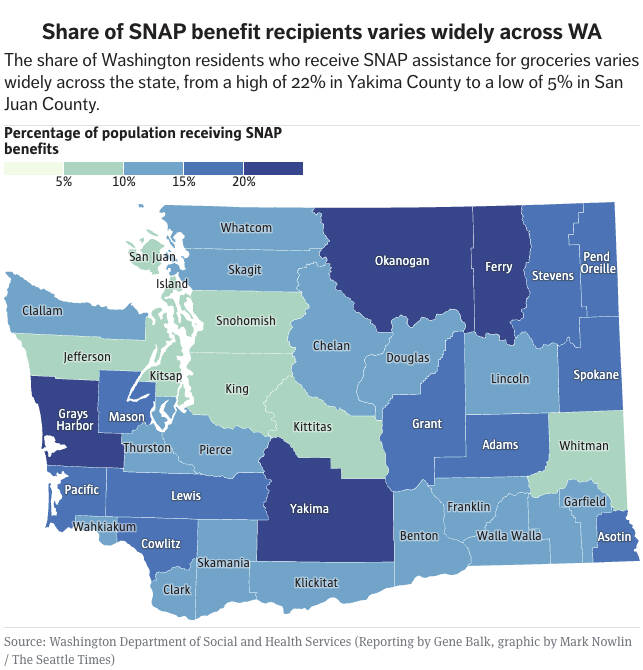
Thousands of Grays Harbor County residents receive government funded food assistance benefits, specifically from the Supplemental Nutrition Assistance Program (SNAP) and the Women, Infants and Children (WIC) program. Those programs have been placed in jeopardy due to the federal government shutdown.
Recently, U.S. Sen. Maria Cantwell (D-WA) released data about the SNAP program, which is currently partially funded through the end of November and has been turned into a political football in Washington, D.C. WIC is funded until mid-to-late November. Meanwhile, Gov. Bob Ferguson on Tuesday directed the state Department of Social and Health Services to transfer nearly $2.2 million each week to the state’s Department of Agriculture for grants to food banks.
As of March 2025, 15,461 of Grays Harbor County’s 77,400 residents receive SNAP benefits worth more than $36 million annually. Close to 9,000 more people in the county are eligible yet have not enrolled. In Washington, over 200 clinics serve more than 212,000 women and their children younger than 5 years old annually under the WIC program. There are nearly 2,800 WIC participants in Grays Harbor County, accounting for nearly $1.5 million in benefits.
The USDA describes SNAP as providing “food benefits to low-income families to supplement their grocery budget so they can afford the nutritious food essential to health and well-being,” while WIC “provides free healthy foods, breastfeeding support, nutrition education and referrals to other services, to support you and your family.”
The Grays Harbor County 2024 Hunger Snapshot indicated that 12,020 people experienced food insecurity, including 3,780 children.
According to Healthy Communities and Families Division Manager Erin Schreiber of Grays Harbor County Public Health, many families are concerned about where their next meals are coming from, especially with the holidays upon us.
“We have a maternal child health home visiting program called Parents as Teachers, we’re serving families who are the beneficiaries of some of these (programs),” Schreiber said. “They’re using WIC, they’re using SNAP to better their families and they’re really anxious right now. We’re talking with families about all of this stuff and they’re wondering, what are they going to do?”
Schreiber said anxiety is particularly high among expectant mothers.
“We have a breastfeeding peer counseling program and our counselor told us she was on the phone with a mom who’s eight months pregnant and she’s getting scheduled for a C-section and the biggest anxiety that she has right now is what if she can’t breastfeed?” Schreiber said. “Where is she going to get formula from if she doesn’t have WIC benefits? Especially for maternal mental health, that is something that we get really concerned about, you know, that parents are supposed to be excited for the birth of their child. We don’t know from one day to the next what’s really going to happen with these benefits and these programs.”
Grays Harbor County Public Health Educator Nikki Gwin says that although food banks are expected to help fill the gaps, they don’t have the time or resources to conduct outreach and inform those in need what’s available to them.
“Right now, food banks are a big, big part of that answer. Due to the nature of food banks in general, they’re volunteer run and they don’t have enormous amounts of time to put into communicating with the community on a scale that might become necessary,” Gwin said. “I see my families typically twice a month for the Parents as Teachers program. Every visit has included this conversation, asking if I’m concerned that my program will end, asking if I know anything about the timelines for WIC or what they can expect now, that kind of thing. They also are very anxious because they are working during food bank hours. Food banks do their absolute best and still you can’t reach everybody. That’s a big part of the anxiety … the solution that we can offer that helps enough for now, for some of them, they’re trying to figure out how they even access that.”
According to Schreiber and Gwin, uncertainty and insecurity with the ability to obtain food has led to mental problems and tough choices for those who are in need of these benefits. Often, people have to choose between critical supplies and food.
“We do a diaper bank distribution network with a lot of other partners throughout the county. There’s a lot of nationwide research around the mental health effects of families not being able to even afford diapers and wipes for their child,” Schreiber said. “As Nikki said, the majority of her caseload of families that she’s working with have young children and they’re using WIC, they’re using SNAP, and they’re working.”
Gwin added that the cost of and the lack of affordable childcare in Grays Harbor County plays into the decisions parents or a single parent has to make. Waiting lists, licensure, finding qualified childcare workers and paying them a living wage all factor into the lack of options in the region.
“A lot of them are one-parent working households,” Gwin said. “So they either are a single parent and they live with a family member, they work, or there’s two parents in the household, only one of whom can work. A lot of times they can’t afford to put their child in childcare. It’s all wrapped into general wellness and security of having the pieces in place to take care of a child.”
Grays Harbor County Public Health Director Mike McNickle said there’s more than just anecdotal evidence regarding the lack of health care and that survey data bears it out.
“I think we need to figure out how we do childcare in this community. We just finished up the survey for the prime age employment gap,” McNickle said. “The vast majority of the problem is there’s not enough child care. The first three issues are all child care related that came out of that.”
As for food insecurity, McNickle says his department has had conversations with state officials, but there isn’t much they can do.
“At the state level, we have conversations with the Department of Health, with the Department of Children and Youth and Family Services,” McNickle said. “But, it’s kind of a one-way conversation at this point, because they’re just telling, they’re not asking. There’s nothing that they can do because their hands are tied. So the state’s saying, ‘We have some emergency funds, we’ll give it to you,’ but it’s minimal and they have to share it among all the counties in the state by population.”
One of the biggest hurdles for Grays Harbor County Public Health and many state and federal agencies is finding ways to get the information about beneficial programs into the hands of the people who need them.
“What can we do right now with the resources that we have, with the skill set that we have, with the mission of public health? We can go out and see how we can support all of the other resources that are already doing these types of things, like food banks,” Schreiber said. “We can bring the resources that we still have, like home visiting, like diaper bank, like, you know, if we have any WIC funds, you know, some of the services that we have here at the health department, we can go out to those food banks. We can meet the people where they’re at and make sure that they know what is available to them and show our support for the community. It seems like a small thing, but it feels like right now where we’re at, that’s one of the little things that we can do that can hopefully make a big difference and also make people feel like they’re not alone or that they’re not trying to scrape by day-to-day by themselves.”
Gwin echoed Schreiber’s sentiments and added that agencies are one avenue of support, but people can also make a difference as individuals.
“A huge part of my job and a big part of Parents as Teachers is connecting them to resources that they didn’t need before, didn’t know existed, things of that nature. The sort of cyclical trap that they’re all in is they don’t have the capacity to go looking for those things a lot of the time. I have a client who has multiple medically complex children. She doesn’t have time to get on her phone for an hour and try to figure out where to go to find a particular resource. That’s a big part of my job,” Gwin said. “Anyone who has the capacity right now to go volunteer or donate if this may be something they would not normally do, this is your time to go do that.”
The Grays Harbor County Public Health department offers a comprehensive list of services at the bottom of their homepage: https://www.healthygh.org/
Food bank and free meal directory: https://www.thedailyworld.com/news/food-bank-and-free-meal-directory/