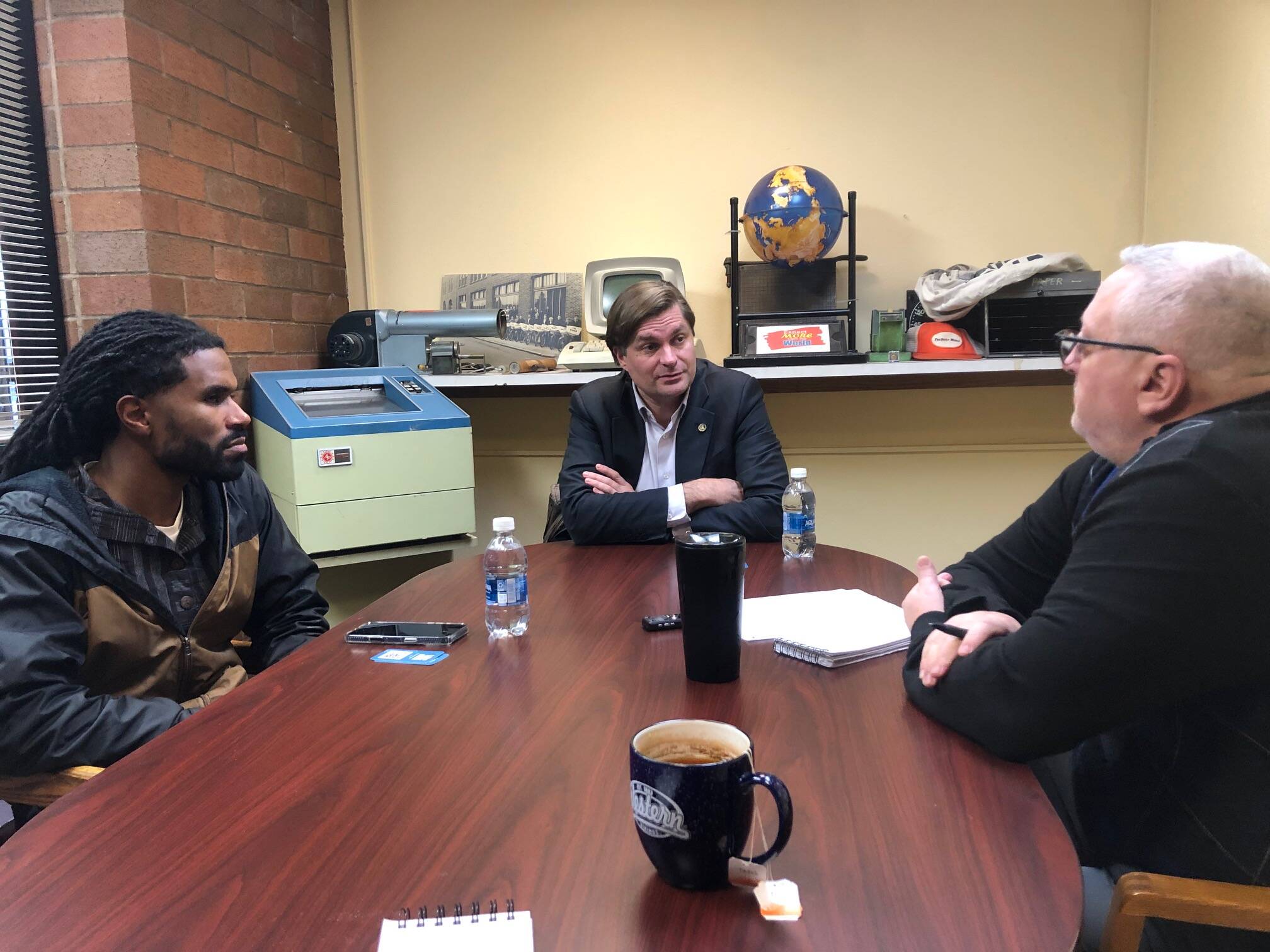
Washington State Treasurer Mike Pellicciotti stopped by The Daily World offices in Aberdeen on Wednesday during a visit to Grays Harbor County and sat down for a lengthy editorial board interview and discussed a variety of topics. In today’s Part I of an exclusive Q&A, Pellicciotti talks about the effects of the current federal administration’s economic policies on the state and local municipalities. We will complete the three-part interview in the next two editions of The Daily World, where in Part II Pellicciotti talks about proposed legislation to implement foundational financial education in Washington schools, and Part III discusses investments, pensions and how Pellicciotti’s office affects the lives of Washingtonians.
Mike Pellicciotti:
I know it’s north of you, but I was in Port Angeles, at the Port of Port Angeles, and … I was talking to them, especially about tariff-related issues and how they’re being impacted, especially on the tourism side, which is what I think a lot of people don’t think about. Within the first month, they had seen a 30% drop in tourism from Victoria. And I can only imagine it’s gotten worse since I was there. Remember that was sometime in the spring. We’ve been talking tariffs a lot. I was in Wenatchee and the Chelan area last week talking about just the impacts on the agricultural side. I talked to shellfish farmers near here and just the impact they’re seeing on the export side and how dramatic that’s been. There are a lot of things that are impacting the economy today, especially here in Washington.
Now, this was a conversation I had with somebody last spring, but they were saying so much of their shipments go to Asia, obviously, and they were saying almost like overnight, it just dried out. Now, I don’t know where things are at now, since I haven’t spoken to that farm, but it was a multi-generational shellfish farm there. And he’s just like, it’s so chaotic because I don’t even know what to expect any given day. How as a business do you operate within a system that is so economically chaotic? It’s very hard to plan. Not to mention just the potential immediate impact if you can no longer export a product that’s ready to be exported right away.
The Daily World:
With your financial background, how do you deal with the gaslighting that goes with tariffs because, there’s a group of people who would have you believe that China’s writing a check or Germany’s writing a check. A lot of companies (may have) actually decided to eat some of the cost before passing it on to consumers. But at some point, there’s going to be an inflection point where they’re going to have to pass that cost on (to consumers).
MP: To be fair, as with any tax on a business, there’s always the possibility the company could absorb some of it. But the numbers I’ve heard is that over 80% has been passed on to consumers from tariffs. My answer to who pays the tariffs was made quite clear by (President Donald J. Trump) changing tariff policy on foreign tropical produce, coffee, bananas, and beef, because he knows it’s increasing the cost to consumers and it’s doing him economic harm. It’s doing the country economic harm and hitting consumers particularly hard. That is in itself a clear acknowledgement by the president who’s paying the tariffs and that’s why he’s changing course on those issues, because consumers can no longer afford those items.
TDW: We don’t understand where the tariff money actually goes.
MP: You and me both. I can promise you the tariff money is not coming into the state of Washington. I don’t even know if it’s real. Money’s clearly been collected, but it seems like it’s always being presented as if it’s going somewhere good. It’s been presented that the money’s going to be returned to the people. Well, we haven’t seen that. It’s been presented that it was going to eliminate the national debt. Instead we’ve seen the national debt skyrocket in the last several months. It’s been presented that it was going to get rid of income taxes. I think people are planning on paying their income taxes. Costs are increasing at a rate much higher than anyone would receive any direct benefit from this tariff tax. At the end of the day, this is a tax being paid for by Washingtonians, and the money is not being returned to the people of Washington. It’s going to DC, and we’re not seeing it return back to our state, yet we as Washingtonians are paying for it. Especially in communities here like Aberdeen, they’re paying a very disproportionate share of the increased consumer costs related to tariffs.
TDW: Isn’t Washington unique due to our proximity to Asia?
MP: And Canada. We are a trade-dependent state. We are one of the few states with an actual trade surplus in recent years, so what that means is we’re getting squeezed from both ends. When I talk to agricultural farmers, especially in Central Washington, they’re getting squeezed on the production side because 90% of our fertilizer comes from Canada. That’s just increasing the cost of production. At the same time, they can no longer export their products overseas, so it’s affecting their ability to actually sell their products. At the same time, costs are increasing for consumers who are paying more for these products. Literally in every direction, we’re paying more and more as consumers. The everyday Washingtonian is getting absolutely hammered right now. They’re getting squeezed from every direction. They’re getting squeezed from inflation in recent years. They’re getting squeezed from additional tax, a regressive tax system. They’re getting squeezed from tariffs. But the problem is that tariffs are such a disproportionately higher cost than any of those other impacts where the estimates for average consumer goods are close to 10 or 12% increased cost for things like toys, things like groceries, things that are just kind of everyday things people would be buying over the next couple of months. Budgets are tight enough as it is, and there’s just no room for that type of drastic increase. That’s why I think we’re seeing the White House relent and admit that this economic policy is failing and increasing the cost for consumers.
TDW: In May, we talked about Medicaid and Medicare. Lately the political football has been SNAP benefits and states like Washington have paid them out. And then the White House says pull them back. It just seems like you wake up every day and you don’t know what you’re going to get or what you’re allowed to do.
MP: We talk about this a lot in our office. One of the things that there was, that we had as a lot of pride in as Americans is that we had an intergovernmental system that led to reliable distribution of funds. We’ve discussed in our office how this is becoming the “bananafication” of American public finances. The idea that money that is supposed to be distributed to the states on a particular date because Congress has authorized those funds to be distributed on that date are not showing up. This is stuff we see in developing countries. This is not the type of operation that is a part of the United States. That type of instability leads to states like Washington and other states needing to better insulate ourselves and prepare in ways that better stabilizes our country, our state, and shields our state from the chaos of the federal government, but at the same time requires us to be ready for more unpredictable situations and doesn’t allow for us to be as efficient in the ways we would normally want to be in distributing those same funds. We might need to have more money in reserves to be able to be prepared for the instability of the federal government. Maybe it would normally make sense for those funds to be distributed to local communities, but we can’t take that risk. Now because we can’t rely on the Medicaid funds to arrive on the date that they’re supposed to show up, or SNAP benefits that Congress has authorized we don’t know if we need to, as a state, try to backfill some of those SNAP benefits or not on the dates that they’re supposed to show up. These are questions that did not exist in our state a year ago, but yet are things we’ve had to prepare for in order to keep our state operational and make sure folks in our community are receiving the essential services they expect from the government.
TDW: Many people don’t know how they’re going to pay their bills, or where the next batch of groceries are coming from.
MP: The number one cause of negative health care outcomes today is caused by financial stress, economic stress. So much that I focus on and the work of our office is trying to lighten the load on the average Washingtonian and do whatever we can to reduce the cost of living on them at a time when they’re getting absolutely squeezed. It’s why I joined (Gov. Bob Ferguson) in partnering with the legal argument to overturn the tariffs that are in a legal argument in briefing the U.S. Supreme Court just this month related to that case. Two previous federal courts have agreed with our legal argument, both the U.S. Court of International Trade and the U.S. Court of Appeals for the D.C. Circuit. I’m hopeful the U.S. Supreme Court will as well because, again, it is almost unbearable for the average Washingtonian or average American now to be able to navigate the world today. Things are getting too expensive, housing costs are too high, childcare costs are almost unattainable. It is getting harder and harder, and governments should be laser-focused on trying to lighten that load and make it easier on Washingtonians and Americans more broadly. Tariffs are just at a time when people are just barely able to make it through, it’s clobbering them over the head and we need to be able to do everything we can to lighten that load. It’s a big focus at what we try to do.
While I’m very much opposed to these recklessly and unlawfully imposed tariffs, I’m not opposed to all tariffs. I just think they need to be smart and targeted. You don’t just wake up every day based on which country you favor, world leader you favor, who gives you a golden orb, right? The next thing you know, you wake up and now the tariffs are no longer on Sweden because they got a new Rolex. What universe are we operating in? This is crazy. It’s not sustainable for businesses. Normally we would rely on business leaders to be standing up and calling this out. They’d be like, “Are you out of your mind? You’re going to wreck our economy.” What happened? Hasbro’s CEO stood up and said, “Am I the only one here who recognizes the toy industry is going to collapse under this?” And they’re like, “All right, now you get 300% tariffs, Hasbro.” This is insane. This is exactly that, which is why this is unlawful. That is the argument to the U.S. Supreme Court is the president doesn’t have authority over tariffs. Congress does. The only exception is in an emergency situation where the president can impose emergency tariffs in an emergency. But what’s not an emergency is waking up that you have been slighted by a random world leader. That is not an emergency and that is why we need to call this out and also Congress needs to do this job.
TDW: Does our administration care that much, and can they make the argument for trickle-down economics?
MP: You have all of these domestic services that are being liquidated, Apple Health benefits, SNAP benefits, local infrastructure, these projects aren’t happening. Increased debt on the average working family in the last, in the Trump tax bill that passed three months ago, increased average debt on working families by $25,000 per family in new federal debt. So you have these increased domestic either costs or services being extracted. It’s being disproportionately given to millionaires and billionaires in tax cuts. If you think of it from the standpoint of, okay, maybe 50 years ago, if you gave tax cuts to the Weyerhaeuser family, an argument could be made that maybe with that additional money, they’ll open up a new factory or a new business, or with Boeing, with those additional savings, maybe they’ll provide some funding to a new community center in town. The reality is those millionaires and billionaires do not live in the communities in which the workers work. What you have is these domestic services being extracted and sucked out of communities, especially rural communities, going now as tax breaks to millionaires and billionaires who are simply putting the money into high net worth investment portfolios. They’re just investing those funds. One of the things that I’ve highlighted nationally is how the average high net worth investment portfolio, because of the impacts of the economic policies over the last several months under the current administration, has led to investing at an increased rate in international investments. Meaning now any investment advisor would recommend to a high net worth investment portfolio to diversify your investments, that at least 20 to 30% of your investments should be invested abroad and not in American assets because of the risk posed to the American economy through increased debt, all of the negative economic consequences we’re seeing. Well, what does that mean? It means you’re sucking out core services of communities, disproportionately sending them to millionaires and billionaires to be put in investment portfolios in which that additional money now is being invested at an increasing rate, up to a third overseas. It is incredible. Even if somebody believed in trickle down, the current Republican Congress, there’s not much they hold on to in terms of Reagan era conservative policy — trickle down seemed like it was maybe one of those things. But it’s not even what it was in the 1980s. This money is now being directed overseas in investments. You’re literally sucking money out of rural and local communities and sending it disproportionately at a higher rate overseas. It’s absurd. It’s dangerous to the future of our country and our future economic strength and it’s one of the things that I’m really trying to highlight and push back on nationally, because I don’t think enough people are talking about that. It’s almost like we’re still tied into the old argument that maybe there’ll be some trickle down, but they’re going to keep some money, like maybe they’ll buy an additional yacht. I’m sure to some degree that’s true, but you can only buy so many yachts. When you’re worth billions of dollars, there are only so many yachts you can buy. The rest is being invested, and at a disproportionate rate, that money’s going overseas as part of their investments.
TDW: But they’re also protecting their profit margins and not eating into those. It’s interesting to see what happens with that because wage stagnation happens over time. The idea with trickle down is that they would invest it back into their businesses, take care of their people, grow their businesses, wages would increase and the business would flourish, but that’s not what’s happening.
MP: It’s why I’ve always been such a big proponent of labor in that I feel that we need to have a higher percentage of folks in organized labor today, because what we’ve seen over the last 50 to 60 years is through that kind of decreasing representation through organized labor, what you often address is a situation where it requires states to step in and provide some of these foundational protections that were used to be things negotiated through labor negotiations. Safe working conditions, appropriate pay for the work being done, retirement, services, those things used to be foundational to any negotiated contract, but it was efficient because it was tied to the geographic location in which you might be in. So, it was just as important for the worker that business continue as it was for the business to continue, and the business leaders often lived in that community. There was a sense of accountability that came from that. What you’re seeing now is through less organized labor, people still want safe working conditions, they still want appropriate pay, they still need to have retirement benefits, all these kinds of foundational things. When it’s not being provided through large employers, what it means is you see the state having to step in and say, well, we need to create paid time off or safe work conditions or certain additional policies. Now you’re trying to do a one-size-fits-all for all employers in the state and all geographic regions, which might not be the most efficient way to implement those types of policies. But it’s a necessary step that the state is taking in order to step in for the lack of the organized labor that often existed in those larger companies. It also then leads to criticism, because then what you see is businesses will say, wait, this doesn’t fit us well here at the Idaho border, for example, near the Idaho border, because we have to deal with a different minimum wage than folks across the border. And it seems like, Olympia, you’re not considering the larger impacts to how it affects us in this community close to Vancouver or, in a more rural area, whatever the case may be. That is the natural consequence if you no longer provide the negotiated kind of labor agreements that were more targeted to that particular community and what those needs were in order to keep that business operational but still provide appropriate services.
As I go around the state, truly each of our 39 counties, whatever county I’m in, people are driving 30 to 45 minutes away to work in the county. Then I go to the towns in which they’re driving from, and people are driving 30 to 45 minutes away to work in that town. And then I go to that town, and then people are driving 30 to 45 minutes to that town. I always thought at some point I’d reach full circle. I’d find this magical town where people are able to afford to work in and the reality is that is just not the reality because of increasing housing costs. That affects everything because now there’s increased pressure on transportation at the same time with, you know, higher gas prices, the impact that has, especially in rural communities, people driving, and now you’re increasing the cost just going into work.
All of these things are things that the government needs to be able to address and I think that we should play a significant role in trying to address them. I think about these issues a lot, especially in rural Washington. These are things that we need to continue to highlight. We need to inject capital into communities and not let it get sucked out. We’ve seen that happen for decades now where it’s gone, especially out of rural communities, into urban centers where wealth is congregated. Now it’s getting more dangerous, more problematic, where the federal government is sucking money out of communities and it’s being sent abroad, which is even more problematic from my standpoint.
TDW: One of the things that we’ve seen here in Grays Harbor County in the last few months is a sea change in the conversation. It started with talking about health, then they realized that health is more than that. It’s economic development, financial stability, mental health, chronic conditions, housing, it’s all these things. All these different things play into the economic well-being of the region.
MP: What I see as I go around the state and what you’re describing is not unique to here, that’s part of the challenges that we’re seeing. There’s no question that being healthy in the broad term, but also healthy enough to be able to work or live one’s life has a huge impact in economic development, one’s ability to contribute to a local economy. It’s foundational to be able to navigate the world. If you’re not healthy, it limits pretty much anything that you can do.
That’s why I’m so concerned about the Medicaid cuts coming from the federal government. Federal funding risks. … I view them in two separate categories. There’s the unlawful reduction of federal funds, which is exactly what you described. Congress has directed money to be allocated. Congress controls the purse. And obviously, it’s the role of the executive branch, to execute that law. And they have unlawfully failed to execute that law. They’re not sending the money on the date it’s supposed to go or they’re withholding it from a particular location because they don’t like that particular governor or whatever the case may be. We know that’s unlawful. We know we will win in court because it painfully violates the Constitution. But we prepare as we need to as a state to be able to withstand as much as possible that withholding until that money’s turned back on. That is separate from the lawful reduction of federal funds, which we’ve seen through Medicaid funds.
TDW: You’re a treasurer in a blue state. That seems like a double hard thing with this administration right now, they are trying to make it more difficult in blue states.
MP: That’s what we were, our office and what I’ve been preparing for since last August is the potential of the current administration unlawfully withholding money from the state of Washington. I started talking to other state treasurer colleagues around the country about this last fall. When I brought up my concern that I thought a future Trump administration would unlawfully withhold money from the state of Washington and their states as well, they said, “Mike, if a future President Trump does that it would just be unlawful.” I said, “I know. That is what we need to prepare for.” I had a similar conversation with the Biden White House and the White House Budget Office last fall about my concerns. I actually met with President Biden, about maybe three or four weeks ago at his house in Delaware, to thank him for the work that his team provided as we partnered with them last December.
We have prepared in the best way we could to avoid the unlawful federal coercion that has been attempted by this administration. What I mean by that is the 10th Amendment of the Constitution is very clear that certain rights and law-making authority rests with the states. The federal government has incredible power in certain areas. They do not determine individual state laws in other areas. And the only way in which the federal government can impose its will unconstitutionally would be to unlawfully withhold money from states. We’ve seen that effort attempted with universities successfully. We’ve seen it attempted with law firms successfully. We’ve seen it attempted with media companies successfully. I will not let that happen to the state of Washington. If the people of the state of Washington pass a law, whatever it is the people of the state of Washington choose for a law to be, that is the law in the state of Washington. Under the 10th Amendment of the Constitution, the federal government has no lawful authority or business telling the state what those laws should be. The only way to defend our state from the coercive efforts of withholding federal dollars is for us to be financially solvent to withstand that financial pressure and that financial coercion. That’s what we’ve done as it relates to unlawful withholding.
That is different from the lawful reduction in federal funds based on Congress passing a law to reduce Medicaid benefits, to reduce SNAP benefits, to increase debt by $25,000 per family in order to disproportionately give tax breaks to millionaires and billionaires. I worked to advocate against that bill. That bill passed. It was signed into law by the president. That is how that process works. It’s now incumbent on the people to vote different people in if they have a different view on those issues. But it is not possible for any state to make up the loss in that federal funding, but the difference is when it actually works through the process, it doesn’t happen overnight. You don’t wake up to withholdings of dollars through a tweet at 4 a.m. They pass a law. It’s implemented over a period of a year or two. There are negative consequences, but there is an ability to at least respond to that.
The concern I have is that what we’re seeing from companies who receive those Apple Health or Medicaid dollars is those businesses are not going to wait for that money to not show up as planned at the end of 2026, which it is no surprise that Congress decided to pass that law and have the implementation occur after the next congressional elections. But those health care providers and the ones that I’ve spoken to need to, as most businesses do, prepare in advance and my concern is that they’re going to start closing down rural health care. Over three out of four births in Grays Harbor County are Apple Health Medicaid funded births. It’s 47% statewide, in rural counties, it’s two out of three and in several rural counties, including Grays Harbor, it’s more than three out of four. There is a disproportionate amount of Medicaid and Apple Health dollars coming into rural communities.
Inevitably, those healthcare providers are going to be making business decisions because they’re the ones who are not going to be receiving the $3 billion this year from the federal government and they’re going to make decisions on where to reduce services. A lot of these rural clinics that I think are very important and there needs to be every effort made to keep them open, were operating on thin margins as it was. They’re barely profitable as it is. So they’re going to be viewed as the first target by these healthcare providers. I’m not going to speak for them, but I think that is a likely consequence of Congress passing this bill.
TDW: That would be really harmful to this community.
MP: And other rural communities of the state in a very significant way. One of the things that’s missing, it’s not just that critical healthcare services being provided in these communities, it’s the economic development tools and economic development that those healthcare services provide because it’s not just the doctors and nurses there, it’s the services provided. It’s the janitorial staff, it’s the people providing construction services for a new wing to be developed. We had an economic revenue forecast council meeting, which is an independent economist board that the state has on revenue projections and one of the things that is allowing us to not see as much of an impact so far is a lot of the kind of governmental services and healthcare services dollars still arriving. I’m concerned about what we’re going to see next year, because again, that has an impact not just in the communities, but the larger ecosystem. When I was in Spokane, nearly half of their economic development is tied to healthcare within that region. These things are so connected, interconnected. This is why I get so angry about this and I try not to be a person who gets particularly angry. I’m a pretty level headed guy. But this is what I mean when you are extracting and sucking out domestic dollars and giving them disproportionately to millionaires and billionaires.
TDW: Back to the SNAP surplus, set aside for when things like the government shutdown happen, and it seems that there is a cruelty behind such actions.
MP: I’m not here to, nor am I able to, justify the actions of the President of the United States.
TDW: We just had an election nationwide and it went well for the Democrats.
MP: I view it to be an awakening by the electorate that America is on the wrong course. There’s a need to redirect us and hold accountable both political parties to better represent the interests of the people. It’s one of the things I was talking about at Grays Harbor College. I’ve always rejected all corporate campaign donations since first running for office. I feel like there’s too much corporate money in politics. It disproportionately and negatively affects a lot of policy outcomes, and both parties are to blame related to that. I think that the people have had enough of the government not working, and what is important for me is that we use this opportunity now to make government work better for people, and we should be laser-focused on reducing the cost of living in Washington, on Americans, at all levels of government and make it easier for people to get by at times when it’s getting increasingly difficult for folks financially to make ends meet.
I like any election that results in greater accountability for elected officials, that they’re in a way delivering a clear message that the public expects them to make life easier for the average American and not more difficult or not self-serving for that particular politician.