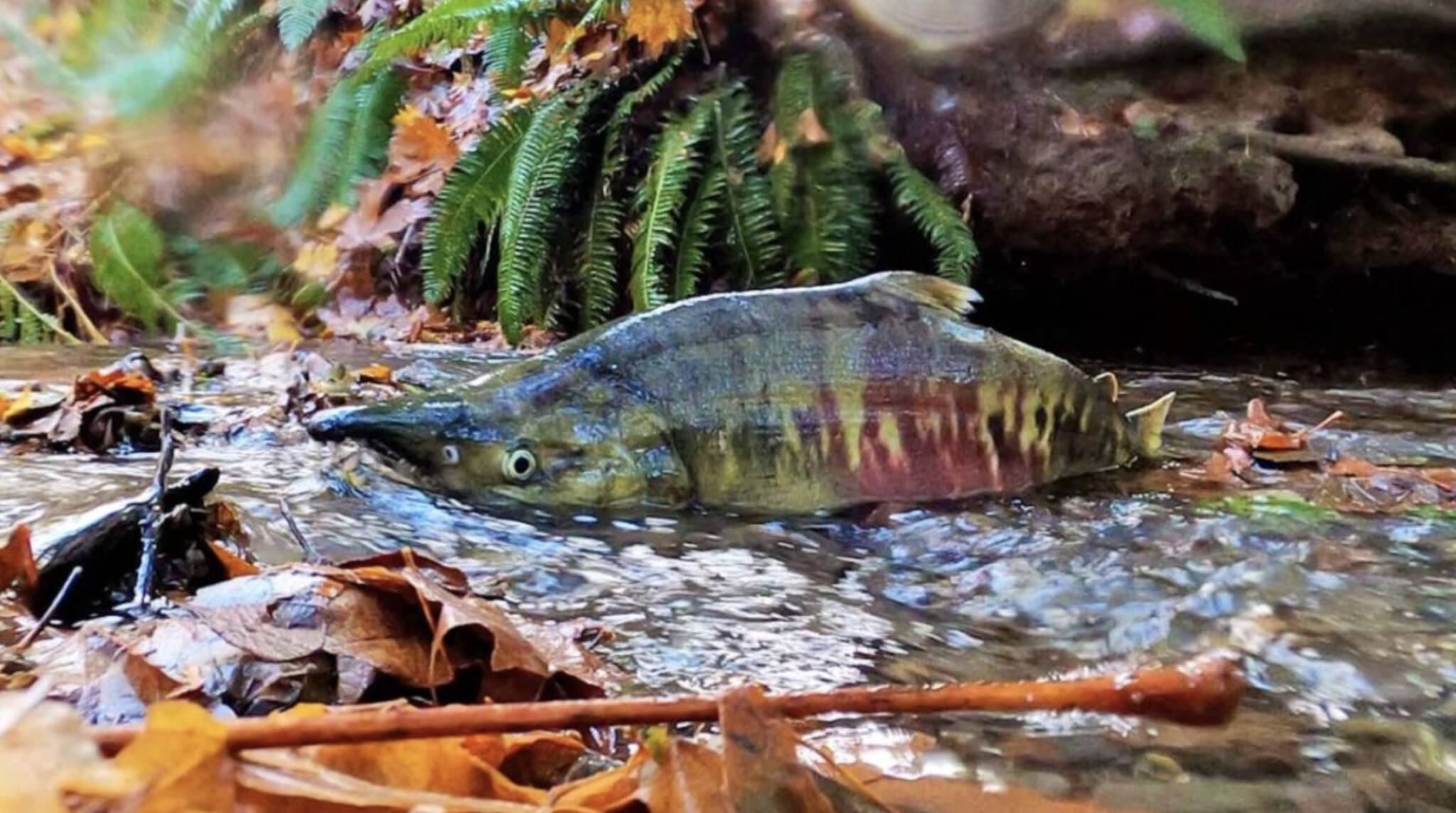
Pacific salmon perform one of the greatest wildlife migrations on the planet.
You can view the migration just east of Grays Harbor County at the Kennedy Creek Salmon Trail.
WHAT: View spawning chum salmon in their natural environment. About 24,000 adult chum salmon return to Kennedy Creek each year to spawn. Kennedy Creek Salmon Trail (KCST) features several viewing stations and options to walk 0.1 to 0.5 miles on our well-maintained (but unpaved) trail, educational signs, and trained volunteers available to answer questions.
WHERE: West Old Olympic Highway, halfway between Shelton and Olympia between mileposts 356 and 357).
WHEN: 10 a.m. to 4 p.m. on weekends in November. Dates vary slightly each year based on when the fish are expected to arrive, but the peak of the run is typically in mid-November. Gate is locked at 4 p.m.
WHEN (guided school field trips): Weekdays in November.
HOW: Access to KCST is free for everyone. Parking is extremely limited, so plan to carpool. If the parking lot is full, you may park on the logging road as long as you don’t block the road for emergency vehicles.
NOTE: No dogs allowed for two reasons: 1) salmon carry a microorganism that is deadly to dogs and 2) this is a Natural Resource Conservation Area and the mandate is to protect sensitive wildlife and habitat. It is not a recreation site like Capitol Forest.
The Kennedy Creek Salmon Trail is our region’s premiere salmon-viewing experience. KCST has been open since 2000. KCST is open to the public annually on weekends in November. Field trips for school groups can be scheduled for weekdays in November. Visitors learn more about the salmon life cycle and observe chum salmon spawning and courting behaviors. Thanks to our volunteer docents, no questions go unanswered and all visitors get a rich Pacific Northwest experience.
In any given year, the spawning chum salmon population here can reach as high as 80,000 fish. Normally, the range is between 20,000 and 30,000 spawners. These spawning adults can produce approximately 30 million to 60 million eggs annually; not all eggs will survive to become fry or adults. Each female lays about 3,000 eggs, but only 2-3 individuals will survive and return to the natal stream where they were hatched to create the next generation of salmon.
KCST is located on the ancestral grounds of the Squaxin Island Tribe. Long before the trail we know as The Kennedy Creek Salmon Trail existed, another trail passed this way. It began in the Sawamish/T’Peeksin village, which stood near the mouth of Kennedy Creek. The villagers, ancestors of today’s Squaxin Island Tribe, knew the creek as the “Place of the Singing Fish”, called that for the multitudes of frogs that would sing along the creek on spring nights.
The trail was used for gathering food, basket-making materials and hunting. The trail stretched from Totten Inlet to Summit Lake, and was part of a trail network that connected the villages of the south Puget Sound and the Pacific Coast to one another.
Millions of salmon returned to the streams each year, providing one of the most essential food sources for the people of this village, and other Puget Sound tribes. In The Sawamish/T’Peeksin people built rock weirs at the mouth of the creek to catch the fish, which were then preserved by smoking. The abundant oil in the chum was utilized as a lubricant to move large logs used to build canoes and houses. The Sawamish/T’Peeksin people viewed the salmon as kin. Today’s Squaxin Island Tribe continues the traditions of their ancestors each year during the First Salmon Ceremony.
Over-fishing and habitat degradation throughout the 20th Century turned the once abundant Kennedy Creek into a small chum run that averaged 1,000 fish and spent the majority of the summer as an ATV track.
In 1998, things changed for the better when the Squaxin Island Tribe began closely monitoring fishing in Totten Inlet. At the same time the Taylor family (of Taylor Shellfish) signed a 20-year lease with the Kennedy Creek Management Committee and the South Puget Sound Salmon Enhancement Group to restore the creek as a chum spawning ground and to develop an interpretive trail for public use. Today the trail acts as an interactive learning site to view the incredible annual spawning event of the returning chum salmon. Returns now average 18,000-30,000 fish. In 2019, Washington Department of Natural Resources (DNR) purchased over 600 acres of land containing prime chum spawning habitat from Green Diamond Resource Company to preserve and protect vital habitat in the watershed and restore ecosystem processes. In 2020, DNR purchased the land that contains the Kennedy Creek Salmon Trail from Taylor Shellfish. The Kennedy Creek estuary is part of a 200-acre Natural Area Preserve managed by DNR since 1999. Above the estuary, the corridor all along Kennedy Creek (about 1500 acres) was designated as a Natural Resource Conservation Area by DNR in 2016. The land within this NRCA is a mix of private and state landowners.
Salmon viewing tips
Peak viewing months are between July and November.
Approach a stream slowly and stand quietly at the edge (do not enter the water). Quick movements may cause salmon to assume you are a predator and become startled. Walking in streams while salmon are spawning may damage salmon nests with eggs (redds).
Leave dead or dying salmon. These carcasses will provide valuable nutrients to the ecosystem and the future generation of salmon.
Wear polarized sunglasses to help prevent glare from the water’s surface.
Maintain control of pets so they do not catch or scare salmon.
If you don’t see salmon, don’t give up! Try again in a few days or weeks, after rainfall, or at another location.