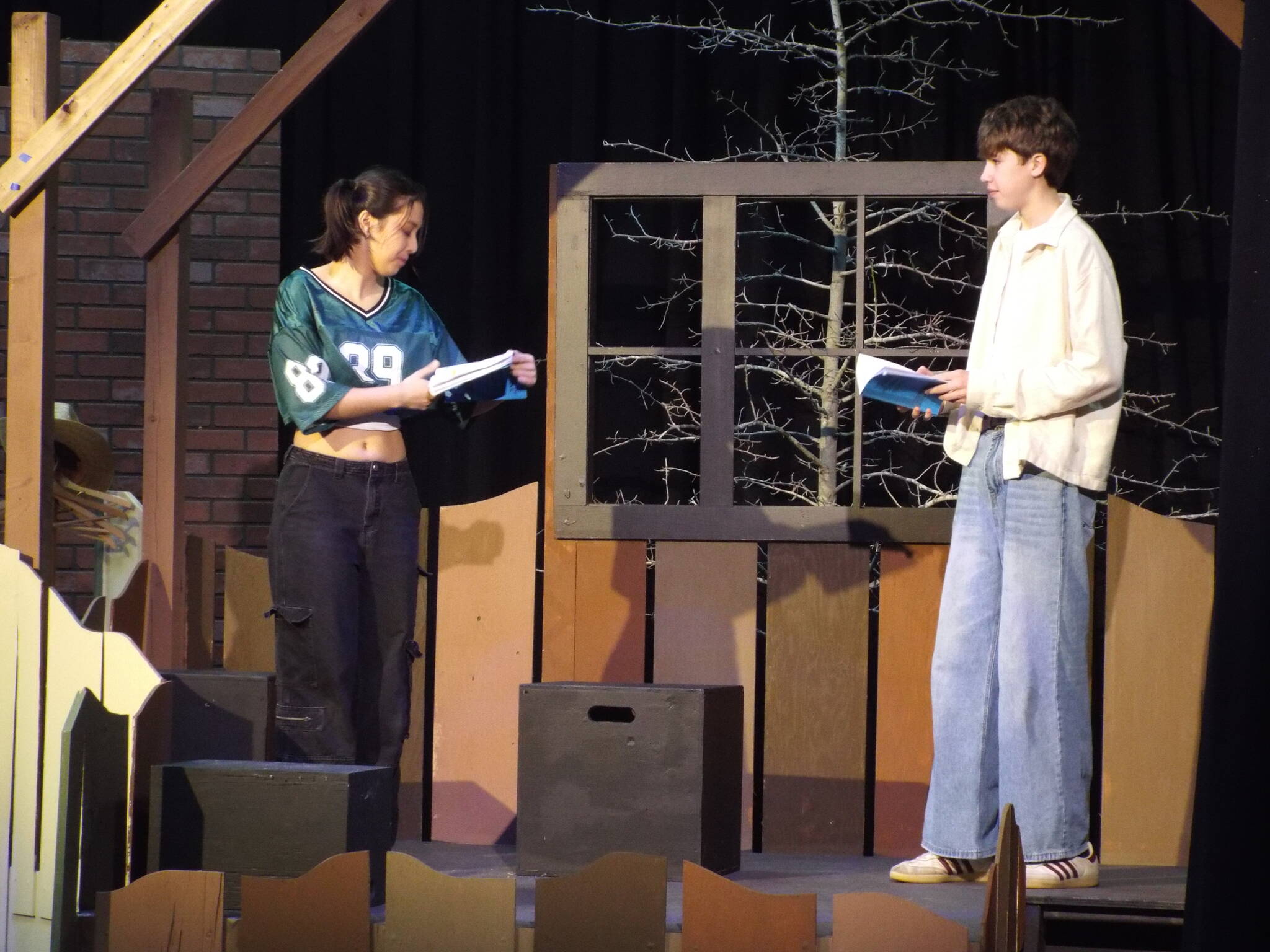
On the Thursday night two weeks prior to opening night on Friday, Nov. 28, rehearsal began at 7 p.m. at the Driftwood Theater.
“Let’s warm up who’s here,” Director AJ Cooper called out, and he led the cast through a series of stretches and vocal exercises to ready their bodies for all the acting that Cooper promised they would be doing. Once warmed up, the actors took their places on a set designed to evoke the living spaces depicted in Anne Frank: The Diary of a Young Girl.
“The Diary of Anne Frank” is the second play in the Driftwood Player’s 2025-2026 season. The version they are performing is the adaption by Wendy Kesselman of the play written by Frances Goodrich and Albert Hackett.
After having been a member of the Driftwood Players for over a decade and attending shows as a child, this is Cooper’s first time directing.
“This place is like another home, along with everybody in it,’’ he said.
As for why he continues to act, and now direct, “the artistic fulfillment is really the whole motivation behind everything we do, at least in my case,” Cooper said. “That’s a big motivator for sure. [It’s] very rewarding to be putting in weeks and weeks and weeks of work and then have the performances and everyone can appreciate it for what it is. It’s a nice reminder at the end of why we do it.
To learn more about how Cooper approached staging “The Diary of Anne Frank” and why it still resonates, The Daily World spoke with Cooper; later Jasmine Jo Lock and Ron Rogers, Anne Frank and Otto Frank, respectively, joined in the conversation.
What follows is our conversation edited for length and clarity.
TDW: How prepared should people come to see the play if they’ve only read the book years ago in middle school or high school?
Cooper: They should prepare themselves for an emotional journey and also to sit back and be ready for it, because it’s our history, and it’s happening again.
It’s deeply entertaining in the way that it makes you want to laugh and then it makes you want to cry. The through line of it is the hope and the togetherness that everyone shares and the community that is really presented in this show.
Because that’s what it’s really about – this young girl who inspired so much light for everyone she was in hiding with, and also inspired the world forever after her book was published.
TDW: Can you share the history of the adaptations of Anne Frank: The Diary of a Young Girl? The adaptation that Driftwood Players is putting on is described as the newly adapted version by Wendy Kesselman.
Cooper: Francis Goodrich and Albert Hackett wrote this version in 1955 and that version was made into a film. It was a hit on Broadway and it lasted a very long time. It’s still that text at its core but what changed with the ’90s revival that was newly adapted by Wendy Kesselman is this [version] has more of what was in the definitive edition of the diary.
Originally, when Anne’s diary was published, Otto Frank, Anna’s father, decided to omit certain entries because they were too personal. There was quite a bit about Anna’s strained relationship with her mom. It’s a diary of a young girl who’s going through puberty and she writes about that. And at the time, that wasn’t something that got published.
Otto had originally asked for those entries to be omitted, and after he passed away in 1980, the definitive edition came to be. Those entries were translated and re-added back in, and a new translation made for a bit more of modern English.
What this play does is essentially the same thing, but it adds those entries back in. What is great about those [entries] is how much they round out everyone in the story and fully humanizes them.
What was interesting about when the play was first published was they never spoke Hebrew and there wasn’t much German in it either. Wendy Kesselman made sure that we hear the family pray in Hebrew; she prided herself that [this adaptation] was definitively more Jewish. The reason why they were targeted was identity. And what was their identity? Practicing Jews and not being Anglicized or hiding their Jewish.
TDW: How did you determine which version of the play to submit for consideration for the 2025-2026 season?
Cooper: What made me pick the Wendy Kesselman adaptation was that it’s a little bit shorter but also it has a different flow. The scenes blend more into each other, and I really enjoyed that. It really humanized everyone in the story a bit more because we have more material to see from them.
TDW: Is the original adaptation still being performed?
Cooper: Absolutely because they’re both the same incredible story. There’s some scenes that I almost prefer in the original that have a different dramatic charm. It’s a bit more old-school Hollywood kind of or old-school Broadway vibes in those scenes.
TDW: Why did you want to direct this play?
Cooper: I saw a story that really needed to be told again because we all need a reminder of what can get us through troublesome times, times of war and political dissent. For example, being able to watch a war occur on social media really informed my decision to put this show on the table because every time someone posts from that situation, that’s another diary. This modern age we’re living in and being able to see all of that happening in real time, and yet what are we all doing about it? Are we ready to tackle this and say, ‘This is enough.’
Making art can be a revolutionary act because if you live in a world, for example, that is cruel, then kindness is a form of rebellion. In a world that seeks to divide everyone, then coming together stands against that. That’s what we do in the theater.
And that’s what the characters do in this play – they survived for two years because a group of people decided that they could help them.
That is one of the most inspirational parts of this [play]. The power of reaching out and helping someone else who is being persecuted by a completely corrupt and fascist state.
TDW: When designing the set, how did you capture the physical space that Anne and her family lived in?
Cooper: When designing the set with Monika Kuhnau, I wanted it to be cramped as possible. We couldn’t have recreated the secret annex exactly on stage but I did know we could evoke the feeling of what everyone went through in that space. The rooms are kind of on top of each other and all of them are very, very small. And the attic itself kind of towers above everything else. Anne enjoyed going into the attic because she had a view of the outside world from there. It was one of the only windows that didn’t have a blackout curtain on it because it was too high up for it to matter.
She took a lot of solace in the attic. She would look out the window at the chestnut tree and be able to daydream, and she liked watching the seagulls go by as well. That provided her a lot of hope so I really wanted to recreate that particular window on the set.
TDW: How did you approach filling the roles?
Cooper: I was truly blessed to have a lot of talented and seasoned actors from the area try out for this show. A few of them were almost no-brainers because I’ve watched them on stage my entire life. I’ve grown up with them and they’ve taught me so much about theater.
For example, Ron Rogers, Gary Morean and Kathe Rowe, are true veterans to this stage and I knew they needed to be in this show. Likewise, we’ve also got a lot of newcomers, especially the kids who are new to theater but they’re all talented and hardworking. They make this process so much easier with their imaginations and their collaboration.
TDW: Jasmine, why did you decide to audition for the role of Anne?
Lock: I originally wasn’t until Kathy Rowe called my Nana and said, ‘She’s absolutely wonderful. I loved her work in Mary Poppins Jr. I would love her to at least try out.’
I wasn’t planning to because of how busy I am, but I thought I’ll put myself out there and see how it works, and now I’m here.
TDW: Because you are of similar age to Anne when she wrote in her diary, can you relate to her?
Lock: Personality wise, I am kind of like Anna. While I’m reading the book and playing her, it’s really odd because this is kind of like me.
TDW: What have you taken away from playing Anne?
Lock: I knew Anne Frank was a girl who went into hiding from the Nazis and sadly died. After the first readthrough, I was reading her last voiceover and hearing Otto’s, her dad, monologue in the end. I thought, ‘Wow, this is really sad. Someone went through this.’ It seems really unreal that something like that could actually happen in real time.
Cooper: Something to keep in mind too, when the first adaptation was made into a film and a play, it was still very fresh, whereas now we are pretty far removed.
TDW: Jasmine, is there anything you want to share about playing the role of Anne?
Lock: When I first started acting, I was told I’m not going to get a really big role because beginners don’t get opportunities like that. I am so grateful and incredibly blessed to get this opportunity of auditioning and also getting a once-in-a-lifetime opportunity. I feel very lucky to be able to play this role.
TDW: Ron, why did you decide to audition for the role of Otto, Anne’s father?
Rogers: I actually was uncomfortable with the role. AJ reminded me that it’s hard to play somebody that’s like yourself. I am a father of two daughters in a family of four. Being yourself feels vulnerable.
TDW: As a father, do you reconcile your parental approach compared to Otto’s?
Rogers: I’m still learning that. I recently read that Otto was quite a meek individual until they were in their hiding place, and then he became more of a take-charge authoritarian sort of figure in that setting. Post-war, he returned to his low-key personality, which I thought was interesting, so I’m processing that.
TDW: I won’t take up more of your time since it’s almost rehearsal time, but Ron, do you have any other thoughts to share?
Rogers: This is my first show back with the Driftwood Players in a long time. On a personal note, I reminded AJ that I remembered when he was born. We’re both from Ocean Shores, and we’ve been friends with his folks for that many years. It’s a treat to be on the stage in his first directorial debut.
Cooper: I would just add that theater is a collaborative art form, and I am blessed to have these collaborators working with me.
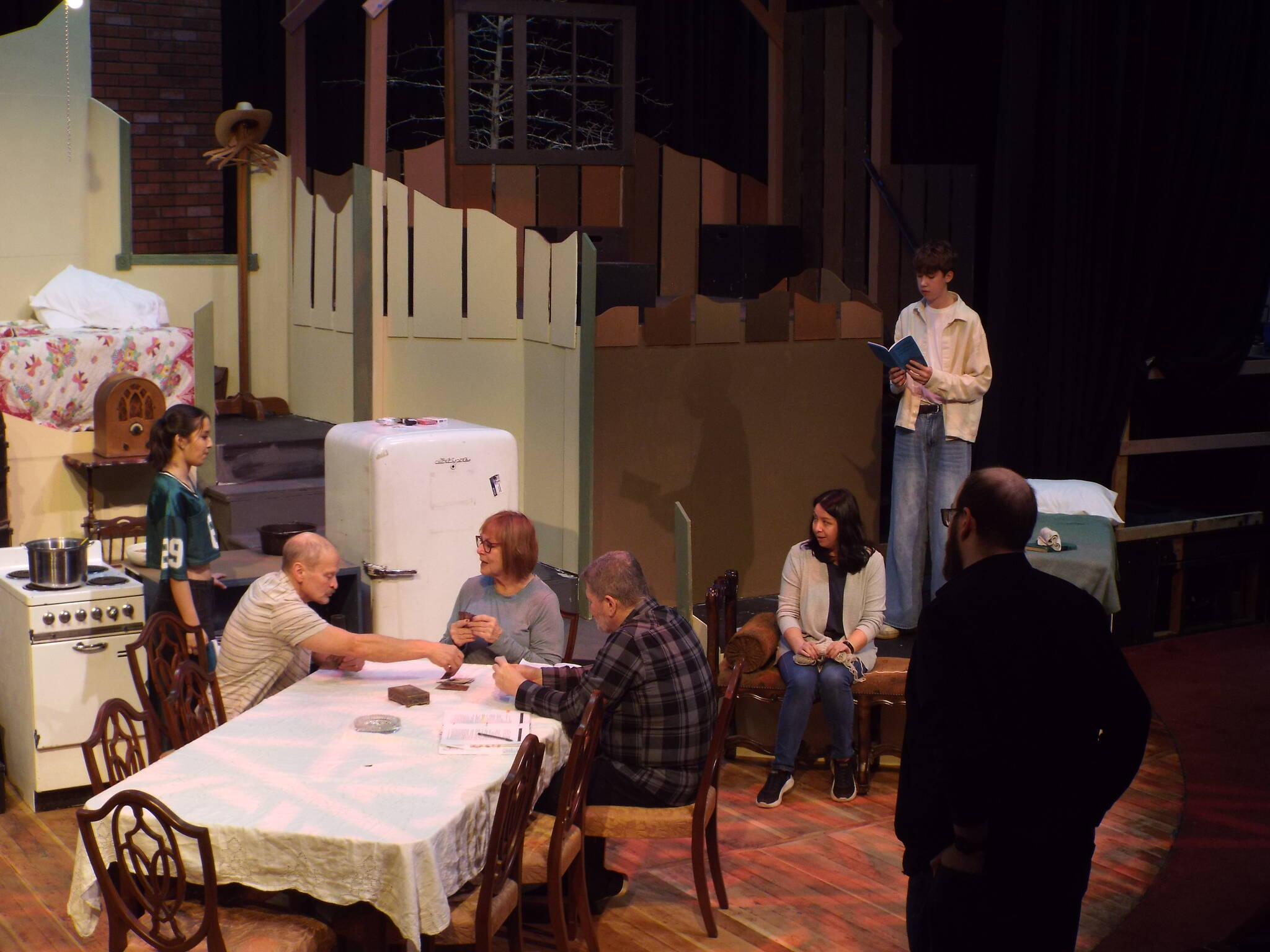
Andrea Watts photos / The Daily World “The Diary of Anne Frank” is scheduled to run Nov. 28-30, Dec. 5-7, and Dec. 12-14. Pictured are Jasmine Jo Lock (Anne Frank), Ron Rogers, (Otto Frank), Kathe Rowe (Mrs. Van Daan), Gary Morean (Mr. Van Daan), Angel Howard (Edith Frank), Emmett Quigg (Peter Van Daan), and AJ Cooper (Director). Other cast members are Emery Evers (Margot Frank), Taylor Jones (Miep Gies), David Quigg (Mr. Kraler), David Bennett (Mr. Dussel), Daryl Johnson (First Man), Skylar Payne (Second Man), and Nick Cler (Third Man).