
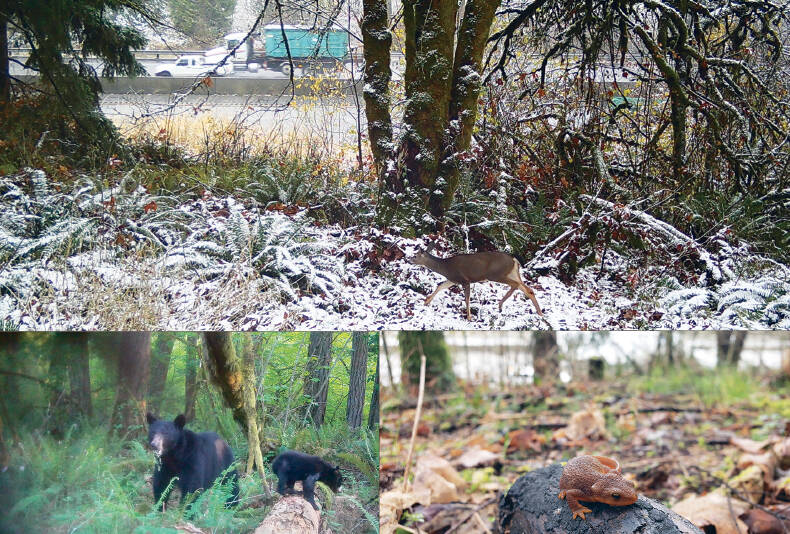
If you have driven on Interstate 5 between Centralia and Olympia in recent weeks, chances are you have seen some roadkill.
Many deer and other animals are hit each week along the stretch of I-5, which plays host to robust wildlife populations on both sides of the freeway.
A group of Washington state agencies along with the Seattle-based nonprofit Conservation Northwest and the Confederated Tribes of the Chehalis are cooking up a project that may change that morbid scene.
The stakeholders gathered on the property of a local landowner along I-5 north of Rochester, to announce an effort to create a wildlife corridor between the Olympic Peninsula and the Cascade Mountains called the Northern Linkage Zone. It would include hundreds of acres of land protected from intense development and a wildlife crossing over the interstate.
The event started with an introduction and prayer from Chehalis Tribe Elder Elaine McCloud, who commended the fledgling partnership between the tribe and the many other stakeholders.
Next, landowner and daughter of the Erickson family, one of Lewis County’s oldest settler families, Marla LeFevre welcomed everyone and shared her and her mother’s excitement at getting to contribute to the stewardship of local habitat and wildlife. The Erickson family is one of the local property owners that will work with Conservation Northwest to prevent their land from being developed.
After the welcoming introductions, officials and leadership from each of the groups spoke one-by-one sharing information and background on the work that has gone into the project so far. Most recently, the state released a report in June called the Washington Habitat Connectivity Action Plan. It identifies multiple sites north of Rochester as essential for connecting wildlife habitat. And in November of 2024, the Washington state Department of Transportation and Conservation Northwest completed a feasibility study for a possible wildlife crossing structure.
Before getting a chance to explore the property and indulge in a traditional lunch of steelhead salmon — technically a type of trout — caught on the Chehalis River, Chehalis Tribe leadership, including the tribe’s Vice Chair Sheilah Bray and the tribe’s fifth council member Thomas Trott, voiced the tribe’s support for the conservation effort.
“To be good stewards of the land is really important, and I hope everybody realizes that most tribes, we’ve been doing that for centuries,” Bray said. “From the tribe’s point of view, we couldn’t be more excited to find out that this idea is not just a pipe dream … I want you guys to know that the Chehalis Tribe’s committed to help do whatever we need to do to make this thing happen.”
Northern Linkage and wildlife overpass
The northern linkage project is the northernmost site on I-5 seen as a possible place for wildlife to cross the highway. The site has been the subject of study for more than 10 years, but has come back to people’s attention after the recent habitat and feasibility studies.
The feasibility study completed in November calls for a 150-foot-wide structure that stretches 350 feet across six lanes of I-5 traffic to allow wildlife to safely cross the freeway. To make the crossing effective, it also calls for preventing development on hundreds of acres on either side of the highway. This would be done through a combination of the state purchasing land or easements from property owners, or otherwise coming to agreements with landowners.
After completing the feasibility study and conceptual designs for the project, the Washington state Department of Transportation estimates the proposed structure will take approximately $30 million to build. Washington state Department of Transportation Habitat Connectivity Biologist Glen Kalisz said the hope for the project is to get support from federal grants.
However, he added that a bit of fundraising to complete design and engineering for the project is the first step and will make the effort more competitive for grants in the future. During his presentation, Kalisz pointed to a recent wildlife crossing structure built in Oregon funded primarily by grants from the federal government.
“The typical path that people take is you get some state-allocated dollars, you leverage those dollars with federal grant programs, and then you’re able to pay for wildlife crossings with grant programs through the federal government specifically devised to build wildlife crossing structures,” Kalisz said. “We’ve heard on good authority that these wildlife crossing grants will come back around. We will have opportunities to apply for them in the future.”
Why connect the Olympics to the Cascades, and why now?
Research into the idea of a wildlife passage between the Cascades and the Olympic Peninsula, according to many working on the project, is not a new idea. Executive Director Mitch Friedman of Conservation Northwest admitted during the Friday event to once being a skeptic of the idea when team members proposed it years before.
“There were years, a lot of years, where my staff would promote the idea of trying to keep the Cascades and Olympics connected, and I was a skeptic,” Friedman said.
“I’m not a spiritual person, but sometimes things fall in place in ways that you wouldn’t imagine.”
However, it now comes closer to becoming a reality than ever before, and with extra urgency from many who say securing a wildlife connection is a race against the speedy development popping up along I-5 between Olympia and the Columbia River.
During the event, Kalisz called the area north of Rochester one of the “highest priority locations in the state” for habitat connectivity.
“Previous analyses have identified this location as one of the last remaining opportunities to provide those connections between these iconic landscapes,” Kalisz said.
Kalisz’s job largely involves improving wildlife passage with the goal of reducing wildlife collisions and, as a result, making Washington’s roadways safer for drivers. That’s certainly called for along the stretch of I-5 that, according to the Washington Department of Transportation, gets roughly 70,000 travelers a day and regularly claims the lives of local wildlife. Unfortunate deer often scatter the highway.
But, according to Kalisz, as well as officials from the Washington Department of Fish and Wildlife, there is a lot more to the connectivity project. A big part of the project is looking to improve the health of Washington wildlife. Letting an elk or bear travel from the Olympics to the Cascades means more biodiversity.
According to Kalisz, research using trail cameras and wildlife collars as well as genetic research of animals west of I-5 has shown the highway to be a barrier. Not only do tracking collars show animals turn back after reaching the highway and being unable to cross, but genetic research shows evidence of high rates of inbreeding among animals in the area.
“Without safe crossing opportunities, we really don’t have that ability to remain connected or provide connections for the wildlife that historically were able to move between the Olympics, the Cascades and beyond,” Kalisz said. “It kind of seems sometimes like these (are) high in the sky ideas that an animal on the peninsula is gonna want to get into the Cascades and make it to Rainier, but we know these movements actually happen.”