Local residents and others with interest in the Chehalis River Basin on Tuesday night got a chance to comment in person on a study estimating the environmental impacts of building a flow-through dam near Pe Ell to mitigate chronic flooding.
The Washington state Department of Ecology held the first of a series of in-person public hearings Tuesday evening at Centralia College to give residents a chance to comment on an official draft environmental impact statement on a proposed dam meant to hold back flood waters during extreme flood events.
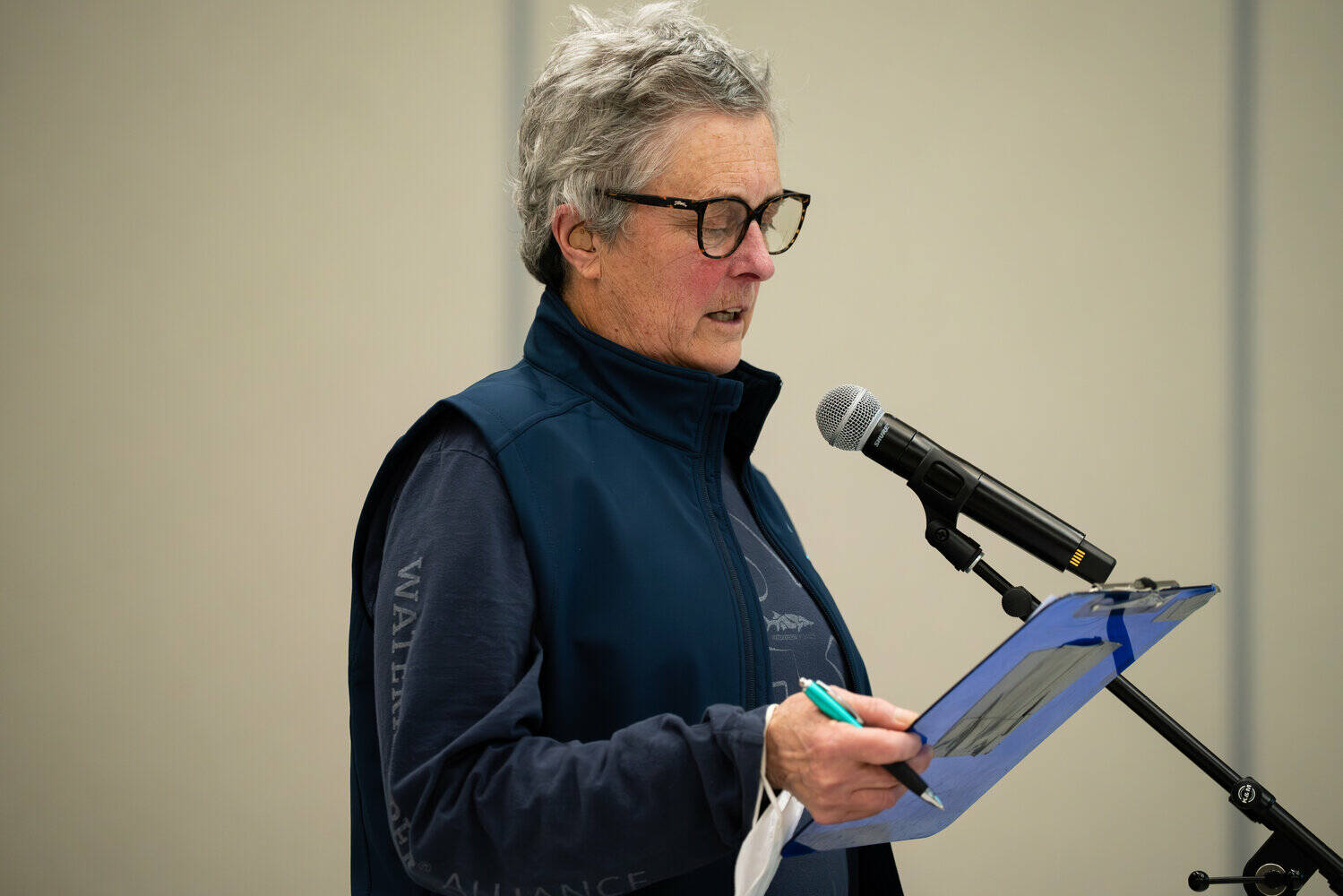
After a roughly 25-minute presentation on the possible environmental impacts of building and operating the structure, state officials heard comments from 13 residents who provided critiques on the process and shared opposition or support for the project moving forward.
The public hearing was meant to provide a short presentation on the more than 300-page study and then receive constructive criticism on the shortcomings of the document to understand where residents thought it could be improved.
Most attendees took the opportunity to express their support or opposition for the project as a whole. Advocates for and against the dam spoke, but it was those against the proposal who made their voices most heard, outnumbering those testifying in favor. Environmental groups such as a local chapter of the Sierra Club led the charge.
“There were lots of words in there about significant change to the habitat, significant change to the salmon runs, spring run salmon could be eliminated,” South Sound Sierra Club Chair Dr. Ed Humble said. “We think it’s actually stronger than that, and we welcome the opportunity to share some of that information. We think that it has catastrophic effects on salmon.”
A long list of elected officials attended the hearing, in addition to residents who showed up for the event, but very few of them spoke in support or against the proposed structure.
A staff member from U.S. Rep. Marie Gluesenkamp Perez’s team showed up to represent the federal official while state Rep. Ed Orcutt, R-Kalama, and a staff member for state Sen. John Braun, R-Centralia, showed up as the region’s state-level representatives.
Representatives from both the Quinault Indian Nation and the Confederated Tribes of the Chehalis Reservation represented the two major Chehalis Basin tribal stakeholders. The two tribal governments remain very active in decisionmaking around flood and fish work in the basin.
Lewis County Commissioners Lindsey Pollock and Scott Brummer represented the Lewis County government while Councilors Adriana Garibay, Chris Brewer and Norm Chapman represented the Centralia City Council. Former councilor Max Vogt also appeared and spoke in support of the structure as a resident and business owner.
Brewer took the opportunity to briefly remind the room that the Centralia City Council openly supports the project. A number of other residents also voiced support for the dam, including Anthony Ahrens, who advocated in favor of the dam and the jobs its construction would bring to the area.
“One thing that we, the taxpayers and citizens, need to take into consideration is, when you’re talking about the cost of a project like this, $2 billion, where’s that money go?” Ahrens said. “It doesn’t go into thin air. This goes to businesses here in Lewis County. This goes to businesses. This goes to homemakers and home builders and construction workers, truck drivers.”
Those opposed to the project, however, highlighted concerns over the impact to native fish such as salmon and the impacts to other wildlife and their habitats. Many also shared frustrations that more information was not included in the draft EIS to explain the mitigation efforts proposed by the Chehalis Basin Flood Control Zone District, which is sponsoring the project. Members of the flood control zone district and the Chehalis Basin Board have raised the same critique in recent months.
As part of the opposition, the chair of the South Puget Sound Sierra Club opened up the testimony and spoke as an advocate for the fish and other wildlife that might be impacted by the construction or operation of the dam. The Sierra Club is one of the country’s oldest grassroots environmental advocacy groups.
Another environmental advocate, Twin Harbors Water Keeper Lee First of Grays Harbor, spoke on her own behalf and that of the Water Keepers organization. First spoke against the construction of the dam while praising the state of Washington as a leader in the process of removing unnecessary water retention structures. First also raised concerns over increasing industrial development in the area despite frequent flooding and advocated for alternate methods of addressing flooding in the basin.
“Let’s get serious about moving people, homes and businesses out of harm’s way,” First said.
“Let’s treat our forests as the flood resilience assets they could become. Let’s fix land use laws and prohibit floodplain fills. Let’s change course now and future generations will thank us.”
She added that the Chehalis River remains the largest river in the state without a major dam installed on its main stem, and she hopes to keep it that way.
Chehalis Basin farmer Julie Puhich spoke, hoping to share her own perspective and that of farmers near her in South Thurston County who have been affected by flooding in the past. She spoke against the dam, arguing that it would damage the habitat of the Chehalis River, hurt salmon and endorse irresponsible development in the floodplains along the river.
“Building a dam on the Chehalis, and let’s call it that, because flood retention expandable sounds like newspeak to me,” Puhich said. “Building a dam on the upper Chehalis is an example of exactly the kind of disruptive development and forest practices that have contributed so heavily to getting us into this mess. Building the dam would give the green light to continue more problematic development in the floodplain.”
After roughly 40 minutes of testimony, all of those in attendance who wished to testify had the chance to do so, and state officials promptly closed the hearing.
According to the officials — including the event’s facilitator Angie Thomson and Department of Ecology Southwest Region Director Bobbak Talebi — all testimony will be incorporated into the final draft EIS that is slated tobe released in August of this year. The draft will include responses to all testimony and to testimony provided during the same process for a previous design of the flow-through dam back in 2020.
The draft EIS receiving comments currently details the potential impacts of building and operating a flow-through dam near Pe Ell. The statement describes the impact as significant and unavoidable in nearly every category, from fish impact to tribal cultural impacts, unless proper mitigation steps are taken. While the applicant, the Chehalis Basin Flood Control Zone District, has submitted significant mitigation project proposals, their feasibility was not measured in the study.
To view the full version of the Draft EIS document, visit https://tinyurl.com/3apw8y3k.
The draft EIS that was so hotly discussed during the public hearing was first released to the public in the middle of November. Its release started a 75-day public comment period that includes both online and in-person public hearings through Feb. 4. Residents of the basin can also submit comments online without attending a hearing. For more information on how to provide comments or attend a hearing visit https://tinyurl.com/4y4bjxst.
There are two remaining in-person meetings scheduled for this month and one final virtual public hearing scheduled for this week. The last of the two virtual public hearings is scheduled for 6 p.m. on Thursday, Jan 8. To register ahead of time for the meeting and attend it when the time comes, visit https://tinyurl.com/nvvr7efd.
Meeting in Aberdeen
The next in-person public hearing is the only one scheduled to be hosted in the lower part of the Chehalis Basin. It is scheduled to start at 5:30 p.m. at the Rotary Log Pavilion in Aberdeen on Tuesday, Jan. 13. The final public hearing, which was announced earlier this week, is scheduled to start at 5:30 p.m. Wednesday, Jan. 21, at the Baw Faw Grange in the unincorporated community of Boistfort.