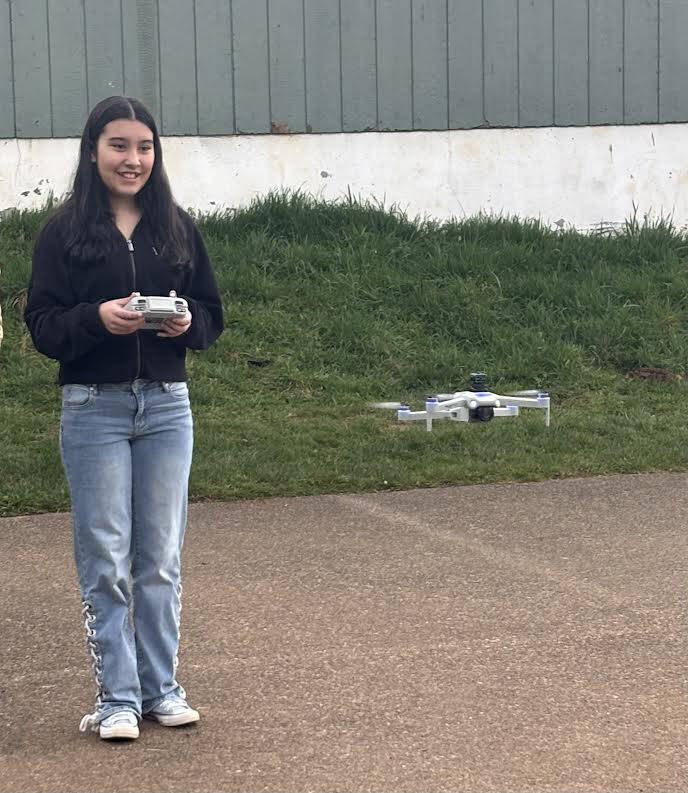
Last year, Patrice Erickson, a special education teacher at the McCleary School District, received a Community Partners Education grant to purchase two drones for her classroom. In the subsequent months of the students learning how to fly the drones, the reaction has been “everyone loves it,” she said.
Bringing drones into the classroom was inspired by her colleague, Chris Hamilton, who before he became an educational assistant, worked for 21 years as a timber faller and is a certified drone operator.
“We’re always looking for ways to connect with our students, in addition to academics, because some of our students, for multiple of reasons, don’t access the academic material as easily as their peers,” Erickson said. “And by going outside the regular academic stuff, we have an opportunity to tap into their other talents and abilities.”
Added Hamilton, “It was part of my bachelor’s [degree in forestry], and so it just all seemed to fit really well together.”
Before the students could fly the drones, Erickson and Hamilton showed YouTube videos on drone technology and how to operate drones safety, such as not flying over people’s heads or using them to chase classmates. The drones they purchased were ones that both had good reviews and were affordable so two could be purchased.
Hamilton credits Todd Bates and Patrick Mahoney, faculty with Grays Harbor College’s Forestry Program, for preparing him to teach 5th-8th graders how to fly drones.
“The ability for me to actually be able to pass on things that were practical in a bachelor’s degree has been a blessing,” he said. “I mean, who gets a bachelor’s in forestry and gets to actually use it in a special ed situation?”
As to how the students have responded to having drones in the classroom, Erickson said, “I don’t think they ever get tired of it. I think we could go out every day and do a drone thing.”
With students trained on how to fly the drones, they’ve been used to take overhead pictures of the school and its garden to highlight how the Community Partners Education grant funding has been used; over the past few years, Erickson has received grant funding for a greenhouse and to restore the learning center trail. But the drones aren’t only used for work; the students will race to see who can fly the fastest.
Incorporating drones into the classroom complements the other hands-on activities that Erickson and Hamilton lead outside, such as working on the nature trail, gardening, and building garden boxes, as well as learning how to operate power tools.
Hamilton sees learning how to operate a drone as providing opportunities for future careers. Drones are everywhere, from the Forest Service to law enforcement, he said. “It’s something that’s becoming just a good common skill for a background job.”
In addition to using the drones for aerial photography, Erickson is also considering using the drones to film their field trips to the nearby salmon hatchery and Kennedy Creek that could be shared.
With the students becoming adept at operating the drones, Erickson said, “now that we’ve started, we’re starting to think, ‘Wow, we could probably get a bigger drone.’”