We all have a family tree although we may not know who is in it. While family sizes have steadily decreased over the past 200 years, it wasn’t uncommon in the 1800s into the early 1900s for families to have 10 or more children.
Jack Kerouac famously wrote in his seminal novel On the Road, “I was going home in October. Everybody goes home in October,” and John Denver’s Take Me Home, Country Roads evokes feelings of family and homecoming. Many people long for familial connection this time of year, especially if getting together with family for the holidays is not an option.
Seasonal depression, detachment, disconnection can all lead to feelings of loneliness and melancholia. Some people just want to know where they come from or discover their ethnicity. While there are numerous resources that can help build a family tree, you need to know how and where to start.
That’s where Carrie Bergquist comes in.
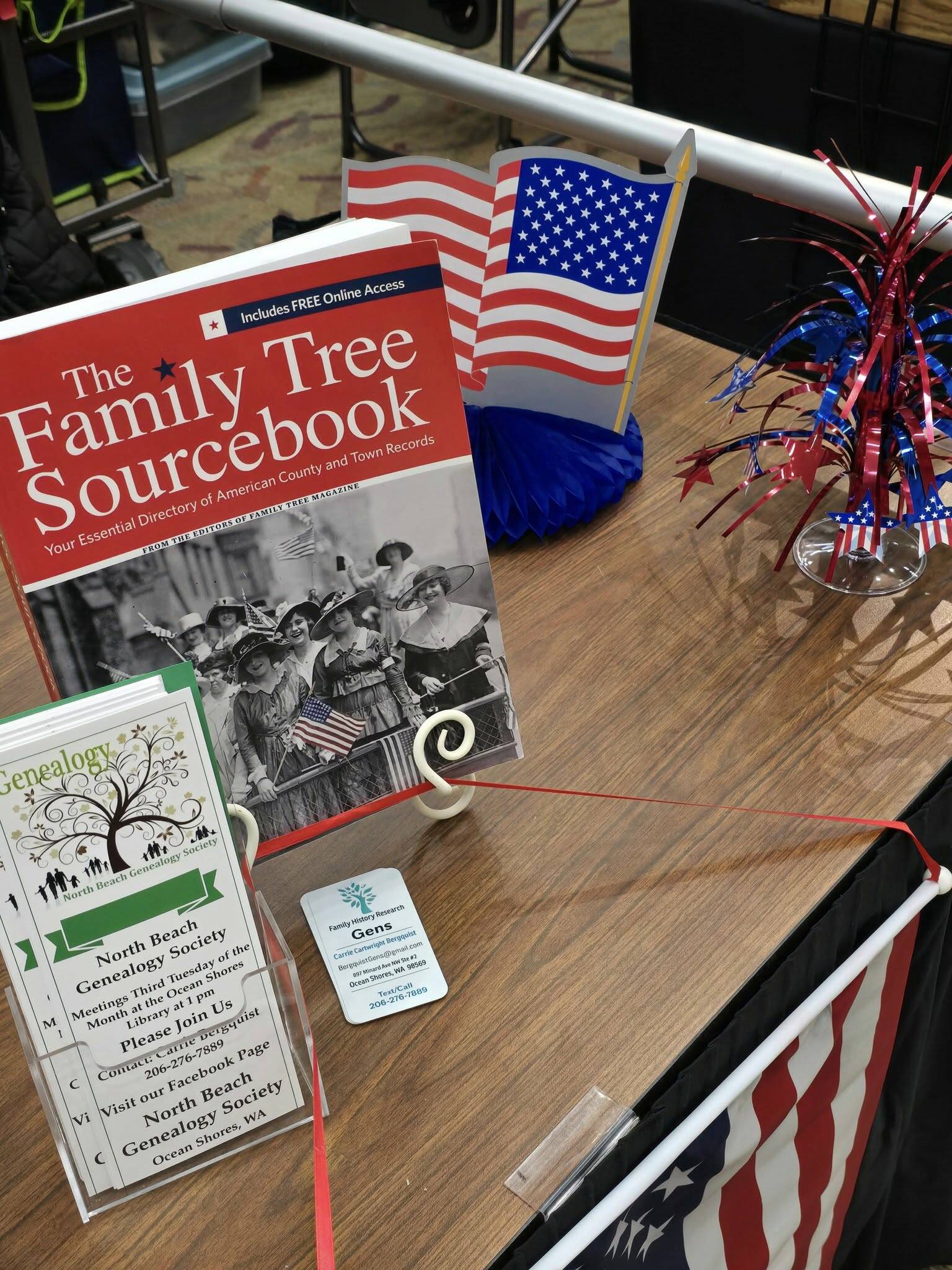
Bergquist is the driving force behind the North Beach Genealogy Society (NBGS), which meets the third Tuesday of every month at the Ocean Shores Public Library. Bergquist also hosts periodic appointment-based “genealogy cafes” at libraries in the region where people can gather information and documentation about their ancestors and learn about the tools of the trade. NBGS has also held genealogy classes for beginners and maintains an office in Ocean Shores.
Although there are software and online platforms, DNA testing and municipal and church records, Bergquist, who has been into genealogy for decades, started her family tree journey with her grandparents.
“I’ve only been doing it for the last probably 45, 50 years. I was always really inquisitive and asked my grandparents so many questions. And so it was kind of just a natural thing for me to ask a lot of questions and to write down what they told me.” Bergquist said. “When my first child was born, I went back to my grandfather and said, ‘can I write your history?’ He was the last of 15 children and he had come here from Italy in 1913. So I wrote a lot about his childhood so that my son would know more about his great-grandfather, what struggles he had and his family had during those years at the turn of the century.”
Bergquist, who is also president of the Renton Historical Society and the research chair of the Grays Harbor Genealogical Society, says the best starting point is close to home.
“The best place to start is with yourself and writing down the information, then your parents and grandparents and writing down as much as you can that you personally know, but then also to talk to the eldest member of your family and record them even, because they have stories that you will never have again once they’re gone,” Bergquist said.
Family tree research has certainly evolved from combing through obituaries, census and marriage and death records, city directories and newspaper articles on microfiche at the local library or archives. Although those resources are useful, many of those records can be found online now.
“Groups of us would go out to the National Archives (in Seattle) and look at census records on the microfilms,” Bergquist said. “You’d get these little codes, and you’d find the right film, and then you’d have to look through the film, and you’d finally find it, and jump up for joy.”
Many people into genealogy are already aware of this, however, another resource when it comes to researching family trees is the Church of Jesus Christ of Latter-Day Saints (LDS). Formerly known as Family History Centers, there are 4,600 FamilySearch centers located in 126 countries. These free facilities are staffed by volunteers, and offer access to genealogical websites.
“The other resource during that time was the LDS Church, I used a lot of resources in the Bellevue offices or Federal Way or even up in Bellingham,” Bergquist said. “LDS research centers seem to have a different specialty.”
The Ocean Shores Washington FamilySearch Center is located at 928 Albatross Street. There is also center located in Elma.
“We do have that resource here, which we’re very fortunate to have here in our small town of Ocean Shores,” Bergquist said. “Then there is a wonderful LDS Research Center in Tacoma, and they have so much equipment where they can digitize so much information for you, or they’ll scan photos, 8 millimeter movies, and slides. They have a lot of free services at the research center in Tacoma.”
Inexpensive DNA testing through Ancestry.com or 23 and Me has become an effective way to find relatives, confirm suspected biological connections or even uncover deep dark family secrets.
“(A fellow) I’ve worked with his family history because his mother never knew who her father was. She was raised by her biological mother, but her mother would never say. So through DNA, we were able to figure it out right away,” Bergquist said. “His people on the father’s side had tested. There were so many matches. ‘This is who your grandfather was.’ And he was just shocked because his grandmother would never tell anybody.”
Bergquist said that Artificial Intelligence (AI) is adding a new dimension to family research.
“A gentleman had taken about five different newspaper clippings from around the time period of about 1905 and he scanned them in and then asked AI to give him a summary of what that was all about,” Bergquist said. “So using AI now in family history research has really opened up so many doors. So that’s a fascinating way of using AI. Something on the horizon that we’re using now is full text search. And familysearch.org, they are at the forefront of full text search. Before we used to be able to search by maybe the title of the document, what surname was in the title, right? Now we can search the whole document for names, wills and probates and land records and all these things. This is what we talk about at our meetings is what is on the cutting edge of genealogy and the different companies that are offering different things.”
As for Washington natives specifically, Bergquist said that additional information is coming online.
“The Washington State Digital Archives is just getting more and more information all the time, especially for Grays Harbor County. I’m getting questions about Native American families,” Bergquist said. “Before the 1889 statehood, they were doing censuses almost yearly so you can find out a lot of information about who was living here in Grays Harbor, specifically of the Native Americans. There are some resources that are so unique to our area, but the Washington State Digital Archives is the real gem.”
In recent years, DNA and forensic genealogy have been used to solve cold police cases, perhaps most famously the Golden State Killer, Joseph James DeAngelo Jr. Bergquist is an advocate of such techniques.
“I’m in favor. CeCe Moore is a known genetic genealogist and has helped solve so many cases,” Bergquist said. “If we have a tool that will help us solve these cold cases, why not use it?”
Bergquist says that if you do embark on a family tree or genealogy journey and find some information someone else may have entered, it’s always best to do your own research and fact check.
“Take it with a grain of salt until you’ve done your own research and document that item,” Bergquist said. “Unless you can find, and we sometimes can’t, but if you can find at least two items that documents that research, then you feel pretty confident that you have the correct information. Documentation is so important. Don’t accept what other people (have done).”
For more information about the North Beach Genealogy Society or starting your family tree research, contact Carrie at (206) 276-7889, email Northbeachgenealogy@gmail.com or visit https://www.facebook.com/profile.php?id=100089769477548