
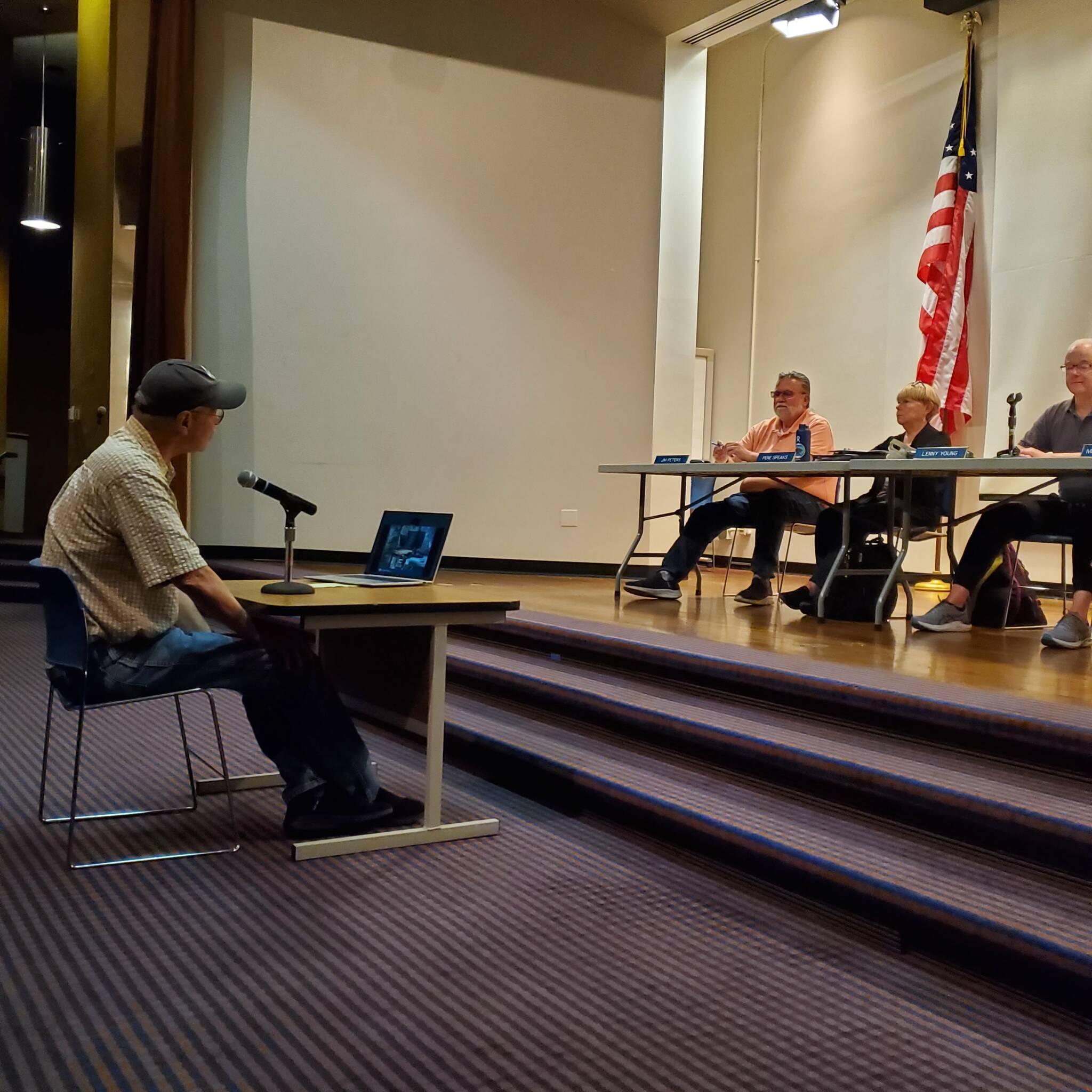
Tuesday in Olympia, around 50 people attended the final hour public hearing for the Forest Practices Board’s proposed rule amendments to Type Np Water Buffer (no fish) for Western Washington.
The attendance was comparable to the three previous public hearings held in Longview, Sedro Woolley and Port Angeles, as was the hearing’s length of two hours. Of the audience members in attendance, 37 provided testimony to the Forest Practices Board.
The reason for the proposed rule amendments is the current buffer width for Type Np streams being considered insufficient to keep stream temperatures cold enough as per the Forest Practices Habitat Conservation Plan and remain in compliance with water pollution control laws.
As described in the Small Business Economic Impact Statement included in the CR-102 Proposed Rule Making packet posted on the Forest Practices Board webpage, the current rule is that on Type Np (non-fish) streams “a 50-foot, no harvest buffer must be established based on the length of the Type Np water from the confluence of Type S [Shoreline] or F [Fish] (i.e., F/N or F/S breakpoint], with additional buffering around sensitive sites.”
The proposed amended rule would require landowners to select which harvest scenario is applicable to their harvest plan and the distance of the Type Np stream upstream from the F/N break (where fish are no longer found in the stream) in which to calculate the required buffer.
Changes in buffer requirements at any specific site are conditional on a range of factors, including: Type Np stream length within the landowner-specific harvest unit, basin size, planned forest harvest extent, stream BFW [bankfull width], and other forest management strategies.
With these larger buffers, the anticipated outcome is to “prevent an increase in mean seven-day maximum water temperature of 0.3oC or greater from human activities above natural condition per WAC 173-201A-320, or an increase above specified temperature thresholds on waters designated for aquatic life or else specified in WAC 173-201A-200 and -602.”
For those who manage forestland, whether small forest landowner or industrial landowner, or whose business depends upon a reliable supply of timber, such as sawmills, it is a single sentence that proves most worrying — “In most cases, the proposed rule increases buffer width and length relative to the current rule.”
Collectively, what the public testimony highlighted is the different, often simultaneously, lenses through which forests are viewed and valued. What may appear as a straightforward decision to increase buffers on non-fish bearing streams has cascading outcomes downstream. A common sentiment expressed by foresters is that “Forestry is not rocket science; it’s harder,” and this was borne out over the course of the two-hour hearing.
Several audience members addressed the economic fallout that is anticipated following adoption of this proposed rule.
Dave Sweitzer, executive director of the Washington Hardwoods Commission, said, “Speaking for hardwoods, the impact would be especially severe. Red alder and other hardwoods grow disproportionately close to the creeks, meaning these rules would target our resource base far more heavily. And for what reason? Protecting against temperature change of water that may only be present for a week, a month, or several months makes no sense. … Imposing this change would risk shutting more [mills] down, eliminating jobs and the increasing wildfire danger without sound scientific justification.”
“Cowlitz County, where I own a small timberland property, is a great place to grow trees. and the manufacturing integration there is really dense,” said John Keatley, a board member of the Cowlitz Chapter of the Washington Farm Forestry Association. “There are five sawmills in Cowlitz County: three conifer, a hardwood mill, and a cedar mill. There’s also a very large chipping facility, there’s also a pole production facility and there’s several pulping companies and their many machines manufacturing paper of various grades and qualities. … The impact of these buffer strips in Cowlitz County will prohibit 245 million dollars’ worth of private timber. That is significant about the supply.”
Pacific County Commissioner Lisa Olsen shared that, “Under this plan, approximately 12% of harvestable inventory, about 32,000 acres and over 600 million board feet, will be taken out of inventory and lost to all involved. Those involved are rural taxing districts, county services, family farms, and families making living wages in this industry.”
Small forestland owners spoke passionately about their family’s legacy of stewarding their forests. For many, their desire to do right by the forest is working under the current buffer rule; for other landowners, they wanted the Forest Practices Board to adopt the proposed changes. What the testimony reflected was the challenge for scientists and policy makers to draft policies that accommodate the diversity of management objectives and forest conditions.
Mason County resident Sherri Dysart said, “In my quest to be a better ancestor, I am committed to leaving the forest in better condition than they were when I was born. … That means updating rules and practices as scientific research evolves. The board should adopt the proposed rule now.”
In his remarks, John Henrikson, co-owner of Wild Thyme Farm that was awarded as Lewis County 2025 Tree Farmer of the Year, said that his tree farms in Grays Harbor and Pacific counties have “thriving salmon runs on major creeks” and that “working forests can provide a better ecological outcome than a no-touch buffer policy that is being proposed here. I specialize in riparian habitat restoration, and I rarely see conditions where the appropriate prescription is to do nothing.”
There was also questioning of how results from the Cooperative Monitoring, Evaluation, and Research Committee’s (CMER) Hard Rock Study and Soft Rock Study were being interpreted to support the proposed rule change of full-length buffers.
Chris Mendoza, a board-approved CMER member for 21 years, spoke because he wanted to set the record straight.
“There’s no question the science came through cooperatively. Every step of the way we designed it, we turned it to policy, who approved it,” Mendoza said. “So everyone in this room had a representative caucus at the table viewed, modified as needed, and approved those studies. It’s not the science in question here; it’s the implications of the results. … The science has progressed, yes, but it’s also, if anything, pointed in the direction of it did 20 years ago — in that loss of shade heats up water.”
Morris Boyer, who was a 2024 nominee for the Washington Tree Farm Program’s Tree Farmer of the Year award and owns a tree farm in Porter, shared how his family has seen first-hand how changes in the science underpinning forest management have changed over the years. When his grandfather purchased the property, it had been logged and red alder naturally regenerated. With state and federal funding, the red alder was removed, as it was considered a weed, and replanted with Douglas-fir.
“Thirty-six years later, I was told I have such terrible root rot, just chip it and saw and pulp, but that’s okay because there’s a program, the state will pay to plant back in a root-rot immune species-red alder, along with cedar,” he said, adding, “People who think they know what they’re doing, don’t always know, but we have to live with these decisions and the consequences. … Before you make a decision, I really hope you look at the science, and look at this closely, because this impacts real people that care about the land.”
David Herrera, a member of the Skokomish Indian Tribe and the Tribe’s commissioner on the Northwest Indian Fisheries Commission and chair of the environmental policy committee, shared comments from a letter that was sent to the board by the Commission’s Chairman Ed Johnstone in support in support of moving forward in the rule making process.
“Research and monitoring conducted by the state’s Forest Practices Adaptive Management program has demonstrated that the current strategy of requiring 50-foot buffers on only portions of these headwater streams is not working to effectively protect and recover water quality for amphibians from disturbances related to nearby timber harvest,” stated the letter.
Also mentioned frequently in the public testimony was the close vote to approve the Western 47 Washington Type Np Buffer proposed rules for the public review process. The vote passed with five in support, four opposed, two abstentions, and two of the board positions were vacant.
One of the final points raised in public testimony addressed the mention of financial compensation called out in the Steps Taken to Reduce Costs of the Rule section in the Small Business Economic Impact Statement.
“Therefore, consideration of economic impacts has been part of the rule development process from the onset,” the impact statement authors wrote, continuing to say, “The Forestry Riparian Easement Program (FREP), in particular, compensates SFLs [small forest landowners] for the loss of revenue associated with lost timber harvest in riparian buffer areas. Given the expected overlap between SFLs and small businesses in Washington state, these programs are expected to continue to mitigate the cost of compliance with Forest Practices rules for small businesses by transferring some portion of the compliance costs back to the state government.”
Ann Rivers, who served on a state senate budget committee for 14 years, said that over the years, funding for FREP has been “up and down, mostly down.” Looking ahead to future budget forecasts and funding, “I can promise you, FREP is not at the top of the list.”
Public comment has now closed and on Nov. 12, the Forest Practices Board will vote whether to adopt the new rule.