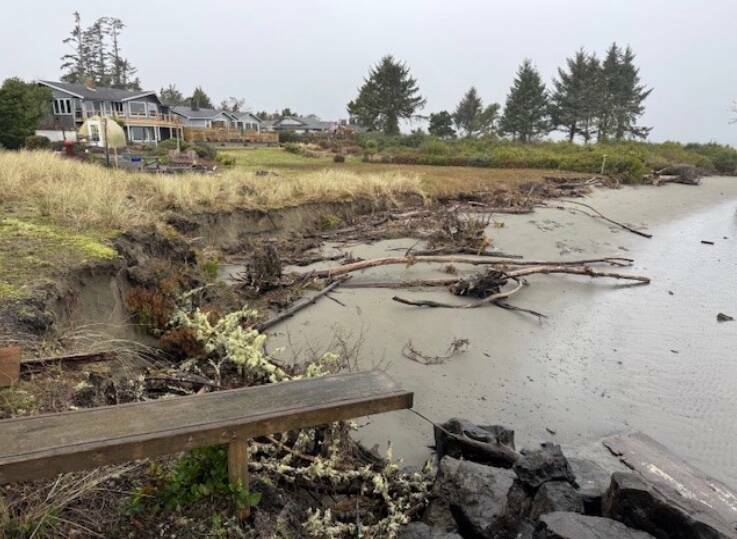
Earlier this week, Greater Grays Harbor, Inc. hosted a Business Forum Lunch at the Rotary Log Pavilion in Aberdeen. Coastal resiliency and flood control efforts were the focus of the event.
Scott Boettcher of SBGH-Partners presented an overview of North Beach coastal flooding and erosion issues affecting Ocean Shores and Westport.
Perhaps the most jarring element of Boettcher’s presentation was the time-lapse image of the coastline outside Grays Harbor that showed how much has changed in just over 40 years. The mouth of Connor Creek has been migrating north, while the southern tip of Ocean Shores and parts of the Westport coastline have changed dramatically as the Pacific Ocean eats away at the edges of the beaches and shoreline.
“We endeavor to understand coastal flooding and we endeavor to understand coastal erosion,” Boettcher said. “Understanding a bigger picture that we exist in is helpful.”
Boettcher, who has extensive experience with the Chehalis River Basin Flood Authority, has been working on flooding issues along Connor Creek, especially in Ocean City, Copalis, Elk Creek and Moclips areas. Earlier this year, Grays Harbor County enlisted Boettcher’s expertise as Ocean Shores and Westport teamed up under the county’s umbrella to combat their common erosion issues.
“The cities of Ocean Shores and Westport, North Bay, North Beach and South Beach; it’s part of a larger system,” Boettcher said. “We’re at the end of the continental shelf and that’s very important for a lot of reasons. But among other things, that is that life zone that brings fish and shore birds and that biologic environment that draws so many people to the coast.”
According to Boettcher, major progress is being made with Connor Creek and flooding along state Route 109 as residents in the area have taken ownership and are chipping in.
“Connor Creek isn’t really a very big system, but it’s big enough to impact a lot of people when it doesn’t flow. In Ocean City, we drilled in hard to understand what was going on there. It’s regular, it’s recurrent, it’s repetitive and we know when it will happen. We went through and identified beaver dams and downed bridges,” Boettcher said. “We enlisted volunteers, people in the community who care about their community and want to help. We notched five beaver dams last fall. We also cleaned all these culverts. People didn’t know that on state Route 109, every driveway crossing had a culvert. They all thought it was DOT’s (Department of Transportation) responsibility to clean up those culverts, but it’s not. It’s their responsibility. The ditches have been cleaned. The culverts have been cleaned. The volunteers are engaged.”
Residents in the area plan to officially create a drainage district and also remove a downed bridge.
“Not only have we had citizen volunteers, but the regulatory agencies, Seabrook, the Department of Transportation, getting them all engaged early on allowed us to do a lot more than we ever thought we could do,” Boettcher said. “The hope is that it can be a self-sustaining, low maintenance passive system. If we can get these barriers and impediments out of the creek … you’ll have a king tide, come in, waters will come up but they’ll recede fast. It used to be that water would come up (and) it would take days.”
When it comes to understanding and combating coastal erosion, efforts are in various stages of planning and execution, and waiting for grant monies. Three months since the cancellation of funding through the Building Resilient Infrastructure and Communities (BRIC) federal grant program it may sound like a broken record, but the federal government’s efforts to slash spending and remake agencies has caused quite a bit of consternation over funding and grant applications.
After several years of trying to implement solutions on their own, Ocean Shores and Westport decided to team up with Grays Harbor County leadership with the belief that the combined voice would carry more weight with state and federal agencies.
South Beach has close to a decade head start on Ocean Shores as the Westport sea wall and North Cove dynamic revetment have held up pretty well to Mother Nature’s constant coastal battering. On the north side, a cobble berm was constructed along the south shore of Oyhut Bay earlier this year and funding has been earmarked for the repair of Ocean Shores’ North Jetty, which is scheduled to begin next summer.
“The county is taking a leadership role and working with the cities to submit two grants,” Boettcher said. “We would like to develop a robust community engagement plan for what we can do and where we can go and what resilience looks like on the coast.”
Some of this information may seem like rehash to dedicated readers and interested parties, however, one of the fresh elements Boettcher brought forward in this presentation is the desire and plan to use anecdotal, generational and tribal knowledge to understand the coastal ecosystem and inform data collection and modeling efforts.
Practical knowledge gained by decades and generations of fishing, surfing and otherwise interacting with the environment in many cases can be more accurate than computer models and simulations.
“There’s a lot of knowledge out there. There’s a lot of documentation, it’s just all in disparate places. We need to bring it together so that people can commonly converse and talk about this stuff,” Boettcher said. “There’s different kinds of knowledge and what this process is about is really engaging that … those that have a deep experience on the coast, who know it, those that do have the academic and engineering credentials so that we can help to communicate it to the world, we need to communicate. And also tap into that long, generational, long tribal knowledge that exists and build a robust understanding of the coast.”
Boettcher said the request for the full proposal for the Cooperating Technical Partners Program grant through the Federal Emergency Management Agency was expected soon, and that the consortium should hear about the National Fish Wildlife Federation Coastal Resilience Fund grant in late November or early December.
The overall goal is to use the grant money to study the problem, utilizing any and all information available and gathered, to develop and put a sustainable action plan in place.