
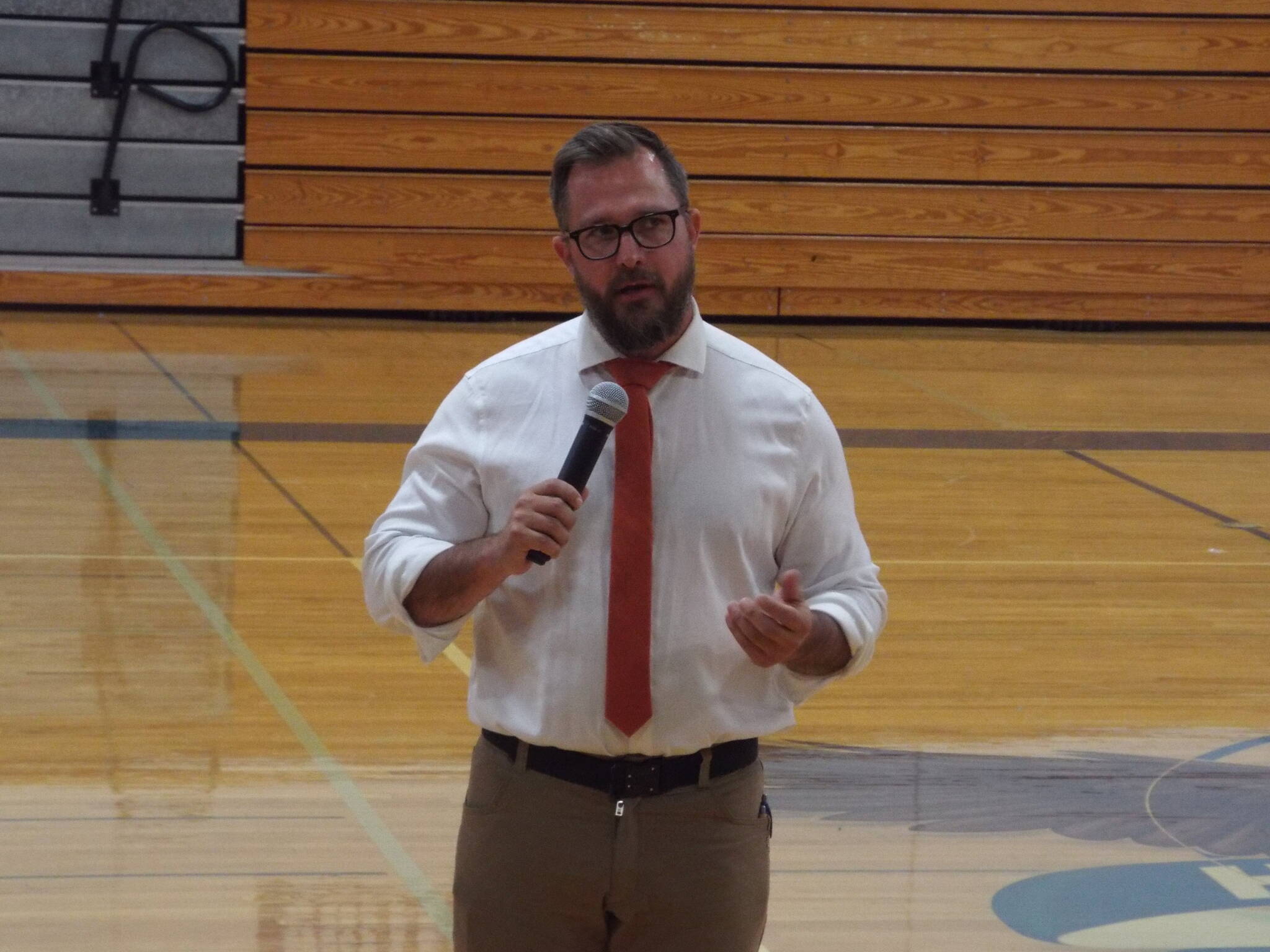
On Wednesday night, residents from around the county converged in Elma to attend what Rep. Emily Randall (D), who represents Washington’s 6th Congressional District in the U.S. House of Representatives, described on her Facebook page as the “first town hall of the fall.”
Four guest speakers opened the town hall and, collectively, their stories highlighted the effects of the current federal government cuts and the consequences of future cuts.
The oldest of three siblings, a resident of Grays Harbor, and a first-generation college student, Genesis is attending a community college, with the goal of enrolling in a nursing program.
“I hope to be a labor and delivery nurse in the future to help all the women in our community, but I am not sure if that will be possible because I have heard that the funds I would be depending on will possibly be cut,” Genesis said, adding that “education shouldn’t be a privilege that only the upper class can enjoy.”
Genesis shared that she is able to attend college because of financial support.
“I want to be an advocate not for only myself and my academic career, but also for my siblings’ future and all the others in our community. … The sad reality will be that my siblings and their generation won’t have something to count on like I did,” said Genesis.
Elma School District Superintendent Chris Nesmith began by saying that “when I came to Elma in 2021, it came with the promise that we were going to have an education system that invested in the future of our students and had the ability to bring a lot of experience across the world.”
The inspiration for this promise was borne from a visit in 2016 to a Syrian refugee camp in Germany and seeing the refugees receive training to join the workforce. What resonated with Nesmith was hearing one of the speakers say, “If we want to have businesses invest in our country, we need to make sure that we can supply the best workforce in the world.”
Nesmith highlighted that after his coming to Elma, students are now working at Vaughan Company and Sierra Pacific Industries and earning a 2,000-hour journey level certification and core high school academic credit.
“This last year, in partnership with Summit Pacific Hospital, and you’re going to hear from Josh Martin next, we launched a CNA program, the only school hospital system in the entire state of Washington where 16-year-olds are allowed to become certified and work in a hospital as we can launch medical careers,” Nesmith said.
As Nesmith promised, Josh Martin, CEO of Summit Pacific Medical Center, spoke next and began by giving kudos to Genesis for speaking publicly and for her commitment to go into health care.
Martin told the attendees that he recently visited Washington D.C. with the largest delegation of Washington state hospital leaders ever to meet with Rep. Randall and the state’s senators to talk about the impacts happening at the federal level.
“And #1 is Medicare Advantage,” Martin said. “Medicare Advantage is CMS’s [Centers for Medicare and Medicaid Services] intent of privatizing health care, and what that means is when you give health care to a for-profit agency, what do they do? Deny, delay, defer, cut. So we’ve asked Congressman Randall to partner with us to say, can we create accountability, you know, to the payers to pay us what we’re owed and create access for community members and patients that need care desperately.”
Martin closed his remarks by repeating that Summit Pacific Medical Center is not on the distressed hospital list.
“We are thankfully in good hands with good governance and good leadership, good community, good support, and thanks to you, we’re expanding,” said Martin.
Chehalis Tribal Chairman Dustin Klatush thanked the attendees for coming out and for being invited to speak.
“I want to begin by honoring and acknowledging the sacred lands on which we gather here tonight,” Klatush said. “These are the traditional homelands of the Chehalis people who have lived, fished, hunted, and cared for since time memorial.”
Klatush shared that he meets with Randall frequently when he visits Washington, D.C., and like her, he is also the first in his family to graduate from college.
“In the short time she has been in Congress, Emily has actively been working to improve education, enhance health care, and ensuring that the federal government lives up to their trust and responsibilities, not just for the tribal people, but for everybody in here too,” Klatush said, closing out his remarks by introducing “my good friend” Randall.
Randall began her remarks by saying that this was her 13th town hall since taking office.
“I just want to thank you for showing up today, for using your voice to write to us and call us and e-mail us, to refer your friends to our caseworkers when they’re having challenges with federal agencies, and for staying engaged in our democracy, because it really is a participation support, and I appreciate you all so much,” Randall said.
She proceeded to give an update on the ongoing budget discussion and looming government shutdown.
“It’s in the hands of the Republican majority to decide how they are going to fund the government without taking away health care for more people nationwide, without continuing to drive up premiums for folks who are already struggling,” Randall said, adding that in spite of Speaker Mike Johnson canceling House votes on Sept. 29 and 30, she will return to D.C. on Monday “to be available to work, to deliver results for our neighbors, to be able to come to the table, to try and find a bipartisan solution if possible, to ensure that we are protecting federal jobs and the programs that people depend on,” said Randall.
Following the update, Randall answered a combination of pre-written questions and questions from audience members who were randomly selected via a ticket drawing.
One question asked how Randall would help prioritize resources for rural places. Randall proceeded to describe the appropriations and earmarks process, and that her office created a list of 15 funding requests solicited from cities, counties, police forces, tribal governments and nonprofit organizations,
“The 15 submissions that we put into the appropriations process made it into the draft legislation,” Randall said. “That’s not always the case for every office … that said, we don’t know if we’re going to pass an appropriations package this year that will fund those earmarks. … In my perspective, if we’re going to have an appropriations package that is passed, it better have funding that will be useful to my district in it.”
Randall went on to say that her office is also looking at introducing amendment language into bills that will help it help rural communities access funding.
“We’re also writing letters and following up on grants that have been rescinded from and paused from organizations and cities and counties that need it,” Randall said. “We were able to get funding for the tsunami tower in Ocean Shores unstuck, [but] we weren’t able to get money for the levy in Aberdeen and Hoquiam unstuck and that is a real frustration because that’s money that Congress already appropriated.”
To the question of whether Randall is able and willing to support the immigrant community, her immediate reply was, “That’s an easy yes.”
Randall elaborated further by describing four visits, both scheduled and unannounced to the ICE detention center in Tacoma, along with visiting Customs and Border Patrol in Port Angeles.
“This last time I went, in response to the detention of two fire crew members at the Bear Gulch Fire, they denied me entrance to the facility,” Randall said.
To the audience question of “Are you suing them yet?” Randall explained that she isn’t since she wasn’t in Congress when the statute granting oversight authority was passed.
“I’m not suing individually,” said Randall. “But I did provide an affidavit of my visit and experience to the members of Congress who are party to the suit and to the Congressional Hispanic Caucus that is taking a coordinating role.”
An audience member asked Randall what congressional Democrats can do differently to become a more credible and compelling opposition party. Randall described her experience representing purple districts means she spends a lot of time “talking to my neighbors about the issues that matter to them and not speaking on behalf of a party. … That [is] most important to me as an elected official. It’s my job as a public servant and a representative, and I’m best able to do that by showing up and talking to my neighbors.”
An audience member asked Randall to comment on the cuts to SNAP and how they impact the community.
“The cuts that this majority has made to food assistance for families is appalling,” Randall said. “My values system doesn’t make it easy for me to understand why our government would prioritize making people hungrier in order to give tax breaks to some of the biggest and wealthiest corporations and individuals in the country, folks who don’t need tax breaks.”
She called attention that small family farmers are being affected the hardest because of cuts to programs that enabled schools and food banks to buy locally grown food.
To an audience member asking how Randall could help the public save our country, democracy, and Constitution, Randall expressed appreciation for the speaker’s passion.
“We have to fight in our communities, we have to fight in Congress, and we have to fight in the courts,” Randall said. “It’s a three-pronged approach to fighting the fascism and the extreme power consolidation that we’re seeing.”
If there is an opportunity to work on bipartisan policy that improves peoples’ lives, Randall said she’ll take that opportunity, with the caveat, “I won’t sacrifice my values.”
As expected, an attendee raised the distinct possibility of a government shutdown and that it’s not due to the Democrats for not participating but the Republican majority. Randall shared that she represents 27,000 federal workers and more active duty military in the district, and that’s she’s heard from constituents to let the government shutdown because the cuts have compromised their ability to do their jobs.
For the last question, Randall was asked about her ideas on housing affordability.
“What I know is that one solution is not going to fix our housing crisis,” she said. “We need to build more. We need to look for more affordable ways to build. We need to look for faster ways to build. We need to increase rental subsidies for folks who can’t afford it instead of closing the HUD [Housing and Urban Development] office in Seattle, which this administration is doing. We need to ensure that we are providing development grants and homeowner assistant grants through the Department of Agriculture, which are programs that have really served people.”
Randall also highlighted funding land trust programs, whereby houses are sold and owned more affordably because the homeowner doesn’t have to own the land; providing more assistance to mobile home communities; allowing more building of accessory dwelling units; and funding programs such as Habitat for Humanity.
“I’ll take any incremental progress towards meeting the housing needs of our communities so that we can preserve rural places and allow people to live affordably near their family, near their jobs, and in the communities that they love,” Randall said.
In her closing comments, Randall thanked everyone for showing up “in so many other places to do everything you can to make sure that tomorrow and the next year and the next year and the next year are better for the people that you love and the people that you may not even know down the block, but that you really care about.”