BE KIND: A powerful prescription for what ails America
Published 1:30 am Saturday, January 24, 2026


DEAR READER: I did something shameful the other day. It was as if a malevolent entity had suddenly seized my brain. Honestly, the last time it happened was in seventh grade when I punched a kid who goosed me in the lunch line at Miller Junior High.
The day the malevolent entity seized my brain was a typical Saturday afternoon at one of America’s major supermarkets. Frustrated shoppers, mumbling about the way things used to be, clogged the aisles because so few checkout counters were staffed. The alternative was self-checkout, management’s plan to marginalize union checkers and boost the bottom line, a preview of coming attractions in an AI world.
Instead of interacting with a real human — one who, back in the day, greeted you by name and asked about your kids — you are required to dutifully scan barcodes, answer all the other prompts on the touchscreen, insert your credit or debit card and then be on your way. However, if the fennel bulb you wanted to buy lacks a barcode, there’s more rigamarole.
I forgot to mention that even if you are shopping for only a handful of items at this supermarket, you must now use a full-size cart. Handbaskets are no longer available “because they kept getting stolen,” a manager told me a few months back. “Why don’t you step up security?” I suggested. “Doesn’t the customer matter most?” The reply was a weary shrug. I can fathom why the booze is under lock and key, but ice cream, too?
But I digress. On this visit, I stopped first at the Bakery Department. They were out of my favorite loaf. Happily, the focaccia was on sale.
Since the lines at the checkout counters staffed by humans were still daunting, I resorted to self-checkout. When I scanned the focaccia, it came up as full price. I summoned the self-checkout attendant. She did not know the sale price. Annoyed, I walked back to the bakery and double-checked the sale price. When I returned to the self-checkout counter, she said, “Aha.” A coupon was required for the discount. She offered to help me access the coupon on my cellphone. It was then that the malevolent entity seized my brain.
“Go away!” I snapped. “I’m sick of this store!”
One onlooker appeared shocked; another gave me a thumb’s up.
The attendant walked away, calmly, as if this was all in a day’s work, with another three hours of opportunity for abuse.
When I got to my car, I sat for a few seconds, wondering what the hell had just come over me. I drove only a block before I realized there was only one sane, honorable thing to do. Shakespeare put it best centuries ago:
“This above all: to thine own self be true.”
Bob Wassell, my favorite teacher at Aberdeen High School, offered that advice before every test as a warning that cheating was dishonorable. The rest of the stanza is equally memorable: “And it must follow, as the night follows day, that when you are not yourself, you cannot be true to any man.”
I DROVE BACK to the supermarket, approached the self-checkout attendant, looked her straight in the eyes and said, “I owe you an apology. I’m frustrated with the management of this store, but none of its corporate shortcomings are your doing. I am so sorry for my behavior. It was shameful. Please forgive me.”
And she did, unhesitatingly, with a gracious smile.
What’s happening to us, people? We’re so aggrieved, so frustrated, so accustomed to the normalization of profane name-calling and hair-trigger tantrums that we’re becoming werewolves. Instead of appealing to our better angels, our political leaders are promoting polarization, branding as “nitwits,” “vermin,” and far worse, anyone who dares to challenge their views.
We’re intent, right and left, at making America hate again — though history reminds us there’s never been a time when hate was dormant.
Fear and loathing are dangerously contagious in countless ways. A friend of mine faced death threats for merely stating an opinion on her Facebook page.
During the 17 years I worked at the State Library in Tumwater, road rage accelerated by the month. On the bluff heading out of Aberdeen, my reward for honoring the sensible speed limit in the 6 a.m. drizzle was to be flipped off repeatedly by tailgating fools in jacked-up trucks. One morning at Baila Dip along the Chehalis River slough, I had a pistol pointed at me. By the time I made it to Mud Bay every morning, I was grateful to be alive. Come quitting time, cars jockeying in and out of the lane for the Shelton cut-off — desperately trying to gain a place or two — make the Indy 500 seem like a chariot race.
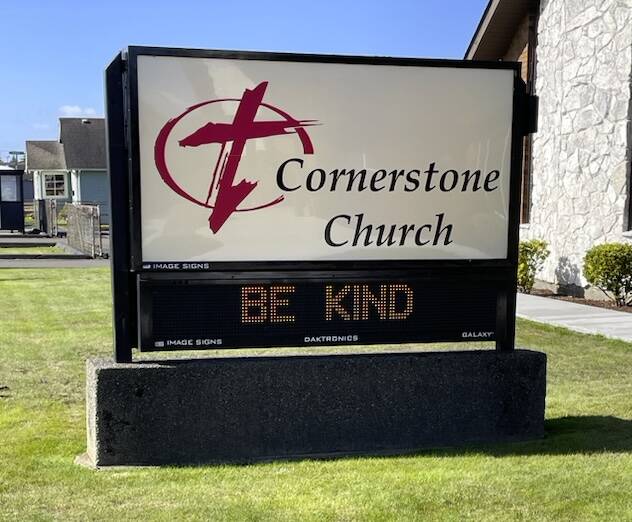
ON THE WAY home from the supermarket, I took note, as I always do, of the reader board at Cornerstone Church on Sumner Avenue in Aberdeen.
I’m a fan of church reader board messages. They range from witty to inspirational. “Need a lifeguard? Ours walks on water!” for instance. Or “Let the Son shine in.”
The one I saw outside a church in Walla Walla last summer is a genuine sign of the times: “Gossip is the Devil’s radio.” I’d substitute “social media” for “gossip,” but they are now pretty much synonymous.
At Cornerstone, they cut to the chase with “BE KIND.” The Golden Rule in shorthand alternates with “WE BELIEVE IN SECOND CHANCES” and “COME AS YOU ARE,” the line that inspired Kurt Cobain all those years ago when, legend has it, he spotted it on a sign outside another Aberdeen church.
From its pastors, Larry and Sharon Dublanko, to its parishioners, Cornerstone seems to attract some of the nicest people I know.
“BE KIND” was a chastening epiphany after my supermarket meltdown.
Frank Bruni, a Duke University professor and New York Times columnist, wrote a compelling 2024 book called The Age of Grievance. It asserts that “More and more Americans are convinced they’re losing because somebody else is winning. … The blame game has become the country’s most popular sport, and victimhood its most fashionable garb.” The decline in civility goes hand in hand with the erosion of civics education in our schools, Bruni writes. And when grownups model shockingly bad behavior, why would the kids think it’s bad form to shout “F*** Joe Biden!” or, for that matter “F*** Donald Trump!”?
Aren’t we better than that?
I’m glad my 5-year-old grandson wasn’t with me at the supermarket that day. He’s so smart, however, that he likely would have looked up to say, “Gosh, grandpa-dad: Can’t we just be nice?”
John C. Hughes was chief historian for the Office of the Secretary of State for 17 years after retiring as editor and publisher of The Daily World in 2008.