
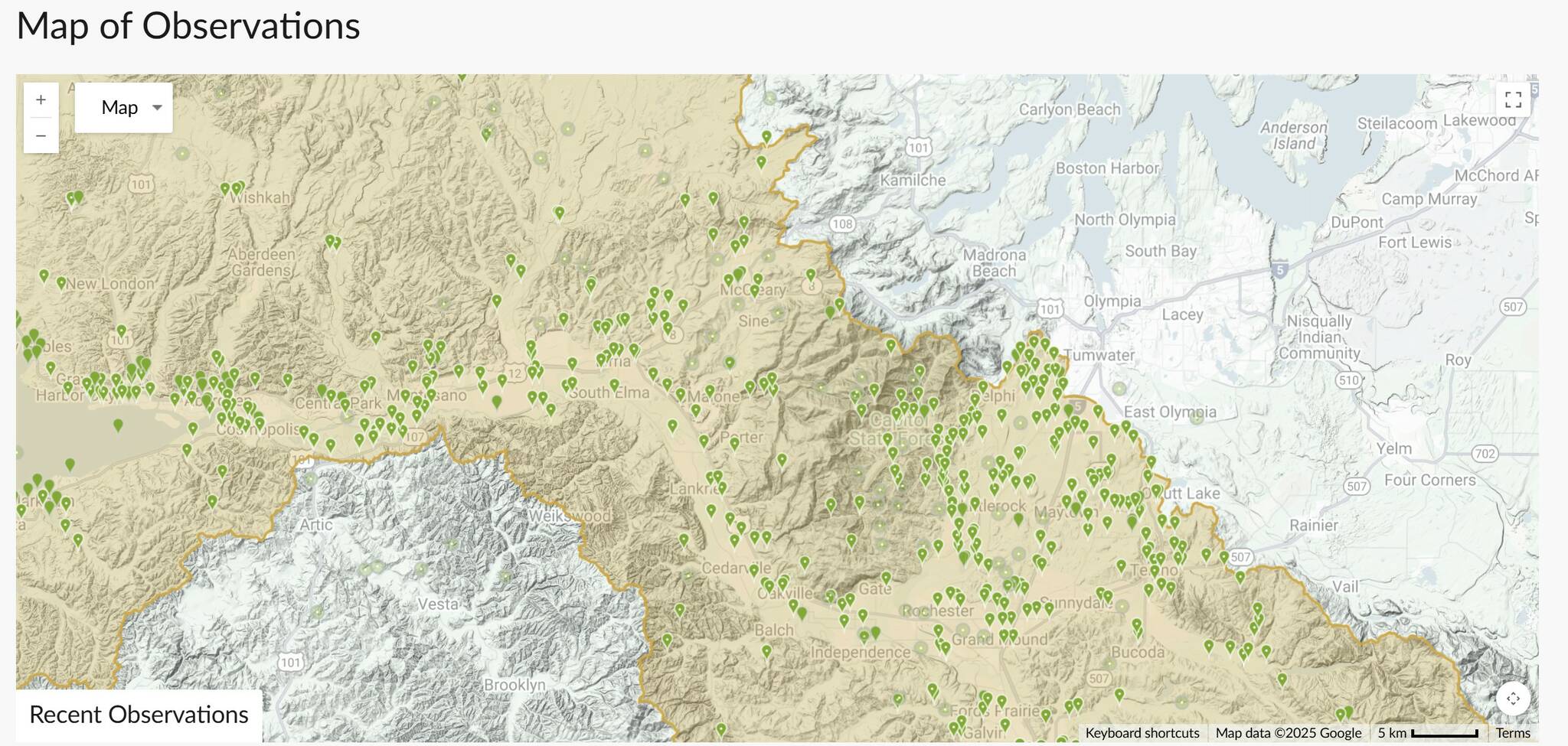
On the landing page of the “Noxious Weeds of the Chehalis Basin” webpage is a map of Southwest Washington with the 2,600 square miles that is the Chehalis Basin outlined.
Red pixels are peppered throughout this outlined area and represent 2,554 observations of 70 species of noxious weeds throughout the Chehalis Basin.
Earlier this year, Sofia Sherman, the Chehalis Basin noxious weed coordinator, created this iNaturalist project. Hearing that the King County Noxious Weeds program and others found success using iNaturalist projects to track the spread of noxious weeds, Sherman saw value in creating one for the Chehalis Basin Cooperative Weed Management Area (CWMA). (The goal of the CWMA is to “to promote cooperative efforts to manage invasive plants and work toward desired plant communities at the watershed level,” and the area spans Grays Harbor, Mason, Thurston, Lewis, Pacific, Cowlitz and Jefferson counties.
“They’ve had a lot of success with what we call early detection, rapid response,” Sherman said. “It’s basically finding a species before it’s gotten out of control when eradication is still feasible, both financially and physically, labor wise.”
iNaturalist is a 501c3 nonprofit organization whose mission is “to connect people to nature and advance biodiversity science and conservation.” People can join for free and through the mobile app or website, and post photographs and locations of the plants, birds and insects they observe. Collectively, these crowdsourced observations are useful to managers such as Sherman, because “it allows me to get data without having to actually go out in the field,” she said.
Not all the 2,554 observations have been posted this year; instead, many predate the creation of the “Noxious Weeds of the Chehalis Basin” iNaturalist project. What this project does is curate all the observations throughout the Chehalis Basin in a central location, making it easier for Sherman to review the observed noxious weeds and identify those new to the area.
“An aspect of my role that I really wanted to lean into was this like early detection of species,” she said. “That’s easily what brings me the most joy of finding a species that was not previously reported and having someone go out and treat that.”
When a new noxious weed has been posted, through iNaturalist, Sherman can reach out to the identifiers and ask follow-up questions, such as where the plant is located or how many plants there are.
This “is super helpful for our folks that are going to go out and survey and treat it,” she said.
The value of this tool for early detection has already been seen in Grays Harbor County. This summer, two previously unknown patches of orange hawkweed were reported on iNaturalist; this aggressive noxious weed outcompetes desirable pasture and range plant species. According to the Washington State Department of Agriculture, in February 2024 Grays Harbor had less than 10 acres of infested area.
“Both of those patches were eradicated and will be added to the Gray’s Harbor Noxious Weed Board’s monitor list,” Sherman said.
Wild basil, which hadn’t been observed before in the county, also appeared on iNaturalist. Wild basil is a class B noxious weed, which means control is mandatory in areas where it’s not widely found. The reason for its listing is it can outcompete forest understory plants and create a monoculture. This patch of wild basil was also located, treated, and the plant added the monitor list.
In addition to providing early detection of noxious weeds, the observations can provide a timeline for how a species’ distribution has changed.
“You can compare years and see how it’s grown and spread over time, [maybe] normally it’s just along roads and [logged areas] and, but sometimes there’s a vector of spread that’s becomes obvious, one pinpoint where they’re all radiating off of,” said Sherman.
If the general public wants to become identifiers, they can join iNaturalist through the app or the website. Sherman has found the app is easier for posting observations.
“It can help with identification if people aren’t certain,” she said. “It’ll suggest either a genus or species, depending on how if the flowers are out or how many different characteristics are present on a certain plant.”
Another benefit that Sherman has found creating this iNaturalist project is its allowing more collaboration among everyone who cares about noxious weeds, both professionals and the general public.
“Being able to readily collaborate with people who might know their weed identification better has been a really good resource for me,” she said. “And also, for people who might not know as much about plants as the people in this world do.”
The iNaturalist project is available at https://www.inaturalist.org/projects/noxious-weeds-of-the-chehalis-basin.