1. FEMA pulls $84M from levee projects
Back in early April, Harborites were shocked when the Trump Administration used the Federal Emergency Management Agency (FEMA) to cancel funding for key infrastructure projects in Grays Harbor County, including the long-awaited North Shore Levee project.
Grays Harbor County District 3 Commissioner Vickie Raines said, “And just like that … years of due diligence and hard work to move the North Shore Levee flood protection projects forward — now down the drain, only to see $84 million in FEMA Building Resilient Infrastructure and Communities (BRIC) grants clawed back by the Trump administration. This is devastating to Grays Harbor County.”
Willie Nunn, director for the Federal Emergency Management Agency’s Region 10, said that when the levee was finished, the project would stop floodwaters, promote future investments, create affordable housing and jobs and foster economic development.
Then, in early August, a federal judge granted a preliminary injunction signaling the Hoquiam and Aberdeen levee project was not dead yet.
U.S. District Judge Richard G. Stearns in Boston blocked the Trump administration from redirecting billions of dollars intended for disaster preparedness work nationwide, including $182 million for 27 projects in Washington state, as part of a lawsuit brought by 20 states.
The cancellation of the Federal Emergency Management Agency’s (FEMA) Building Resilient Infrastructure and Communities (BRIC) program in early April sounded a death knell for the nearly $100 million in funding for major levee projects in Hoquiam and Aberdeen, respectively. The granting of the preliminary injunction and rustling in the tea leaves seem to indicate that these projects may yet receive the critical funding they require.
Once completed, these levees would protect 1,354 businesses, 5,100 properties, and more than 3,000 jobs located in the designated flood zone. They would also reduce construction and insurance costs, leaving more than $5 million per year in residents’ pockets, and promote economic development and future investments.”
Then, on Dec. 12, The Daily World reported “Judge rules BRIC program cut unlawfully.”
U.S. District Judge Richard Stearns in Boston ruled that the Trump administration unlawfully terminated FEMA’s Building Resilient Infrastructure and Communities (BRIC) grant program.
“I am extremely encouraged and grateful that this ruling could lead to the return of nearly $100 million in grant funds to the City of Hoquiam and Aberdeen to build our critical flood levees. The last few days of historic flooding in our state have illustrated exactly why we are building these flood walls to protect our community,” said Brian Shay, Hoquiam city administrator. “The North Shore Levee West will be completely ready for bidding construction in early 2026. I’ve been hoping for a Christmas miracle to get the FEMA funds back so we can bid the entire project and be under construction next summer. The Aberdeen Hoquiam Flood Protection Project is the most critical infrastructure project our communities have undertaken in decades, and our future absolutely depends on it.”
Stay tuned.
2. Port of Grays Harbor expansion
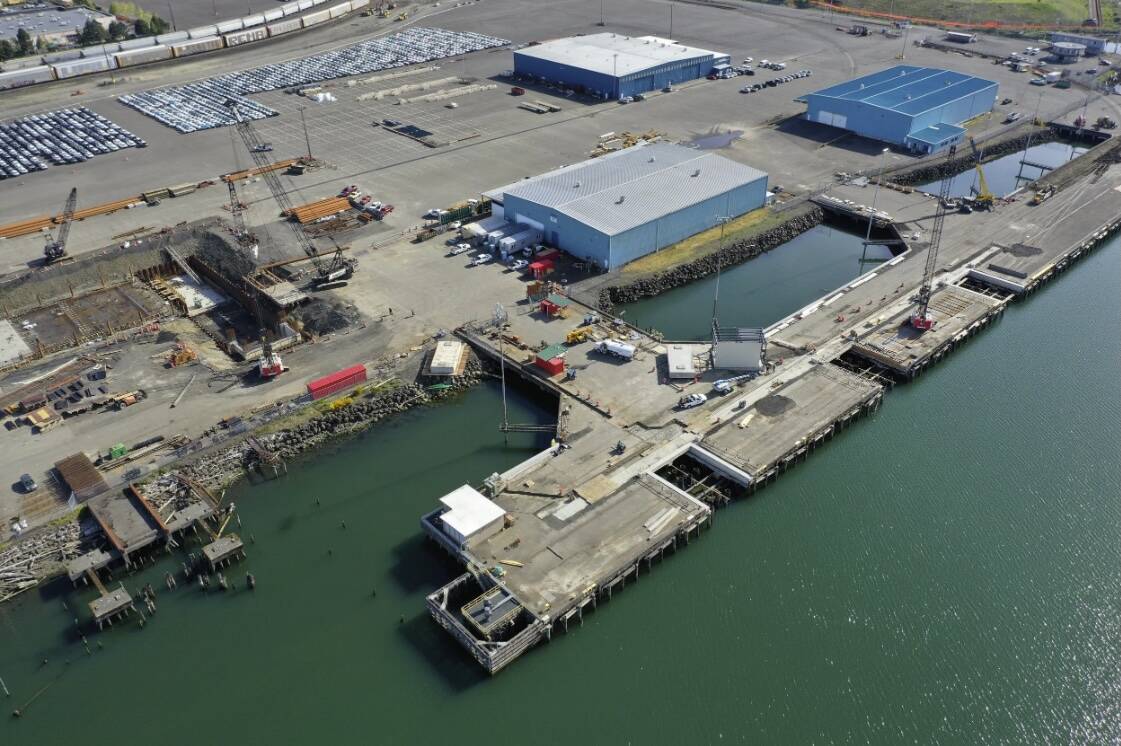
The Terminal 4 Expansion & Redevelopment Project continued to progress in 2025 at the Port of Grays Harbor. The $60 million project supports Ag Processing Inc.’s private investment of $170 million in a new export facility at Terminal 4B, resulting in increased ag exports generating additional vessel calls and more than 80 full-time, family-wage jobs. The project adds more than 40,000 feet of rail into the Marine Terminal Complex. It also includes a new and improved marine fender system designed for bulk and roll on/roll off vessels, as well as a brand-new stormwater collection and treatment system.
The grand opening and ribbon cutting is scheduled for Aug. 3, 2026, and rail traffic is expected to increase exponentially.
3. US 12 rail separation project
In November, the Aberdeen City Council voted to formally confirm Alternative 8 as the preferred geometric layout for the fully funded $74 million US 12 Highway–Rail Separation (HRS) Project.
This decision sets the design footprint for one of the region’s largest transportation safety and mobility improvements, enabling the project to advance into final design and initiate the remaining property acquisition efforts, some of which is already in progress.
Alternative 8 offers a practical design that helps emergency responders, reduces traffic backups, and supports East Aberdeen’s commercial area. U.S. Highway 12 is the main thoroughfare into Aberdeen, serving an estimated 32,600 residents, freight trucks, and tourists’ vehicles each day. The rail line adjacent to U.S. 12 transports 28,000 rail cars of cargo for export through the deep-water Port of Grays Harbor each year. The properties surrounding this 0.36-mile segment of U.S. 12 form Aberdeen’s largest retail and commercial center, generating over $161 million in annual sales (74% of the city’s annual retail sales) and employing approximately 1,000 people. The continuous flow of vehicles, freight, and rail is critical to the region’s current and future economic growth. In addition, approximately 1.6 million tourists visit the Pacific coast communities of Ocean Shores, Westport and Seabrook, as well as the Olympic National Park and the Quinault Indian Nation, along this route each year.
4. More bad news for Cosmo Specialty Fibers
The owner of a defunct and heavily contaminated pulp mill in Cosmopolis is digging in his heels while the bills keep piling up.
For the second year in a row, Washington’s major polluters turned in their greenhouse gas emission allowances to state regulators this month. They’re required to do so under the 2021 Climate Commitment Act. Over the coming decades, state officials will ratchet down the number of allowances sold to decrease emissions.
And for the second year in a row, each of the state’s top polluters turned in their allowances except one: Cosmo Specialty Fibers.
This business, once the largest employer for Cosmopolis just outside of Aberdeen, represents a growing thorn in the side of state and federal regulators. Its owner, Richard Bassett, already owes Washington’s Department of Ecology millions of dollars and thousands of allowances.
But that’s a fraction of his problems. He’s bleeding money and with regulators on his back to fix a series of hazardous problems, he can’t rustle up the tens of millions he needs to start the place up again.
When running, the pulp mill would produce products essential for everyday items like aspirin, phone and computer screens, fabrics and cosmetics. Bassett has big dreams for the place and even imagines using the mill’s byproducts to generate large quantities of electricity for the region.
But the place hasn’t been running since 2022. Its equipment is degrading and leaking acid and other toxic substances, sometimes in residential neighborhoods or into the Chehalis River, state and federal documents show.
Some hazardous substances have been left unsecured without water, electricity and security, giving rise to the risk of a “potential catastrophic release,” the Environmental Protection Agency’s acting regional administrator wrote in January.
Conditions were so dire that last year EPA officials leveled a type of regulatory order against the mill, which still hangs over the property like a black spot on its record.
Bassett has repeatedly argued against the notion that the site is contaminated. The federal order, he said, has scared away numerous investment deals that might have provided the tens of millions in seed money needed to fix the site up and turn it on again.
Should the mill reopen, Bassett argues, it could inject hundreds of millions of dollars back into the community each year.
The mill was once the largest source of tax revenue for the city but once it closed, the money dried up, sending the municipal budget into the red.
This summer Bassett appealed his $2.3 million in fines. He argues that the mill has taken “proactive steps to mitigate risks, responded in good faith, and in many cases disputes the legal basis or proportionality of the penalties.”
The state Pollution Control Hearings Board will hear Bassett’s arguments in the coming year.
5. Air permit upheld paving way for Hoquiam pellet plant
In November, the Washington Pollution Control Hearings Board upheld the Olympic Region Clean Air Agency’s air permit to Pacific Northwest Renewal Energy to establish a wood pellet manufacturing facility in Hoquiam.
The Notice of Construction permit issued by Olympic Region Clean Air Agency (ORCAA) was appealed to the Pollution Control Hearings Board (PCHB). After months of deliberation, the board found that Olympic Region Clean Air Agency permit approval met the requirements of both the federal Clean Air Act and Washington’s Clean Air Act. Olympic Region Clean Air Agency’s Final Determination and Order of Approval for the construction application were affirmed.
Hoquiam City Administrator Brian Shay said, “In general, it means that ORCAA can now issue the air permit which is necessary to operate the facility once it is constructed. (Pacific Northwest Renewal Energy) has been waiting on this appeal ruling before they commence construction.”
The original appellants, Twin Harbors Water Keeper, Grays Harbor Audubon Society, the Friends of Grays Harbor and the Natural Resources Defense Council, are appealing the ruling.
6. Amazon opens delivery station in Elma
In late November Amazon opened its newest delivery station in Elma, marking another step in the company’s effort to bring service to rural areas across the Pacific Northwest.
Operations began at the 48,000-square-foot facility, successfully processing more than 1,000 shipments on its first day, and continued scaling up through the holiday season.
The new delivery station powers the last mile of Amazon’s order process, with packages shipped from neighboring fulfillment and sortation centers, then loaded into delivery vehicles and delivered to customers’ doorsteps. This streamlined process increases delivery speed and expands capacity to serve customers throughout Grays Harbor County.
This expansion is part of Amazon’s $4 billion investment to enhance delivery speed and reliability in rural America. The Elma location will significantly improve access to everyday essentials for communities located far from major retail centers. For speed-critical items like paper towels, diapers, and pet food, customers will no longer need to wait days for delivery or travel long distances to stores. Local residents, including busy families and small businesses, will have access to thousands of affordable items with faster delivery times.
Since 2010, Amazon has invested $350 billion across Washington state through infrastructure development and employee compensation.
7. Scatter Creek juvenile prison opens
In June, the juvenile detention center dubbed Harbor Heights opened inside Stafford Creek Corrections Center in Aberdeen.
The young men will spend most of their day outside, in a three-quarter-acre space, separated by a fence from a building housing incarcerated adults.
But they’ll be an entirely separate population from the prison, overseen by a different agency. The Harbor Heights facility — consisting of two living areas, an outdoor space and a visitor center — relocated some men from the overcrowded Green Hill School, which houses juveniles and men under 25 who have committed serious crimes.
Faced with calamitous conditions at Green Hill, the Department of Children, Youth and Families announced in November it would lease two unused units on the grounds of Stafford Creek Corrections Center, an adult prison near Aberdeen. DCYF has dubbed the facility “Harbor Heights,” and it’s intended to be a therapeutic environment with special privileges.
Split into two 24-bed pods, the youth detention center has been revamped with new furniture, board games and marine-themed decor. Inspirational phrases dot the walls: “Welcome to the harbor; where your future will take you to new heights!”
The young men’s cells are similar to what’s found in the Department of Corrections prison: they have locked doors with small rectangular windows and a metal opening for food trays. Each room has toilets and sinks — unlike Green Hill School’s “dry cells,” which have been the subject of a Washington Court of Appeals case due to the lengthy hours residents spend in them.
Outside, the barren lawn will soon have workout machines, a garden and a space for the men to recreate and participate in therapy. A separate trailer holds offices for staff and a visitation space for family and friends.
The area was not being used by the Department of Corrections and was last used before 2016 as solitary confinement. Despite Harbor Heights being a former Department of Corrections facility and on the grounds of an adult prison, state leaders have been adamant that it will be staffed by DCYF and that the Department of Corrections will have no interaction with the people incarcerated there.
8. Seabrook improvements
Seabrook’s story has been two decades in the making, and the original vision of a walkable, people-centered coastal community is coming to life like never before.
Since its founding in 2004, Seabrook has grown to include 600 homes, over 20 parks, 24 shops and restaurants, a full-size grocery store, an indoor and outdoor pool, miles of walking trails, and much more.
“Building this town is all about creating these traditions for people that love the coast, love community, and want to really connect with nature, but also have all those urban creature comforts and amenities surrounding them,” says Casey Roloff, Seabrook’s co-founder.
Seabrook is dedicated to supporting the local community, and through the work of the Seabrook Community Foundation, almost $8 million has been donated to schools, food banks, emergency services, and college scholarships, with around $250,000 in scholarships awarded each year.
Exciting new additions are coming to Seabrook and the entire North Beach community that will contribute to Seabrook’s dream of becoming a complete town that can meet every need for full-time and part-time living, from raising a family to enjoying retirement.
“That is our goal, to make your lifestyle so easy that you don’t have to get in your car and drive unless you really want to,” Casey says.
$40 million in funding has been secured from the state of Washington to build a new school in Pacific Beach, and land has been purchased just up the road from Seabrook. Most likely a grade school and middle school, the new school is currently being designed, with many volunteers from Seabrook getting involved in the process.
The Seabrook Community Foundation is working towards sponsoring the construction of a community center next to the new school, with the possibility for facilities such as gyms, indoor basketball courts, and swimming pools.
Pacific Beach also broke ground on a new walk-in medical clinic less than a mile away from Seabrook, with plans to combine on-site medical staff with telemedicine to provide the best possible medical care without the need to travel out of town.
Schultz Farm, a fully regenerative, family-run farm, is now operating in Seabrook and will grow vegetables for Seabrook restaurants and the Fresh Foods Market. The farm utilizes compost taken from the town and will provide classes and farm-to-table dinners.
Seabrook is preparing a major expansion of available town amenities, with plans to double the shops and restaurants, build indoor pickleball courts, and expand the 24-mile network of hiking and mountain biking trails.
Big news for golf enthusiasts. Land for a par-3 short golf course has been approved, located a short 5-minute walk from Seabrook’s Fernwood neighborhood, and is currently in the design phase. Eventual plans for an 18-hole course are in the works as well.
Construction on The Sunset District, the final block to complete Seabrook’s Town Center, is now underway. This addition will add luxury townhomes, condos, and retail spaces with sweeping ocean views. On the Southwest corner, a restaurant is planned with five luxury residences situated above, perfectly oriented for unobstructed coastal sunsets.
Across the street, Koko’s Restaurant and Tequila Bar will soon be moving into a much larger space in Pacific Landing, which will also offer unimpeded ocean views.
A couple of blocks down Market Street, the Newhart Building has rapidly taken shape and will feature nine rooms, each with en-suites, that can be rented to groups such as family reunions, weddings, and corporate retreats. In the near future, a new shop in the retail space on the ground floor will be announced.
To the north of Town Center will be the new Makers Village, where artisans will create and sell handcrafted products, including blown glass, leather goods, jewelry, and confections. Artisans will also host classes, and workshop spaces equipped with the necessary tools will be available for homeowners and guests to work on personal projects.
9. Riley T. Carter sentenced to minimum 46½ years in prison
On July 11, former Aberdeen City Councilor Riley T. Carter was sentenced to a minimum of 46½ years in prison.
A lone person sat on Carter’s side of Grays Harbor County Superior Court Judge Katherine L. Svoboda’s courtroom, while the gallery on the prosecution’s side was filled with family, supporters and advocates for the victim and her mother.
Prior to sentencing, Grays Harbor County Criminal Chief Deputy Prosecutor Daniel Crawford deferred to the victim, her mother and anyone else who wished to give a statement.
Mya Hernandez read her daughter’s statement to the court. It read, in part, “I felt betrayed, very betrayed by someone who was meant to keep me safe and happy, but I did not feel that. … I want Riley to be gone forever. I want him to be stuck in one loop, like how I was, and I want him to be in a bad place — like how he put me in a horrible place.”
Hernandez also read a prepared statement from the victim’s biological father that read, in part, “She is the bravest girl I know,” and went on to describe how Carter had betrayed his responsibilities as a step-father.
Hernandez read from her prepared four-page statement, that read, in part, “This isn’t just about abuse. This is about betrayal that carved through the bones of my family. This is about a man who didn’t just break trust — he broke us. He didn’t just lie, he ‘performed.’ To the world. He was a councilman. A hero. A ‘protector of children against predators.’ But in our home he was the danger. … Riley is vile. He confessed — then took it back — and forced a little girl he broke to take the stand and relive every sick thing he did to her. … He is not safe. He is not sorry. And he does not deserve leniency.”
The victim, who was present via Zoom, chose not to speak.
Crawford then made his case and sentencing recommendation. He asked for “top of range” for every count.
“There is zero question that Carter did these acts, he confessed,” Crawford said. “(Then) he tried to convince people he was the victim in this case. He tried to fool the court. He also tried to fool a jury and he tried to fool the community. … He raped his step-daughter for the better part of two years. … Mr. Carter is who he is.”
Young was offered the opportunity to speak on her client’s behalf. She said Carter maintains he was wrongfully accused and decried the fact a request of change of venue was denied and intimated the jury may not have been impartial due to the social and legacy media attention the case garnered. Young also said Carter should have the opportunity to rehabilitate and improve himself, that the punishment should be appropriate to the severity of the crimes and the sentence should be similar to other such cases, and run concurrently, not consecutively.
Carter, dressed in an orange Grays Harbor County Jail jumpsuit, was stoic throughout the proceedings only breaking to speak with his defense team.
When he was allowed to address the court, he said with indignation that evidence in his defense was not allowed to be presented at trial, that he felt compelled to lie and make things up and that he did not understand the severity of the accusations against him, accused detectives of coercion, and lobbed disparaging remarks at the victim’s mother, calling Hernandez his “mentally disturbed wife.”
After quoting constitutional rights, Carter said he was going to prison “wrongfully accused and wrongfully convicted.”
Judge Svoboda took exception to the comments about the possibility of jury bias and defended the jury selection process and the empaneled jury that decided the case.
Svoboda said the interrogation by police detectives should be held up as an example of what such interrogations should be. She added Carter’s statements were not credible and that although he has a right to proclaim his innocence, “that ship has sailed … there is overwhelming evidence of your guilt.”
After handing down what amounts to a 46½-year prison sentence which includes a lifetime no contact order between Carter and the victim, and a no contact order between Carter and his biological children until they turn 18, Svoboda said, “An untreated sex offender in the community is dangerous.”
“They had it right with what was recommended,” Hernandez said. “And the judge said no matter what they sentenced it wasn’t going to be enough. He’s getting 46 to life. Good. Make every day count.”
Carter, who was known for wearing a red ballcap that read “Make Pedophiles Afraid Again,” was arrested by the Aberdeen Police Department in late July 2024 and subsequently forced to resign his post as an Aberdeen City Councilor for Ward 5 a few days after his arrest. He was convicted on all eight counts back on June 6.
“Justice was for most part served today, he’ll be well into his 80s before he’s allowed to seek release from prison, so the community is safer, hopefully the victim in this case can start to heal,” Crawford said. “He’s been sentenced to about 46 and a half years, and then he gets to start asking for permission for release based on what he does while in prison. That puts him at about 86 years old.”
It was noted by several people in attendance that Carter did not say one word about the victim and that he did not admit responsibility or show remorse during today’s sentencing hearing.
“He has no concern about the victim. He cares about one person and one person only,” Crawford said.
10. Ocosta teacher accused of child molestation pleads guilty to lesser charge
In February, former longtime Ocosta teacher and coach Wade Eric Iseminger was sentenced to serve 90 days in jail, and banned from the city of Westport for five years.
Iseminger pleaded guilty to a Class C felony, assault in the third degree and was sentenced to 90 days in jail, five-year “banishment” from the city of Westport, and 12 months community custody. He was also issued five-year non-contact orders for more than a dozen alleged victims. He will also have to pay restitution for counseling and therapy for those victims. It is the understanding of the Grays Harbor County prosecutor’s office that Iseminger would no longer be permitted to teach in Washington state on the basis of this conviction. However, Iseminger will not have to register as a sex offender because he did not plead guilty to any sexual offenses.
“There were good reasons for that to be the final resolution, however, based on the actions, I am very disappointed this wasn’t handled properly in the beginning,” said Daniel Crawford, Criminal Chief Deputy Prosecutor for Grays Harbor County. “The case was charged initially incorrectly, there were a lot of errors in the charging documents, that would’ve been an issue that had to have been corrected.”
According to Crawford, 90 days was the maximum allowable sentence in this case due to the point system put in place by the Sentencing Reform Act that governs crimes committed after July 1, 1984.
Iseminger, dressed in an orange jumpsuit and wearing a smirk on his face, was led into Superior Court Judge Katherine L. Svoboda’s courtroom by Grays Harbor County Sheriff’s deputies. The gallery was roughly two-thirds full, with victims and their families and their supporters on one side, and Iseminger’s supporters on the other.
Crawford, who joined the Grays Harbor County prosecutor’s office in August 2024 and was assigned to the case late in the year, presented 14 speakers who consisted of victims, family members and witnesses who described alleged sexual, physical, psychological and emotional abuse of students aged 9 to 14 years old by Iseminger. Several said they had also witnessed violent behavior that included the throwing of and breaking of classroom objects.
“I’m very disappointed in how a lot of people let these kids down,” Crawford said. “There’s really no excuse for that.”
Iseminger, who was arrested on April 21, 2023, on charges of second-degree child molestation, was stoic as each person read or spoke. He was admonished by Judge Svoboda for conferring with his attorneys Ruth Rivas and Luke Laughlin during the first statement, during which the speaker said Iseminger had touched her “in a way only a lover should,” and that Iseminger molested her “on a daily basis.”
Almost every speaker described recurring nightmares, symptoms of PTSD, depression, anxiety, panic attacks, distrust of family and friends (especially men), inability to sleep and/or eat, fear and some even indicated suicidal ideation. Speakers described an environment of bullying, intimidation and inappropriate touching. They spoke of the school and of the justice system, most notably the Grays Harbor County prosecutor’s office, failing them and their children. They asked, begged, for the maximum allowable sentence, and that Iseminger be required to register as a sex offender.
One victim who had the courage to speak in court said 6th grade at Ocosta Elementary was the worst year of their life and that “life is a struggle, I think about him all the time.” Another former student described temper tantrums and property destruction.
“It’s always difficult to put children on the stand, and some of them may not want to, some of the parents may not let them,” Crawford said. “Ultimately the elected prosecutor (Norma Tillotson) made a decision, while conferring with her chiefs and the sheriff’s office, a decision was made because the ultimate goal based on how everything transpired up to this date was for a felony conviction that would hopefully make it to where Mr. Iseminger can never teach again, and the no-contact orders for each person who was a victim in the initial discovery reports.”
One parent described Iseminger’s plea deal, which was offered by the defense, as a “miscarriage of justice” and that Iseminger was “utterly evil” and had stolen his child’s “innocence and childhood.” Another said this experience has “changed them forever,” and that it’s “egregious that there is no justice, 90 days is a slap on the wrist.” Yet another said the victims were “promised their bravery would be rewarded, my child suffered greatly, our family will never be the same,” and added that complaints lodged with the Ocosta School District went unheard.
When asked for comment, Ocosta School District Superintendent Heather Sweet said, “Due to pending litigation, the Ocosta School District has no comment.”
A civil suit was filed Nov. 27, 2023, against the Ocosta School District for the district’s actions concerning Iseminger’s alleged sexual harassment and misconduct over several years with 11 former students or guardians named as plaintiffs.
The Daily World’s Top 10 stories of 2024
A few stories from 2024 continue to remain in the news as we move into 2026. Here’s the list from a year ago.
1. Port of Grays Harbor expansion
2. Flood control efforts
3. Opposition heats up over proposed Hoquiam wood pellet mill
4. Aberdeen city council approves homeless camp closure
5. Grays Harbor College opens new $52M student center
6. Modular Building Assembly Plant approved for South Shore Mall
7. Westport Golf Links closer to EIS
8. World Music Day unites Aberdeen
9. Stafford Creek Detention Center near Aberdeen chosen for youth facility
10. Aberdeen City Councilor Riley T. Carter charged with first-degree rape

City of Aberdeen The 3D view was approved as the preferred geometric layout for the US 12 Highway–Rail Separation Project.

Nick Wagner / The Seattle Times The defunct Cosmo Specialty Fibers plant is seen near the Chehalis River in Cosmopolis.

U.S. Industrial Pellet Association In November, the Washington Pollution Control Hearings Board upheld the Olympic Region Clean Air Agency’s air permit to Pacific Northwest Renewal Energy to establish a wood pellet manufacturing facility in Hoquiam.
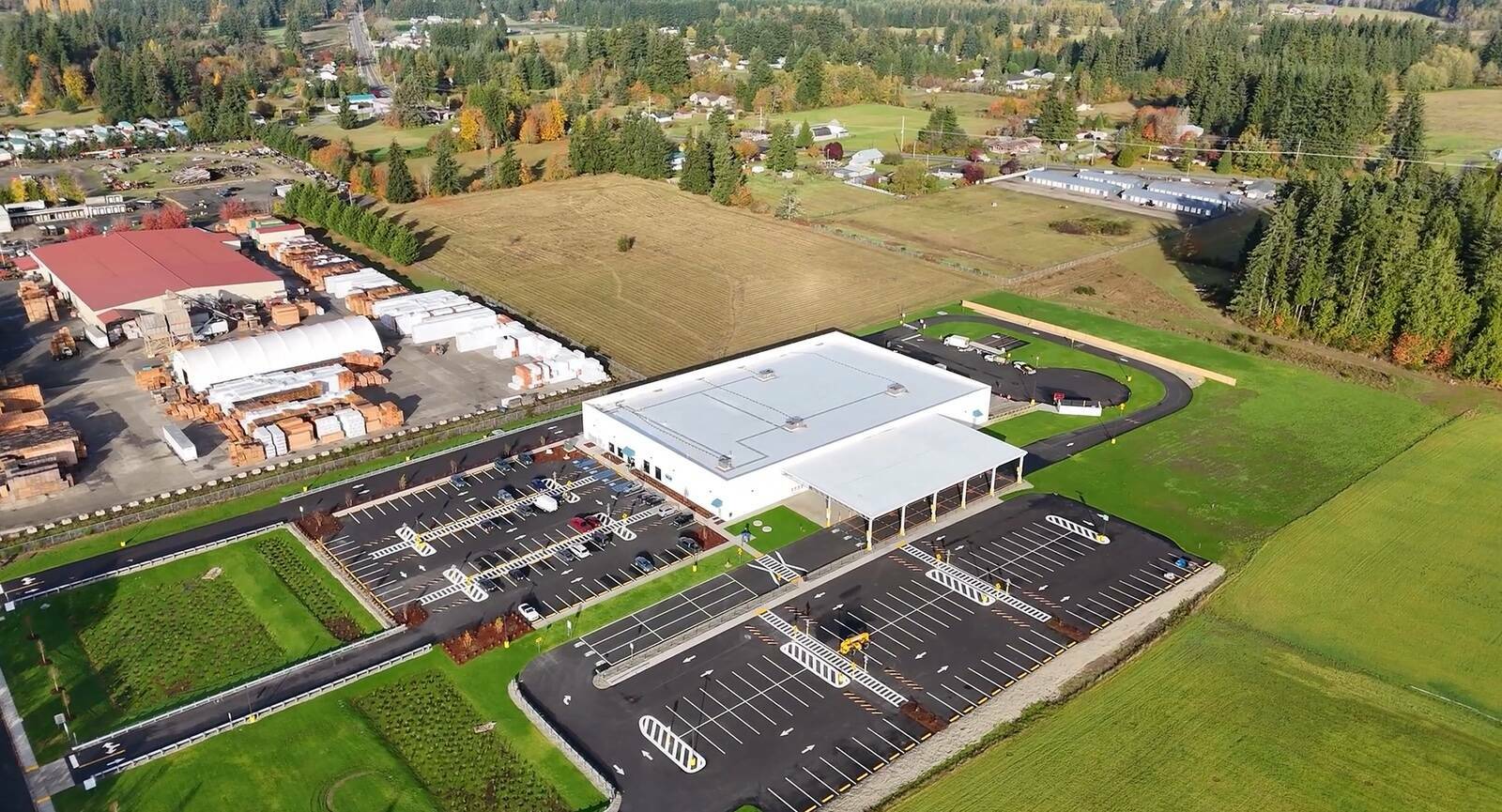
The Daily World Amazon opens delivery station in Elma.

Kevin Clark / The Seattle Times A renovated room at Harbor Heights inside Stafford Creek Corrections Center in Aberdeen.

Seabrook Seabrook’s Sunset District

The Daily World On June 6, former Aberdeen City Councilor Riley T. Carter was convicted of three counts of rape of a child in the first degree, three counts of incest in the first degree, one count of child molestation in the first degree, and one count of incest in the second degree, by a jury of his peers in Grays Harbor County Superior Court.
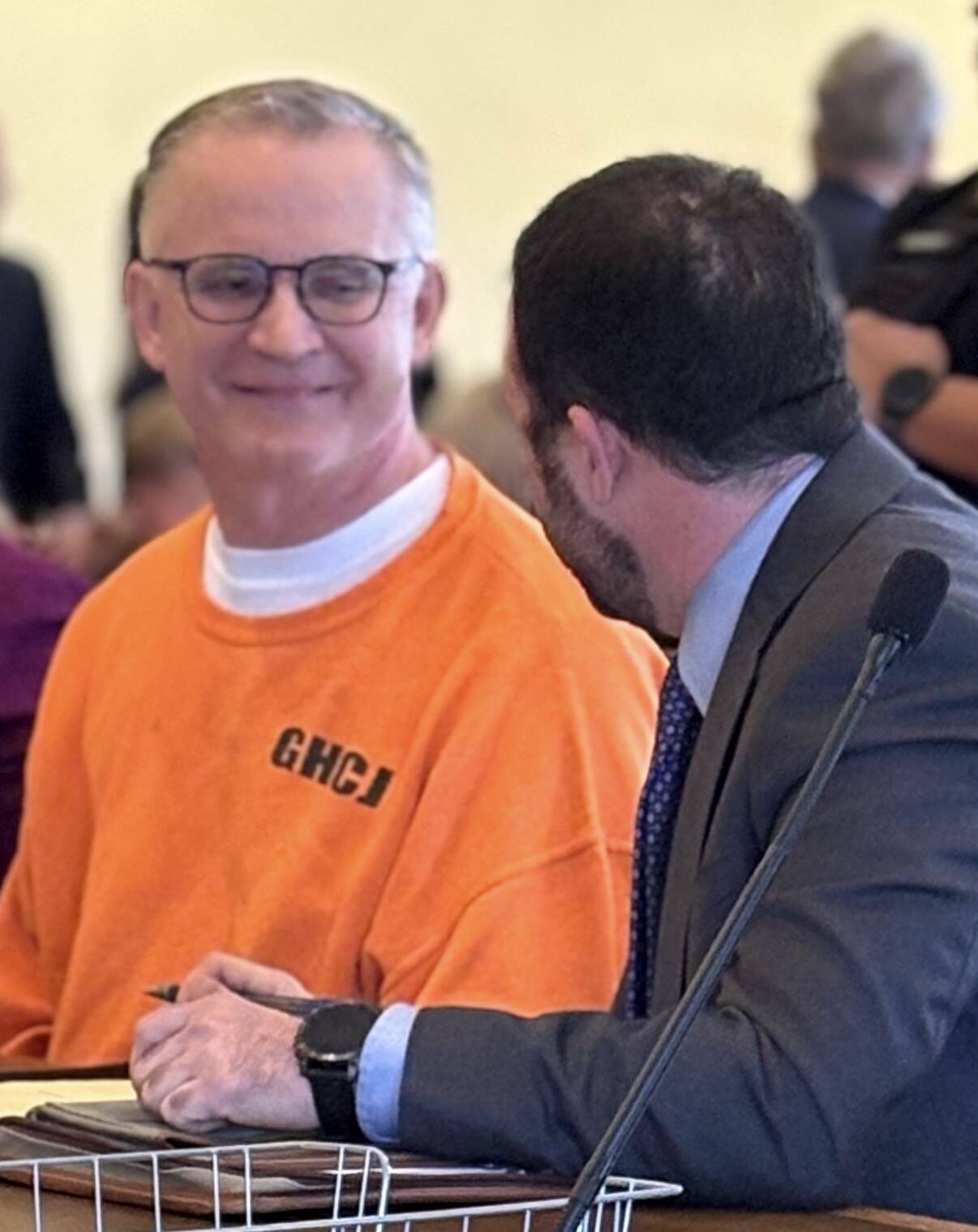
The Daily World Former Ocosta teacher Wade Eric Iseminger chats with one of his defense attorneys, Luke Laughlin.