Officials in timber-dependent counties around Southwest Washington say the state Forest Practices Board’s new rule expanding no-logging zones around some streams amounts to an economic siege.
“We’re under attack in the rural communities,” said Dan Cothren, a longtime Wahkiakum County commissioner. “We always get the short end of the stick.”
Commissioners in Cowlitz, Skamania and Pacific counties echoed that frustration with big-city policymakers.
“They just want us to be able to make their beds and flip their burgers when they come down to look at how beautiful everything is,” said Lisa Olsen, a Pacific County commissioner.
The rule will result in a decrease of $2.8 billion in harvestable timber value on private lands around the state, according to a May report from the University of Washington’s Natural Resources Spatial Informatics Group.
The study found Southwest Washington counties are hit hardest by the timber inventory loss, with Lewis losing $398 million, Pacific losing $274 million, Cowlitz losing $258 million, Wahkiakum losing $70 million, Clark losing $41 million and Skamania losing $36 million.
State research placed the losses much lower: $320 million to $1 billion for the state at large.
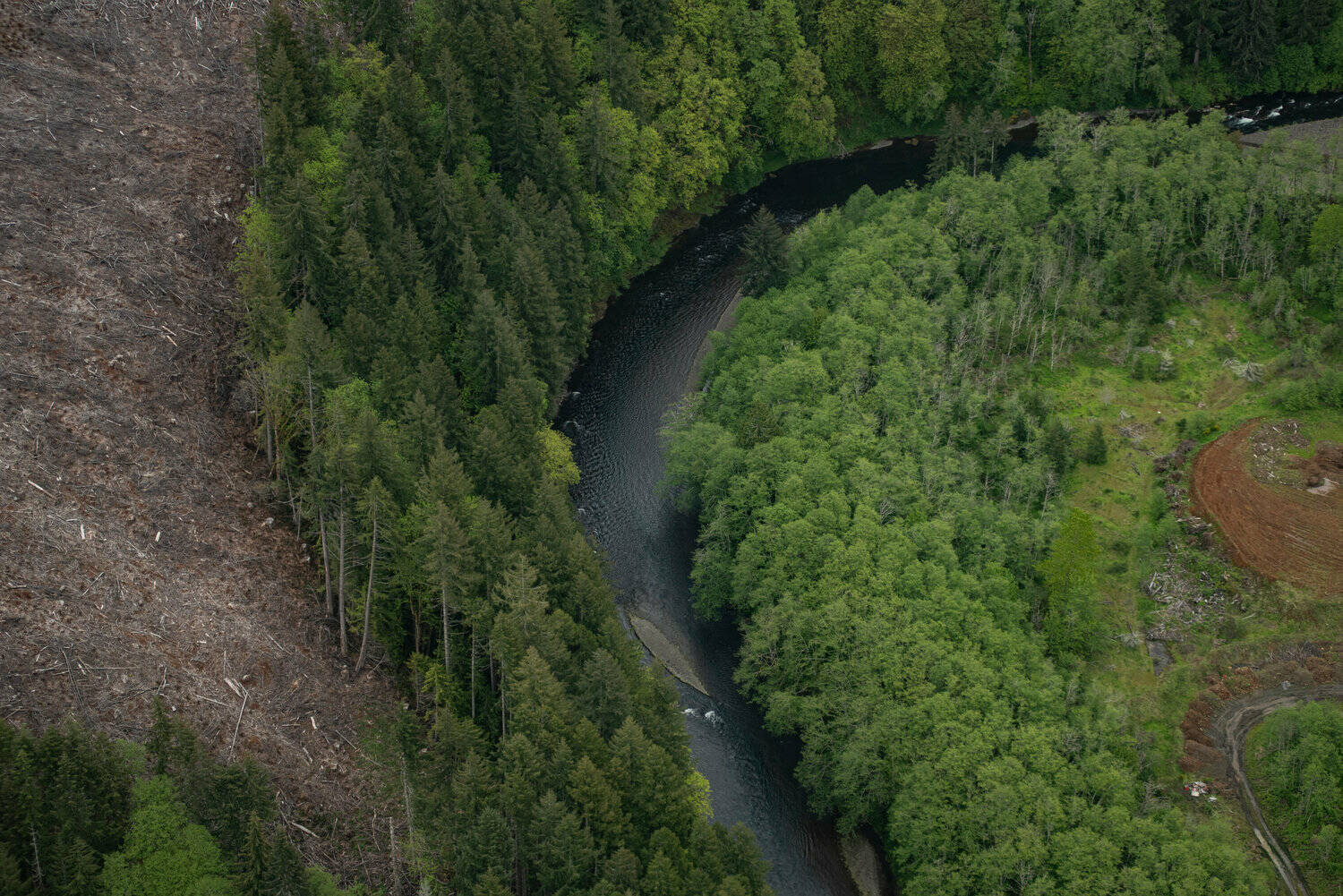
On Nov. 12, the Washington Forest Practices Board — by a 7-5 vote — approved a new rule that increases the buffer zones around streams that run all year but don’t have fish in them.
The new policy is set to go into effect Aug. 31. In general, it moves the boundary that companies cannot log from 50 feet to 75, although both the current and incoming policies have a slew of caveats allowing for varying buffers under specific circumstances.
Another key caveat: The rules don’t apply to all timberland owners. The state and some other entities follow their own “habitat conservation plans,” which often require bigger buffers. The new policy just applies to everyone else, said Katie Allen, deputy supervisor for forest practices at the Washington State Department of Natural Resources and the chair of the Forest Practices Board.
“So that’s the majority of private timberland owners, both small and industrial land owners, in the state of Washington,” she added.
Research from the state Department of Ecology found the rule “would substantially improve water quality for non-fish bearing perennial streams in Western Washington.” That’s because the remaining trees would both provide shade and potentially stop more soil from eroding into the streams.
While the streams to which the policy applies don’t contain fish, they’re important because they feed streams and rivers that do — meaning the policy shapes the conditions in which endangered salmon will spawn.
Salmon fisheries contribute about $1.5 billion to Washington’s economy annually and provide about 23,000 jobs, according to the state. The state and federal governments also are legally obligated to protect Native nations’ treaty-reserved fishing rights and must make sure salmon are still in the Columbia and other rivers to be harvested.
Ecology said it analyzed the costs and benefits of the new buffer rule and concluded it’s “necessary and in the overriding public interest.”
But not everyone agrees.
“The rural counties, for the most part, don’t get considered,” Olsen said. “It’s whatever’s best for Pugetopolis and all the big counties.”
Olsen said about 5% or 6% of Pacific County’s budget is tied to timber. If the sector takes a hit, she said, jobs will follow, and that in turn will hurt things like booster clubs and cheerleading uniform fundraisers.
“Those are the things that get lost in our communities, and our communities … die,” she said. “That’s the eventuality.”
Olsen said the new rule also will push small landowners to convert their properties into residential housing sites.
“How is that better for the habitat and the rural areas than having timber that can be harvested around non-fish-bearing streams?” she asked.
The rule’s impacts may be worse still in Wahkiakum and Skamania counties, where commissioners said as much as one-third of their budgets are tied to timber.
Much of that revenue to counties is from logging in state forests, which returns the counties about 75 cents on the dollar, with the state getting the rest for managing the land, said Ryan Rodruck, a spokesperson for the state Department of Natural Resources.
While timber has been exempted from yearly property tax in Washington because of the forest excise tax, that policy also means that when trees are harvested, counties get 4 percent of the value and the state gets 1 percent.
That means counties around Southwest Washington stand to lose about $40 million in tax revenue, based on numbers from the University of Washington study.
But Luke Rogers, one of the study’s co-authors, said researchers looked only at the value of standing timber.
“We’re not looking at any of the downstream stuff — employment and jobs that are multipliers associated with people that work at a mill, and the families that live with that person in that community, and all the downstream economics,” he explained.
Rogers and co-author Jeffrey Comnick emphasized that they have no stance on the policy but produce work to inform conversations.
But Cowlitz County Commissioner Rick Dahl said he is against the policy because of those downstream impacts, especially if they stand to impact local mills. Cowlitz County Commissioner Steve Rader also opposes the policy and said it comes at a particularly difficult time for small counties’ budgets.
“The counties right now throughout the state are struggling with the number of unfunded mandates that are getting shoved down our throat,” he said, pointing to the state’s new public defender caseload standards.
Allen of the Department of Natural Resources said state Forest Practices Board members weighed concerns from timber-dependent counties but were swayed by Ecology’s determination that the rule will be good for salmon.
“We take that determination very seriously at a time when we’re continuing to lose ground on salmon recovery,” she said. “We saw that as being critical.”
Allen said the Forest Practices Board has a responsibility to assess the policy annually and she hopes the Legislature will address any problems.
But for Asa Leckie, a Skamania County commissioner, a promise is not enough.
“We’re never made whole. There’s a legacy of promises, and as electeds come and go, those promises are forgotten,” he said.
Leckie said the new rules compound the potential loss of timber from a different state rule — and the loss of millions in funding the federal government is supposed to pay in exchange for not allowing counties to log federal lands.
Cothren said the combined weight of Olympia’s policies is becoming too much for Wahkiakum County to bear.
“Do we have a civil war here?” he said. “I mean, that’s what it’s coming to.”
Olsen, the Pacific County commissioner, said the new rule is the wrong solution.
“We do have issues,” she said, “but instead of tightening up some of the logging principles — which is actually what the Forest Practices Board is supposed to do — we’re just getting this broad, sweeping attempt to tie up thousands and thousands of acres that don’t need to be tied up.”