
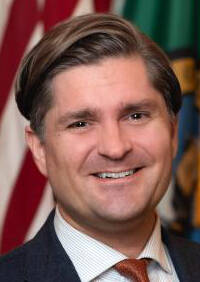
Washington State Treasurer Mike Pellicciotti stopped by The Daily World offices in Aberdeen last week during a visit to Grays Harbor County and sat down for a lengthy editorial board interview and discussed a variety of topics. On Saturday, we published Part I of an exclusive Q&A. Pellicciotti discussed the effects of the current federal administration’s economic policies on the state and local municipalities. Today we publish Part II where Pellicciotti talks about proposed legislation to implement foundational financial education in Washington schools. Part III in Wednesday’s paper discusses investments, pensions and how Pellicciotti’s office affects the lives of Washingtonians.
The Daily World: It seems like a lot of times when we post a story on Facebook about classes and education in schools and what the kids are learning, invariably somebody comments that they need home economics. Where did you get the idea for this?
Mike Pellicciotti: We’ve actually doubled the amount of resources put toward financial education training in the state. So we provide financial education to veterans and to seniors and to students in elementary school or high school. But it became very obvious to me that we need a baseline understanding of financial education and financial literacy. We as Washington state are now one of a minority of states that do not require financial education to be taught in our schools. When I talk to Rotaries, and I talked to the Rotary over the lunch hour (Wednesday), most folks assume that financial education is still part of the curriculum because that’s what they experienced when they were younger. But when I spoke to Grays Harbor College, I spoke to a number of students and faculty there, I asked the students, how many of you have taken a financial education course? There were a couple dozen students there, and maybe three raised their hands. We ask a lot of 18- or 19-year-olds. We ask them to sign this or sign that, but yet we never explain the difference between a grant or a loan. We don’t explain how interest rates are good when you are saving money and bad when you are borrowing money — foundational concepts that are necessary to be able to navigate the world today. I just have a firm belief that young people should not be reliant on how good their parents are with money as to whether or not they are able to be good with money and be able to navigate the world today.
TDW: It’s funny you mention that because everything has changed. We have automatic bill pay now but up until a certain point in the mid-2000s, we were still writing paper checks for everything and we were actually sitting there balancing a checkbook. Nobody does that anymore.
MP: I believe we need more financial education today and I would like to see it at all ages but age appropriate, right? You actually need to teach these concepts, foundational concepts, but they’re very important. We’ve been doing roundtables around the state on this financial education bill that I’m proposing and one of the superintendents that I’ve spoken to, and actually it was the superintendent of the Auburn School District, coincidentally enough, and he gives a speech as a part of his commencement address every year. One of the things that he says in his commencement address is, if any of you want to open up a credit card, make sure you talk to someone at least 10 years older than you first and the parents laugh and nod their heads and agree. But again, if these things aren’t being taught. You’re saying to yourself, I want to buy this item at Target here today and they’re offering me a credit card and I sign here and I get the item and 10% off, I’m the smart one here, right? Then you can see how, very easily, people get themselves into debt issues very early, especially in their 20s. The next thing you know, they’re digging out of it for years. There’s no shortage of predatory entities who are looking to take advantage of that.
I want to empower Washingtonians because I believe financial education is the key to economic empowerment. As I’ve visited each of our 39 counties, I’ve spoken to tens of thousands of Washingtonians. I’ve yet to meet with a single person who has said, “Mike, I have this financial education thing mastered. Leave me alone. I don’t need to know a single thing more about this.” We all know that there’s more we need to know. But at a minimum, there needs to be a baseline. That’s why I’m putting forward this legislation to make that happen.
TDW: How much have you been working with and talking to OSPI about all this? And what, if it does go through, what happens on the other end of it when it comes to the educators and how you get this in?
MP: We’ve met with the Washington Education Association and teachers, we’ve met with the School Board of Education. They’re going through what’s called a future-ready process over the next two years to look at integrating new curriculum. So we’ve been working with all these partners, including, I’ve now spoken to dozens of superintendents all around the state. Because as you might imagine, the initial reaction from an educator is, well, that sounds good. Where are the resources to support it and where do we fit that in? All very fair questions. But it’s also one of the things I’m always happy to point out is we’ve spent years now creating the modules and getting the material together and laying out a framework where it can be more easily integrated than pretty much any other form of education. These partnerships over the last year and these roundtables that I’ve been doing around the state, I think have been very helpful in getting folks ready for what we’re proposing. I remain optimistic that within the next two years we’ll see this integrated into the curriculum, or at least the law put forward that would allow for its integration in future years.
I’m working with Sen. Adrian Cortes, (Clark County), he’s in the Battle Ground area and he’s a teacher himself. We’re going to be doing a hard push for this legislation in both the Senate and there’s been a previous bill introduced in the House that we’re going to be continuing to support as well. It is rare today that you can find near unanimous bipartisan support for an education policy issue. I say to superintendents, I say to legislators, pass this bill and take the win. This is the time to put forward things where we can all agree that it’s something that we need to see happen. We’ve worked with the educators and school board officials to make sure it will be successful, but we still need the Legislature to pass it.
TDW: Are there any areas that are giving pushback?
MP: Yes. Look, I’m a treasurer, right? Education policy is a newer thing for me to be exposed to but I realize there are a lot of different views that folks have, and you have different committees in the House and in the Senate with different committee chairs who might have different views on things and on other educational policy things potentially to be included in the curriculum. What’s important for me is really developing this base of support around this initiative. And like I said, just take the win. When you have the support, the public’s behind it, and we’ve taken the steps necessary to work with educators to make sure we can actually integrate it and make it successful, it’s ready. It’s past time that the Legislature required financial education in our schools and I’m not going to quit until we see that happen.
TDW: As a parent, the problem is you can’t get kids to listen to you when you are trying to teach them not to make the same mistakes you did at their age.
MP: It’s true, but look, at Grays Harbor College, I thought the students there understood it, because when you talk about it in terms of economic empowerment, I think it’s much different than somebody older saying, “don’t make this mistake.” Do you want to be economically empowered? You need to understand these things. I think there’s something to that. I remain optimistic that if we get this to pass, it will make a very significant difference in empowering the future students here in our state to be able to navigate the world. One of the reasons I first ran for the Legislature was to address predatory lending. It’s actually one of the things I was talking about to Grays Harbor College students and faculty. I think it’s important that the Legislature is doing as much as it possibly can to provide consumer protections to keep that type of predatory lending from occurring.
I think, especially in tough times, you start rolling things from one credit card to the next credit card to lower the rate. Folks are just trying to get by and they’re trying to deal with whatever crisis they’re navigating.