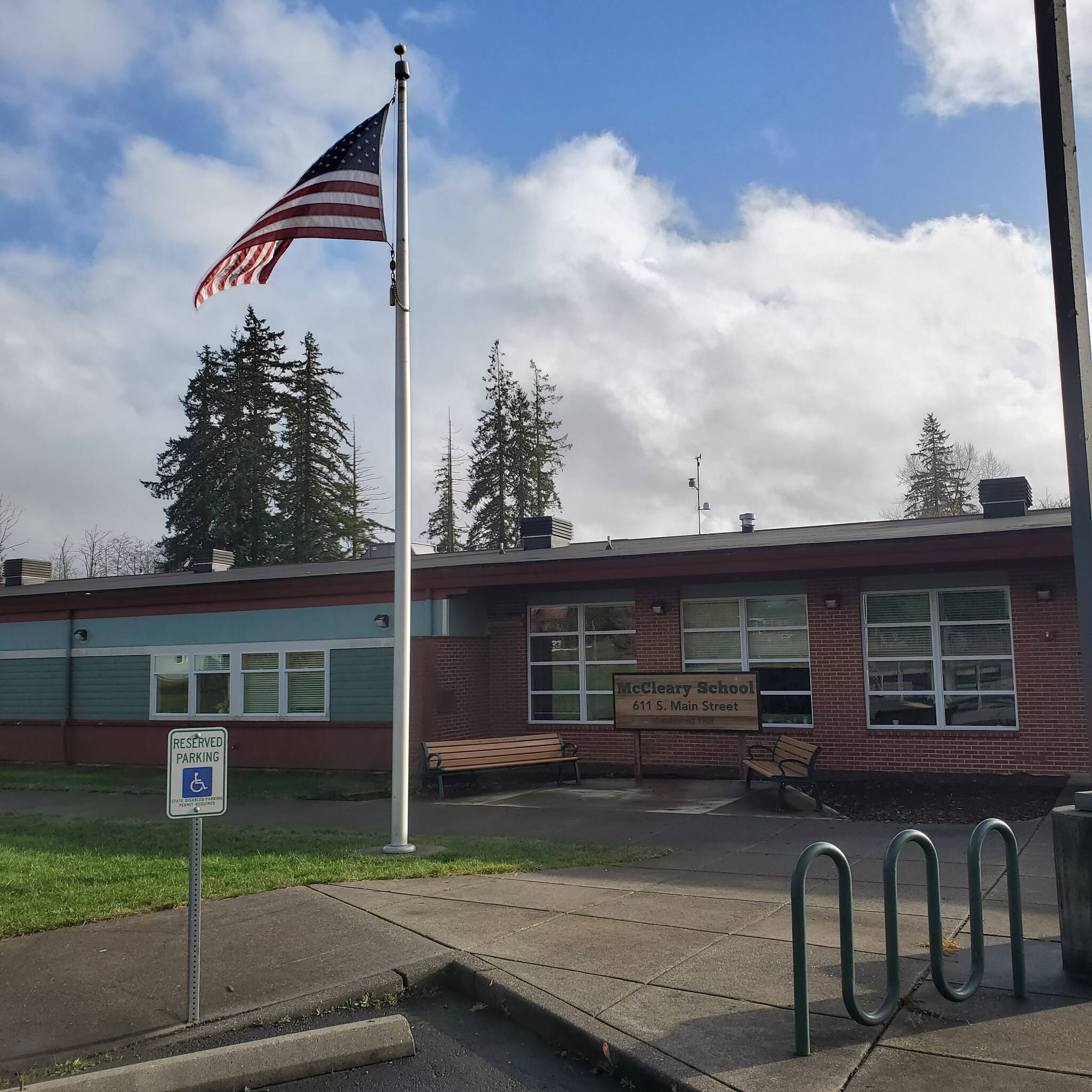
The McCleary School District (MSD) is among five school districts in Grays Harbor County asking voters on Feb. 10 to approve replacement educational programs and operations (EP&O) levies.
Voters within the MSD will also decide whether to approve a 20-year bond to fund much-need capital improvements to the school.
During January and in the first week of February, the MSD held six drop-in info sessions and created a webpage to provide information on what the levy and bond, if approved, would fund. Programs being funded by the EP&O levy are preschool, athletics, arts and music, science and technology, food services, non-high payments, staffing and support. Currently, the District serves 332 students in pre-K to 8th grade.
Superintendent Susan Zetty, who has been with the MSD for four years, and Business Manager Tiki Willey led the info sessions.
The MSD is seeking a two-year levy, because with the state funding decreasing, it’s hard to commit farther than two years out, Zetty said.
Of the District’s funding sources, 73% is from state funding and grants, approximately 18% from the current voter-approved local levy, 7% from federal grants and 2% from other funding sources.
The amount of state funding that all schools receive is based upon the prototypical school model. Developed by the Legislature in 2009 and amended in 2010, the model reflects the current economic or staffing reality that schools grapple with. For example, under the prototypical school model, the MSD receives funding for five to six classified positions, which include custodians, office and kitchen staff and paraeducators.
However, for the MSD to fulfill its mission of providing “educational opportunities” and to “create a safe, respectful environment for all students where their individual needs academically, socially, and emotionally are met” requires 22 support staff and 47 staff.
Additionally, the materials, supplies and operating costs of running the school, such as utilities and insurance, keep going up — specifically the cost of insurance has doubled, Zetty said.
“The funding that we’ve received has not kept pace with that and so again, this levy is in some ways trying to do a stopgap,” said Zetty. “Essentially, it’s not even covering the full cost of what [we] are having to subsidize.”
One line item in the MSD’s budget is paying the schools where the 114 students in 8th to 12th grade within the MSD’s service area attend; this generally averages a little over $200,000 per year.
“People don’t realize that when our students go to high school somewhere else, we are responsible for paying them,” Zetty said. “And you pay, whether or not your levy passes.”
And the amount that’s paid is determined by that school district’s levy. For example, the District pays a lower amount for students attending Elma than those attending Olympia.
If the proposed levy is passed, it will replace the current levy set to expire on Dec. 31, 2026. The amount collected each year would be $1.4 million in 2027 and $1.5 million in 2028. In the presentation that Zetty and Willey prepared for the informational sessions, a slide said that the “tax rate would not exceed $2.50 per $1,000 of assessed value.”
For what voters could anticipate paying each calendar year:
For property valued at $450,000: $94 per month/ $1,125 per year
For property valued at $500,000: $104 per month/ $1,250 per year.
For property valued at $550,000: $115 per month/ $1,375 per year.
The MSD would also receive local effort assistance (LEA) funds, which is also called levy equalization. It’s funding that the state returns to property-poor communities; however, this levy equalization funding is contingent on the levy passing.
“If you don’t have a levy, you don’t need it, because you don’t need to be equalized with everybody else,” said Willey. “But if you have a levy, you get equalized and it assists. It is bizarre.”
Zetty added, “Even though you went out for [a levy], but it failed that assumes then people don’t think you need it.”
In 2024, through the LEA funds the MSD received $1,942 per student.
To supplement levy funding, MSD teachers and staff actively pursue grants. For the Community Partner Education Grant’s 2025-2026 grant cycle, McCleary teachers received $4,218 in grant funding. Additionally, Teneille Carpenter, coordinator of systems development and implementation, does a lot of grant writing.
“We’re really getting into the groove of applying and receiving grants,” Zetty said.
The MSD did submit an application for the Office of Superintendent of Public Instruction Small Schools Modernization grant, and while they haven’t received it yet, Zetty said they aren’t out of the running. [This is the grant that the Satsop School District received last year.]
Zetty also said they look for opportunities to save money and are open with their finances. People “might not agree with something that we’re spending money on, but we’re going to be open up and explain,” she said. “Sometimes, you’re spending money on something because it’s a law.”
Where the proposed replacement levy is for learning, “bonds are for building,” is how Zetty described what the proposed bond would fund. The last major remodel was 20 years ago, and three years ago, the downstairs and gym were expanded and remodeled, Willey said.
Examples of building the bond would fund include an auxiliary gym, safety and security updates, including a vestibule that would provide additional security, playground modernization, educational technology upgrades and urgent repairs and maintenance, including drainage.
A community survey conducted in summer 2025 identified that safety and security systems were a high priority, as was the gym, and improving the playground, building and grounds.
To tackle the work, MSD will use a “progress design builder” approach where the contractor and architect are working together on the projects. This approach is best, Zetty said, because many of the updates, such as updating the playground surface, building an auxiliary gym, and improving parking, are all connected and its best to work on all of them together.
In spring 2025, the MSD put out a request for qualifications and hired Construction Services Group at ESD 112 as project manager and NAC Architecture. Last fall, both Construction Services Group and NAC Architecture did a facilities walk through.
If passed, the bond would collect $19.3 million from 2027–2045. The anticipated tax rate would be $2.22 per $1,000 of assessed value.
“If it passes, then that’s where we have to bring those people together that I mentioned earlier and prioritize so that we are maximizing our dollars and we’re being very responsible with our funding and with our priorities,” Zetty said. “We feel a very big responsibility to be really fiscally responsible for people’s funds. I don’t ever want to forget we’re dealing with real people and money.”
A reason that drainage is specifically called out as part of the urgent repairs and maintenance to building systems is because MSD experienced flooding events in recent years. And a downstairs custodial closest has been out of commission due to an ongoing leak beneath the floor that is causing the water level to raise.
MSD has to worry when it rains a lot that their sump pump will keep up and not flood downstairs, said Zetty.
“After the first flood, the construction got a group of people to come in and they chopped all that out to do the test, cameras down the lines, all the things,” Willey said.
Added Zetty, “We can’t close it up. We need to resolve it first, and water issues are never inexpensive.”
The latest near-miss flooding incident occurred on Dec. 17, when the power went out overnight. The maintenance/custodial lead came to the school at 1:50 a.m. to check the status of the water level in the custodial closet. With the pump not working because of the power outage, the water had risen nearly to the floor level. Until the power came back on, which Zetty estimated was around 7 a.m., the custodial lead bailed out the water so the students and staff wouldn’t arrive to a flooded downstairs.
Also in the downstairs, “there’s also a little middle school commons area [and] it’s also sinking on one end,” Willey said. “The gap has grown from just really close to the locker and the ceilings to maybe about 3/4 of an inch.”
The other major upgraded needed is the HVAC system that is 20 years old and it’s getting expensive to maintain.
“People think of schools and they think of kids in education,” said Willey. “There’s a lot more to it.”
In closing the presentation, Zetty said, “This is really a very special and unique school community. Just the people are very proud of being part of it. Our kids are just really wonderful.”
Ballots
Ballots must be returned by Feb. 10 to be counted. EP&O levies require a simple majority (50%-plus 1 vote) to pass. Bonds require a supermajority (60%-plus 1 vote) to pass.