
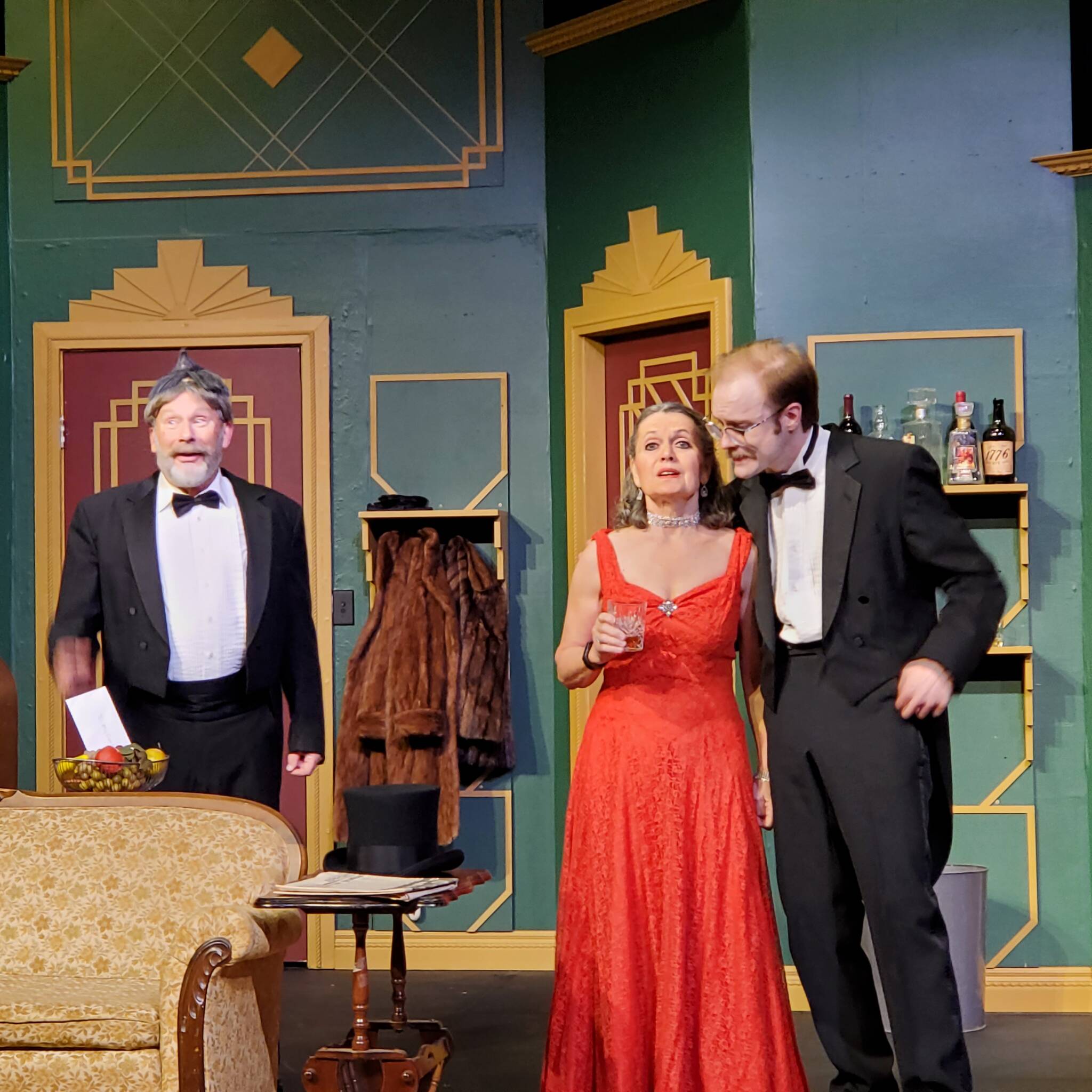
Given that Kong’s Night Out is inspired by the original King Kong, which was released in 1933, the set is a hotel suite decorated in the art deco style.
And because it’s a farce, the set features seven doors that are integral to the plot. (It’s through one of the doors that the showstopper prop designed by Shannon Weidman will burst through.)
Kong’s Night Out is directed by Alex Eddy, who has been involved with Aberdeen’s Driftwood Players since the 2011-2012 season when he performed in Glorious! and The 25th Annual Putnam County Spelling Bee the following season. In those productions, he was the actor, but it was during a summer program at the Bishop Center where Eddy began watching Brad Duffy, president of Driftwood Players, while he directed.
“I just remember, watching him walk around the stage looking up all the time at the lights, and I always wondered what is he looking for, what is it that he’s looking at?” Eddy said. “I think it was in 2014, I finally asked him if he would mentor me here at Driftwood, and we did Calendar Girls. And that was when I officially became a director.”
In the subsequent decade, Eddy has since directed at least 10 plays or musicals with Driftwood Players, but “when I get a chance, I still like to sneak in on stage sometimes,” he said.
Kong’s Night Out, which is written by Jack Neary, is a fairly recent play, less than 10 years old, and there are few snippets of it available on YouTube.
“Part of why I wanted to do it was because I read the play and I wanted to see this,” said Eddy.
As a preview to opening night on Friday, Feb. 13, The Daily World chatted with Eddy and a few of the actors before their dress rehearsal on Feb. 10.
What follows is our conversation edited for length and clarity.
The Daily World: Noah [Johnson] why did you audition for the role of Little Willie?
Johnson: The moment I heard this show picked, I think I messaged Alex that night and I was like, you should be expecting me because I have loved the ’30s King Kong since I was really little. I used to go over to my grandparents and watch it over and over again to a weird degree for a young child to watch nowadays.
And it’s something that I felt like hadn’t been done before on stage. There is a King Kong musical, but outside of that, I feel like no one’s really taken advantage of the comedic potential.
TDW: I’ve only seen snippets of the ’30s version of King Kong. How familiar do you need to be with the movie to follow this play?
Eddy: If you came into this not knowing anything about King Kong, you would still leave really happy and really enjoy the show, because, essentially, they explain the entire plot of the movie throughout the play. If you know the movie pretty well or have just a vague idea of what the plot is, you’ll get more enjoyment out of it. But you definitely don’t need to have to come in being professor of King Kong lore. The point of it is to make you laugh, and it does that.
Johnson: It rewards the people who have seen it because it definitely ties it together. The play is structured to line up with the entire third act, everything after they leave Skull Island, basically.
TDW: Do you know why Jack Neary decided to mine King Kong for comedic value?
Eddy: I don’t think I’ve seen any interviews with him.
Johnson: The only things I could say would be conjecture but maybe he saw something in the story that not a lot of people have taken advantage of. I friended him on Facebook.
Eddy: That’s been actually one of the fun little sagas of the rehearsal processes. As soon as the cast announcement came out, Jack Neary liked the Facebook post, and I think he commented saying this is a great cast. That’s never happened to us before, where the playwright actually is interacting with us.
Johnson: He screen grabbed the poster and he put it up on his Facebook page. It’s really cool seeing a director going out and supporting these small community theaters trying to put on his shows. You can tell that he’s a guy who’s very genuinely passionate about what he’s created; he loves this movie.
TDW: What drew you to the character of Little Willie?
Johnson: He is such a weird dichotomy of characterization. He’s the brain and the brawn of the group somehow at the same time; he can throw down if he needs to but he’s also a walking dictionary. It’s just a very, very, funny role overall.
TDW: What are the challenges of directing a comedy versus a drama versus a musical?
Eddy: Honestly, it’s funny because I think audiences would think that it’s the opposite, but the dramas compared to this are so easy. As far as acting goes, making someone cry versus making some laugh are two very different skill sets. Comedy is heads and tails harder, because there’s so much more to it: the timing, how do you say the line and you have to understand the joke. When you’re in a comedy, you want to be funny, but as soon as you’re trying to be funny, audiences see that, then they’re going to stop laughing at you. But I think once you are just this character and you’re doing what this character would do in this situation, if it’s a well-written script, the jokes are there. You just have to let them land.
Johnson: This is maybe my eighth or seventh show, and I find that dramatic acting is easier because you can draw from your own personal pain or grief you’re trying to convey. But when it comes to comedy, that’s really when you have to step into a character and completely change how I think about the situation. That’s the thing that makes or breaks it too. What I don’t know if either of us have said is that interplay you have to have — that bounce back and forth — or the comedy doesn’t work. This is a farce. It is all about those misunderstandings, miscommunications, misinterpretations of the situation. And if there’s nobody to misinterpret from, the comedy is just not there.
TDW: How did you approach designing the set?
Eddy: I met with Monika Kuhnau, our set designer, in the shop downstairs. They have a little model that actually has blocks so we got to play with these wood blocks. Because when you have to have seven doors, where are we going to put them all? Once we figured out the general layout, then it was labeling, and once you do that, then it’s making sure that the cast doesn’t forget.
TDW: What does having many doors mean for the actors regarding how they move around on stage?
Eddy: As far as staging goes, more doors definitely does make it a little more challenging. It’s a farce and so, by definition, there has to be one door’s closing, the next door’s opening. Everyone has to know exactly which door they’re going to .
Johnson: I wish I could say from the actor’s perspective that it was a very meticulous and thought-out thing, but it really comes down to when we’re doing blocking or running a scene, I’ll hear, ‘Nope, wrong door. Let’s just run back out.’
TDW: What interested you about auditioning for the Daisy, Julayne?
Julayne Fleury: Because she’s hilarious. She’s not the brightest crayon in the box, but I’m also not the dumbest character in the show, but it’s close. Also, the director asked me to do this upstate New York hokey accent that sounds very Midwestern with Canadian influences. That’s super fun because I’ve never done that type of accent before. I get tangled into the scheme of the show where they disguise me as Anne Darrow so Kong will go after me instead. And then I get to use the best prop in the show: the Tommy gun. Alex told me it’s my action hero moment in the show, and I’ve never gotten action hero moments in a show before. I wanted to audition for this show and be any role because I love farces and fast-paced comedic dialogue. I jump on any chance to be able to do that because it’s a great challenge and super fun. And it’s so fun being in a comedy because the audience has bigger reactions, and you feed off of that with. A play is never complete without the audience.
TDW: Monica [Ewing], what attracted you to the role of Sally, the producer’s mom?
Ewing: She’s sarcastic, and it’s not a bad fit for my real personality, except I’ve never been a stripper, and Sally is a former stripper, which comes out several times in the show. One of my grandsons says, ‘Why do you keep getting cast in these parts as stripper or something?’ I go, ‘It’s either that or a nun.’ Alex Facebooked me and said, ‘Hey, I think you’d be great in this role.’ And once I read the script, it was hilarious. I generally do musicals and wasn’t going to audition this time of year because I was going to take a break, but I’m really glad I showed up for the auditions.
TDW: And to you Ed [Logue] why did you decide to audition?
Logue: I like a smaller role, and Alex said this character role [Sig Higginbottom, a Hungarian investor in the play] would be a good fit for me. It’s been six years since I have been in play, and this was a perfect fit. The whole thing about theater is you’re a team, like a sports team. Everybody works together on it. Certain people have more lines and bigger parts, but it doesn’t work unless everybody’s on board the same thing. And it’s so much fun. Even if you have a smaller character part like I have, it’s still a blast.
TDW: In speaking with casts of other plays, I am struck by the camaraderie that comes across during the interviews.
Ewing: I don’t know how many shows I’ve done in the last 30 years at Driftwood and Bishop, but you get a cast sometimes that just hits and it’s life changing.
Logue: Yeah, we got a good one this time.
Johnson: Depending on the night, it could be like having a second job, but by the end of it, you feel like you have a second family.
Logue: I’ve been a sports guy forever, doing rec sports and stuff. And when I started doing theater, all my friends go, ‘You’re in theater?’ I said, ‘Yeah, you should come to it.’ Most guys that I know aren’t theater people, and when they watch the show, they go, ‘My gosh, what have I been missing all these years?’
Kong’s Night Out will be performed Feb. 14, 20, 21, 27, 28 at 7:30 p.m. and Feb. 15, 22 and March 1 at 2 p.m. https://main.aberdeendriftwood.com/