Washington residents wouldn’t normally welcome a week of rain amid a stretch of sunny summer weather.
With Washington’s wildfire season in full swing, however, state officials were excited to see rain in the forecast.
“The No. 1 way to reduce fire danger is to rain on it,” said Matthew Dehr, wildland fire meteorologist at the Washington State Department of Natural Resources.
Firefighters could be “dropping hundreds of gallons of water from helicopters, from scooper planes” on wildfires,” Dehr said, but “it doesn’t compare to getting a half an inch or an inch of rain …”
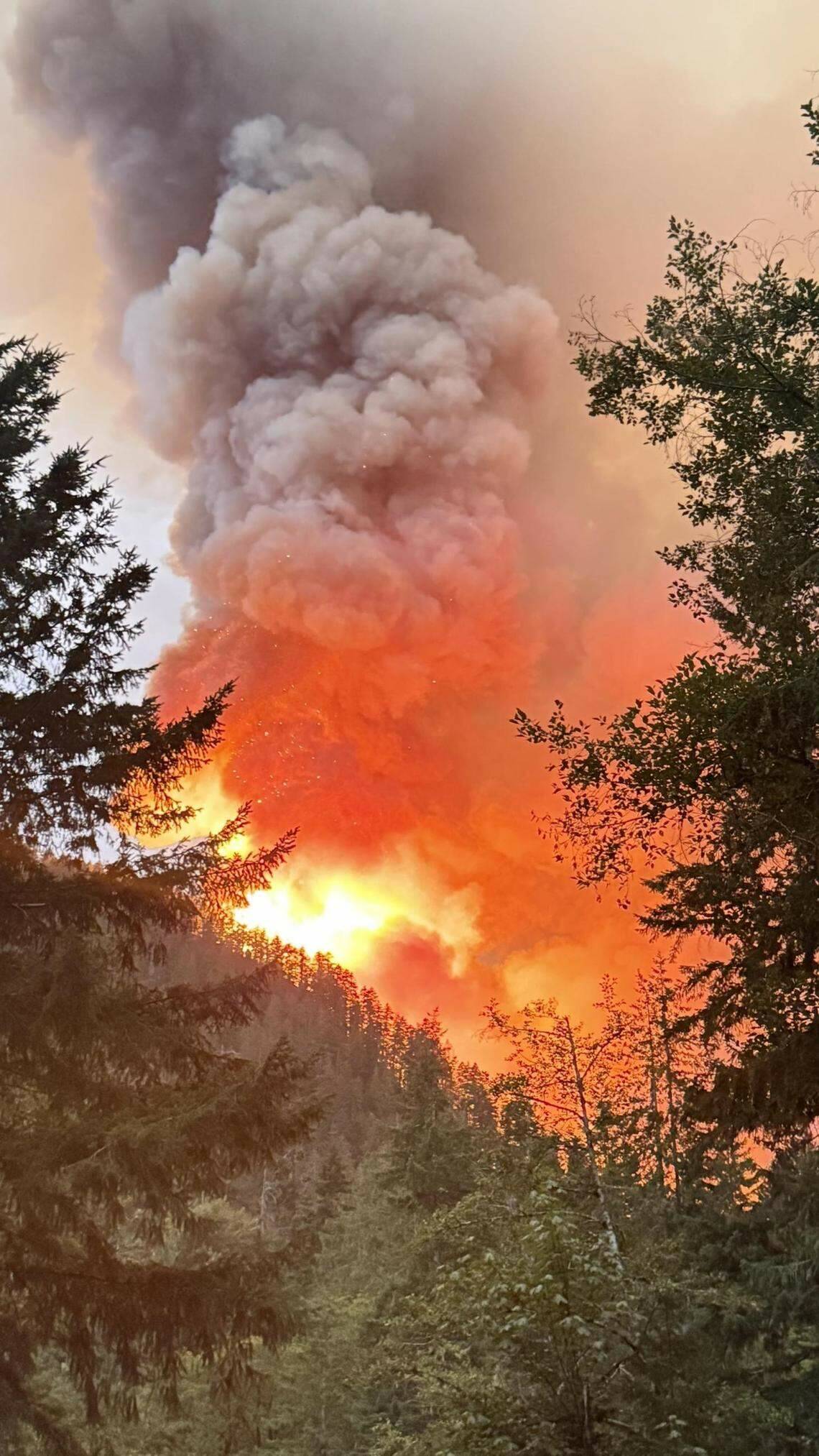
The Bear Gulch Fire sparked in early July near Lake Cushman in Olympic National Forest. As of Thursday, Aug. 14, the wildfire had spread to a total of 8,257 acres and was just 3% contained, according to InciWeb.
“Across the state right now, we have really quite a noticeable lack of large fires on the landscape,” Dehr said. “The most noticeable one is going to be Bear Gulch …”
The Bear Gulch Fire is more than twice as large as the Pomas Fire, which had burned 3,533 acres near Lake Chelan as of Thursday, according to InciWebs. The Burdoin Fire near the Washington-Oregon border had scorched 10,675 acres as of Thursday and was 94% contained.
Dehr said that firefighters have struggled to contain the Bear Gulch Fire, which has impacted air quality across the Puget Sound region, due to its location.
“The main struggle with that one is that it’s burning into super steep, inaccessible terrain,” Dehr explained. “All of the firefighting efforts really are focused on containing the areas around the national park structures, around the houses and around the recreation areas there.”
According to the National Weather Service’s latest seven-day forecast, there was a 70% chance of rain in Western Washington on Thursday, with a 10th to a quarter-inch of precipitation possible. By Friday morning, Western Washington will have a 90% chance of rain, the weather service said, and the probability of rainfall rises to 100% by Friday night. Western Washington could see up to 1.25 inches of rain on Friday alone, according to the forecast. Chances of rain drop to 70% on Saturday, when less than a 10th of an inch of rain is expected to fall.
Although Dehr doesn’t expect the rain to put the Bear Gulch Fire out completely, he thinks it will help firefighters get the blaze under control. The Bear Gulch Fire is “just so established” and “so dense with fuel that I doubt that it’s going to fully put it out,” the meteorologist said. “It would take, likely, a very hot and dry period with no precipitation for a week, two weeks, to get (the fire) back up and going.”
Dehr expects the smoky air that’s plagued Western Washington from time to time since the fire began to largely go away as well.
“I think that it will be an immediate benefit,” Dehr said. “You should see less smoke,” he added. “There should be less days where the sky is all hazy in the immediate vicinity of the fire.”
Areas in the immediate vicinity of the fire, including Lake Cushman and Hoodsport, could “still get some residual smoke,” he said.
According to Dehr, the rain could extinguish several of the smaller wildfires burning across the state.
“All the smaller incidents, especially in Western Washington, really should be pretty much wrapped up with this rain event,” Dehr said.
Eastern Washington isn’t expected to get quite as much rain as the western side of the state, according to the National Weather Service. The weather agency’s latest seven-day forecast for Spokane called for a 40% chance of rain on Friday night and a 60% chance of precipitation on Saturday. Kennewick will have a 30% chance rainfall on Friday night and a 50% chance of rain on Saturday, the weather service said.
Although the east side of the state won’t “get quite as much rain from the system,” Dehr said, “They will benefit from the cooler temperatures, the cloud cover, the increasing moisture.”
That means “a lot of the fires over there should be wrapped up and contained,” he said. “As we go into the back half of August, there’s still plenty of potential to get new fire starts, especially east of the Cascades,” Dehr added.
The famously rainy state is facing longer, hotter and drier fire seasons, raising the risk of a mammoth fire that will be nearly impossible to fight. All the state can do is prepare.
While the rain is expected to put a dent into Washington’s wildfire season, blazes could still have time to start — or reignite —before the weather cools off.
“If this were mid-September, and we (got) this wetting rain … then that’s when we would start talking about the end of fire season,” Dehr said. “Right now, even with a couple inches of rain in the Cascades, a hot and dry pattern could absolutely get us back to burning by early September.”
However, wet weather could buy wildland firefighters across the state valuable time as the rainy season approaches, experts say.
“Even if we go from this rainy period into a warmer and dryer period for Western Washington, it’s still going to take at least two weeks to get the fuels back to the level of dryness that we’re seeing right now,” Dehr said. “So it really is a very good buffer, especially at this time of year, which is typically our hottest and driest.”