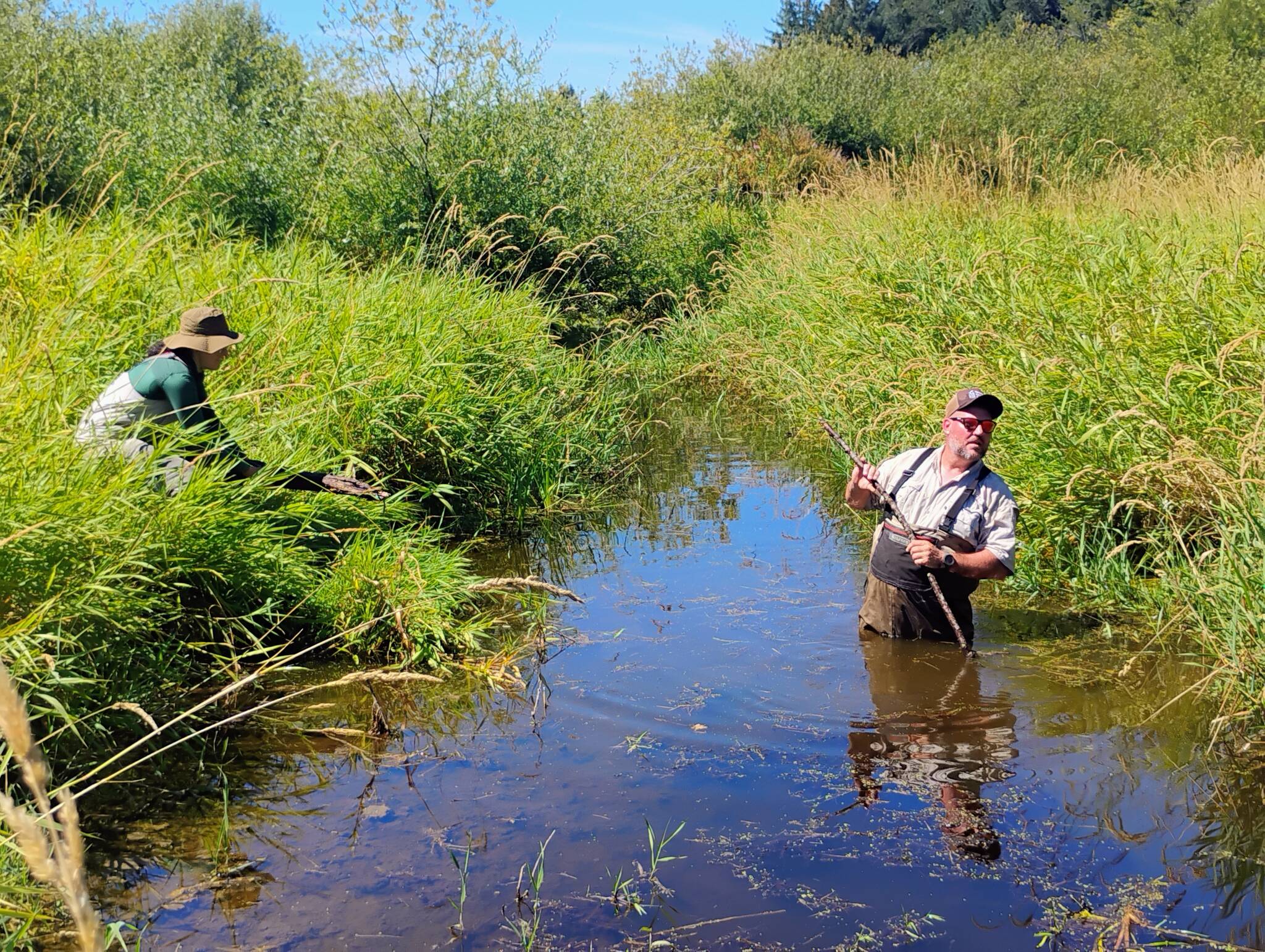
Since joining the Olympia-based nonprofit Ecostudies Institute earlier this year as an intern, Aberdeen-resident Jason Wintersteen has assisted on prescribed burns, wetland delineation surveys, and bird surveys. Restoration ecology is his passion, and these hands-on experiences complement the ecology courses he’s taking at The Evergreen State College.
“It’s been awesome because there’s so many subject matter experts, like Sarah Hamman, who teaches an ecology master’s program at Evergreen,” Wintersteen said. “And being in this internship is like riding on the shoulder of giants.”
Wintersteen served in both the U.S. Navy and U.S. Air Force, and after seven years of seeking an entry point for a career in restoration ecology, he is now on the path because of the Veterans Conservation Corps (VCC).
Established by the Legislature in 2007, the VCC is a program within the Washington State Department of Veterans Affairs.
“We empower veterans to continue their service after transitioning from the military by engaging in meaningful work, conserving and restoring our natural ecosystems with our environmental conservation and agricultural community partner organizations,” said Kim Pham, the program manager of VCC and an U.S. Navy veteran.
The program’s mission is based upon U.S. Marine Corps veteran John Beal’s experience after returning home from the Vietnam War.
“He had some health issues and his doctor let him know that he wasn’t going to live very long if he continued the way that he was,” Pham said.
At the time Beal lived near Hamm Creek, a tributary of the Duwamish River in Seattle that was quite polluted after decades of industry activities. He began pulling the trash out of the river to clean it up.
“He realized that at some point, as he was doing this by himself, he felt a general increase in his mental and physical well-being from doing the physical work [and] tangibly seeing that he was able to make a big difference and do something good with his hands,” said Pham. “And at some point, he realized that he couldn’t do this alone. … Having a shared purpose and mission, that just heightens the opportunity and capacity for healing.”
For its first nine years, the VCC connected veterans to volunteer opportunities available with natural resources organizations, and in 2016, VCC added a paid internship program. Pham was among the first veterans who participated in the internship program.
“When I decided to do that internship, I was in a phase of transition from the military. … I served in the Navy as an engineer and came out realizing that the hard skills on my resume didn’t necessarily translate into what I actually wanted to do and the person I wanted to be outside of the military,” said Pham, adding that “the internship was a really great opportunity to explore something different, something that I really connected to because nature and the environment was critical to my well-being during my service.”
Wintersteen had a similar experience while serving in the Air Force. Trained as an electrician, while in Alaska he assisted on Superfund cleanups sites from World War II. Seeing the restored creeks with salmon spawning in them “created a spark,” Wintersteen said.
After being discharged from the U.S. Air Force in 2018, Wintersteen found a position with Oregon Department of Fish and Wildlife at a fish hatchery that got him into the natural resources field but there wasn’t an opportunity for advancement because he only had a two-year degree in fisheries. Additionally, most positions within restoration ecology require a combination of a degree and experience, which he didn’t have.
Accepting a scientific technician position with Washington Department of Fish and Wildlife brought him and his wife to Washington where they had wanted to live and eventually, Grays Harbor. When that job ended, Wintersteen fell back to electrical work with a position at Tacoma Power, which he described as not feeling as “self-accomplishing.”
While searching for restoration jobs, a Google search took him to the Veterans Conservation Corps (VCC) website, and Wintersteen didn’t hesitate in applying to the program. Shortly thereafter, he was working for Ecostudies Institute as a paid intern while attending Evergreen full-time.
“Most jobs you come out of [from the military], you have the education, but not the experience, or you have the experience, not the education, and the VCC gives you the opportunity to have both,” Wintersteen said.
Added Pham, “This internship requires no prior background or education in environmental conservation, which is very rare in terms of finding a paid conservation [job].”
A VCC cohort generally consists of 15 to 20 veterans, and they are placed among the 24 community partners that VCC works with. The internships can last from two to three years based upon the veteran’s preference and the community partner’s needs.
A crucial aspect of VCC, Pham emphasizes, is the community partners, which can include federal, state, county or nonprofits.
“When we partner with an organization, they’re creating brand new opportunities that weren’t existing before,” Pham said.
And she’s seen instances when the organization later creates a position so they can hire the VCC intern.
“Which is a big feat for some of the organizations that we partner with,” she said. “And so it shows that they really value the interns that engage in this program.”
In addition to providing veterans an entry into a career in conservation, their VCC internship provides access to DVA resources.
“A standard part of our internship program is when an intern enrolls in our program, we directly connect them to their accredited local veteran service officer,” Pham said. “And we require that they meet at least once to establish connection, and then from there, whether or not the veteran decides to pursue accessing their earned benefits or whatever veteran resources they need is up to them.”
Looking ahead, Pham wants to grow the program and ensure long-term stability and funding sources for the internships. Internships are currently paid for by a combination of state funding and grant funding that partner organizations secure.
“I would love to have at least one environmental conservation opportunity in every single county of the state,” she said.
“I wish more people would know about it because I just helped one other person get into the program and they weren’t aware that it existed,” said Wintersteen, adding “I wish it was bigger than what it was … [through VCC] you’re getting a sense of community and you’re meeting people who are like-minded, that understand that we need to take care of our home.”
Eventually, Wintersteen hopes to get a job with the Grays Harbor Conservation District, because the stuff they do “is so awesome.”
To learn more about VCC, visit www.dva.wa.gov/vcc. There is an application process to join the program, and there is no limitation of how long a veteran has been separated from the military to participate.