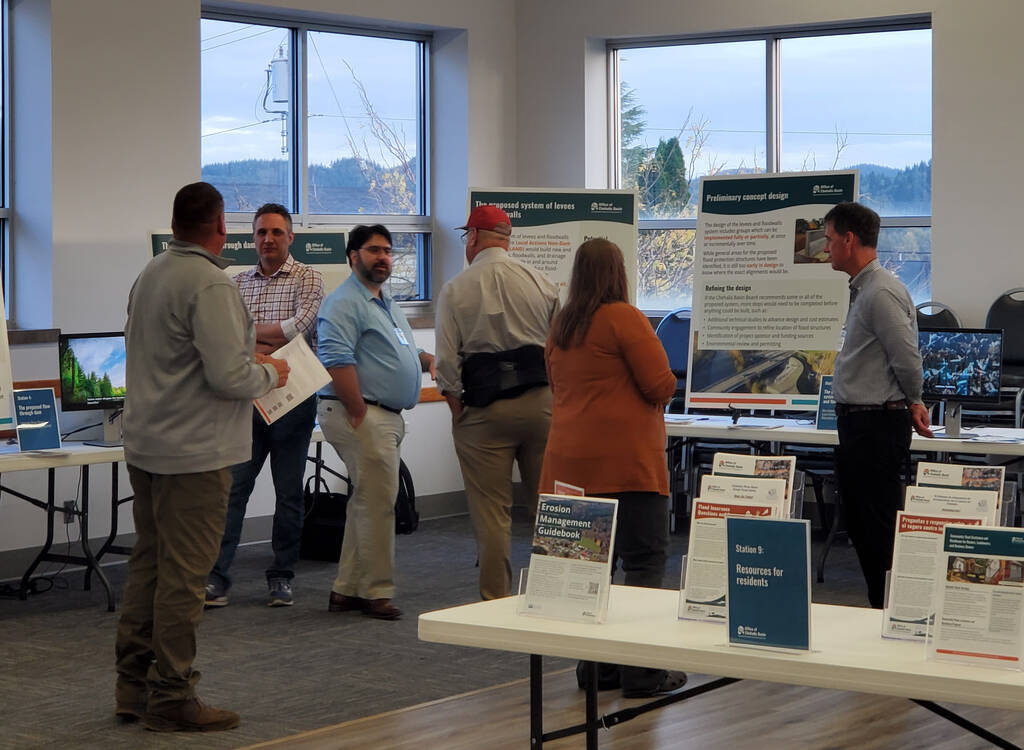
Earlier this month in Montesano, the Office of Chehalis Basin held the second of two open houses for the community to learn what’s been accomplished thus far and to provide feedback on the long-term Chehalis Basin Strategy that the Chehalis Basin Board (Board) will expand next year.
For those unable to attend open house in Montesano or the first open house held in Centralia on Sept 25, a virtual open house option and feedback submissions is available through Oct. 31.
The Board is comprised of seven voting members charged with developing the Chehalis Basin Strategy and identifying projects to fund. Grays Harbor County Commissioner Vickie Raines is chair of the committee, and other committee members include representatives from the Chehalis River Basin Flood Authority, Quinault Indian Nation, Confederated Tribes of the Chehalis Reservation and Office of the Governor. There are five ex-officio members representing Department of Fish and Wildlife, Department of Natural Resources, Department of Ecology, Department of Transportation and the Washington State Conservation Commission.
In 2026, the three issues that the Board will consider are:
How much should be invested in aquatic restoration for the next 30-plus years?
Are large-scale structural flood option(s) needed for the upper basin, such as a proposed flood-control dam near Pe Ell, a system of local levees and floodwalls in and around Chehalis and Centralia, or some combination of both?
What is the best pathway for the Skookumchuck Dam going forward?
What follows is a conversation with Curt Hart at the Montesano open house on the Chehalis Basin Strategy and how the feedback gathered at these open houses will be used by the Board; Hart is the communications manager for the Washington State Department of Ecology, The conversation has been edited for length and clarity.
Question: Can you provide an overview of what is the Chehalis Basin strategy?
Hart: The Chehalis Basin strategy is a two-fold thing: how do we reduce damages from floods; and how do we restore salmon and aquatic habitat because salmon aren’t the only important aquatic species.
The Basin is home to 14 different amphibian species, which is the highest diversity of amphibian species any place in the state. And we have three species of salmon, steelhead, rainbow trout, lamprey, and other aquatic species that are really important, economically, culturally and recreationally.
People here take a great pride in saying, ‘I own land and can go down to my river once or twice a year, I can see salmon.’ And when that stops, that’s something. We know that salmon runs have been dwindling in the Chehalis River Basin for the last century.
And flooding is probably going to just get worse; this is what scientists in Washington, University of Washington Climate Impacts Group are saying. All our modeling, our predictions say flooding is going to go up, and they’re going to be worse in nature, more dangerous and stronger.
Question: How will the proposed flow-through dam near Pe Ell impact downstream communities such as Montesano?
Hart: If the dam were to be built, it would really do a lot to control the impact of flooding in the upper basin from Pe Ell past Centralia and Chehalis. It would basically just have open river running right through it unless there were a major flood, then the gates would close and hold back water temporarily until the flood would dissipate and it would be safe to return the water back into the region.
It wouldn’t stop all flooding but the thought is, if it were to be built, it could alleviate the immediate effects of floods, especially for towns like Pe Ell, Centralia, Chehalis, and the upper basin. That would have an effect on the lower basin, because if you’re holding back flood water and it’s not going down, then there would be a benefit to the river system.
Question: At the Centralia open house, what were some of the questions the attendees had?
Hart: People were very interested the proposed Chehalis River flow-through dam because that would be just up the road from there. They were really interested in the proposed system of levees and floodwalls, and we had some questions about the Skookumchuck Dam.
One of the things that the Office of Chehalis Basin and the Chehalis Basin Board both support is the North Shore Levee Project, which lost federal funding through FEMA.
The Board worked with the Legislature and in the last two years, they managed to get $35.5 million in state grants, so it’s not dead by any means. And we’re strong proponents of it because it would really help the cities of Aberdeen and Hoquiam.
Question: What will be the next steps then after this open house?
Hart: We’re going to take the comments and we’re going to compile those for the Board to consider as they start looking at what should be parts of their strategy. Do we want to have this flow-through dam proposal? Another big question, what should we do about the operation of the Skookumchuck River Dam? That dam is not owned by any public entity, it’s owned by TransAlta and there would have to be negotiations with TransAlta because there are water rights involved.
It’s really these big issues. What do we do moving forward? How much do we continue to invest? The Legislature since 2017 has provided about $340 million for the Chehalis Basin Strategy, and we’ve approved 140 projects that are successfully reducing damages from floods, protecting businesses, and restoring habitat.
Question: What’s the breakdown of investments in habitat restoration versus protecting infrastructure?
Hart: The spending that we have is about half and half. We can spend millions and millions on artificial solutions to try to control floods, where if we go in and restore habitat for salmon and other species, that also helps control floods.
Because floodplains help control floods; they help widen things out, create new channels, and open up oxbows that used to be closed. All of that slows down the floodwater, and that gives the flood a chance to do what it did before Europeans arrived here.
Question: What do you foresee the level of funding will be going forward?
Hart: We know that times are tough but the Legislature did give us $70 million for 2025-2027, which is comparable to previous years.
Question: Will $70 million be enough to accomplish the proposed flow-through dam or the levees?
Hart: That’s a good question, and it’s going to take partnership, and it’s going to take people knowing what’s going on, and it’s going to take a lot of planning and a lot of evaluation assessment to make sure that what we’re proposing is workable and doable. That’s why we need the public to understand what’s going on.
The virtual open house is available at https://openhouse.officeofchehalisbasin.com/.