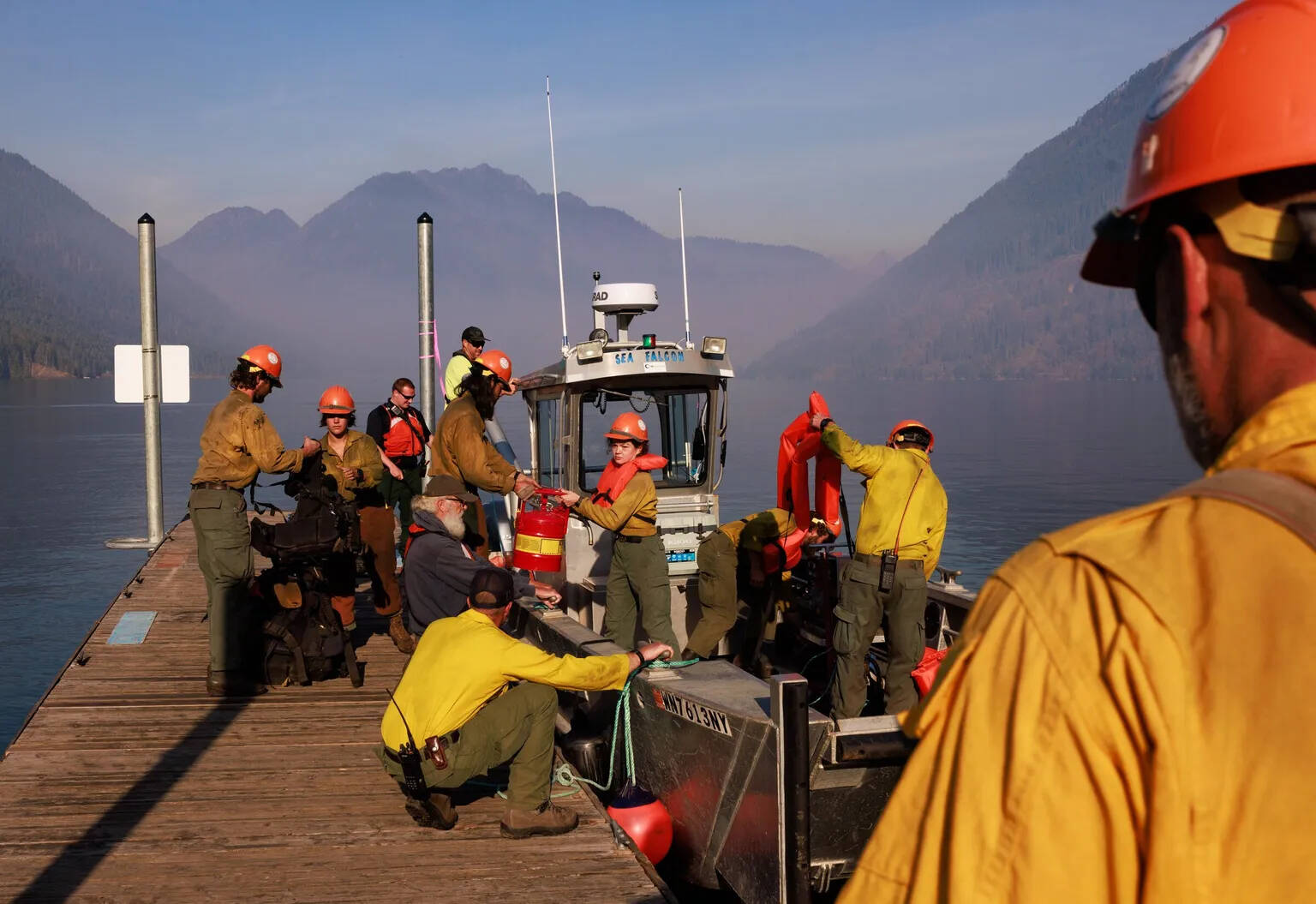
Despite 434 firefighters and support crew battling the Bear Gulch Fire on the north side of Lake Cushman, the wildfire continues to grow, up to 8,702 acres as of Monday, with only 13% contained.
Hot and dry conditions resulted in increased fire activity Sunday. The same weather pattern remains Monday with expected fire perimeter growth in the northwest and eastern areas of the fire near Seven Stream and Slate Creek. Aircraft will continue to drop water in these areas to help mitigate fire spread. Smoke production will be especially heavy overnight and into Tuesday morning until the inversion lifts around noon. This pattern is expected to continue for the next few days.
Currently there are seven helicopters assigned to the fire. There is a Temporary Flight Restriction over the fire area. Personal aircraft and unmanned aircraft, like drones, are not allowed within the restricted zone. If you fly, air operations must be grounded for safety inhibiting firefighting efforts. Along the northwest shore of Lake Cushman, there is a heavy presence of fire personnel maintaining structure protection systems such as pumps, sprinklers and handline.
The recent increase in temperatures will result in more active fire behavior in the next few days. Firefighters have been preparing for active fire behavior and the compounding effects of the hot and dry weather.
On Monday, fire behavior was expected to be active to very active with upslope fire spread, flank runs, torching and short ridge spotting. Heat sources are spotty and could rekindle for an active fire spread day. Multiple drainages on the fire are expected to become more active.
A heat advisory was issued through Monday evening. Later in the week, a gradual cooling trend will begin due to a low-pressure system developing off the Gulf of Alaska. This system will gradually increase humidity later in the week for the area.
Most of the fire’s growth happened over just seven hot and dry days since it sparked July 6, from a human cause that’s still under investigation. At one point it sent a column of smoke nearly 30,000 feet into the air, visible from as far as Seattle and Aberdeen. Popular hiking and camping areas remain closed. So far, homes and buildings have been spared, and no one has been injured.
The fire is the biggest on the Olympic Peninsula since 1951, said Jeff Bortner, a fire management officer representing both Olympic National Park and Olympic National Forest.
“Generally, our fires are within the natural range of variability,” Bortner said of fires on the east slopes of the Olympics. “The current Bear Gulch fire is testing that theory a little bit because it’s certainly bigger than anything in the historical records.”
This part of the forest gets an average of about 100 inches of rain each year. That, coupled with long periods without fire, means a lot of dense fuel is available for the flames, compared with drier areas.
Unlike fires that explode in the flashy fuels of Central and Eastern Washington, Western Washington fires typically smolder in the duff — the dense, peaty layer of partially decomposed moss and debris that builds up in these productive moist temperate forests — until the fall rains arrive.
— The Seattle Times contributed to this report.