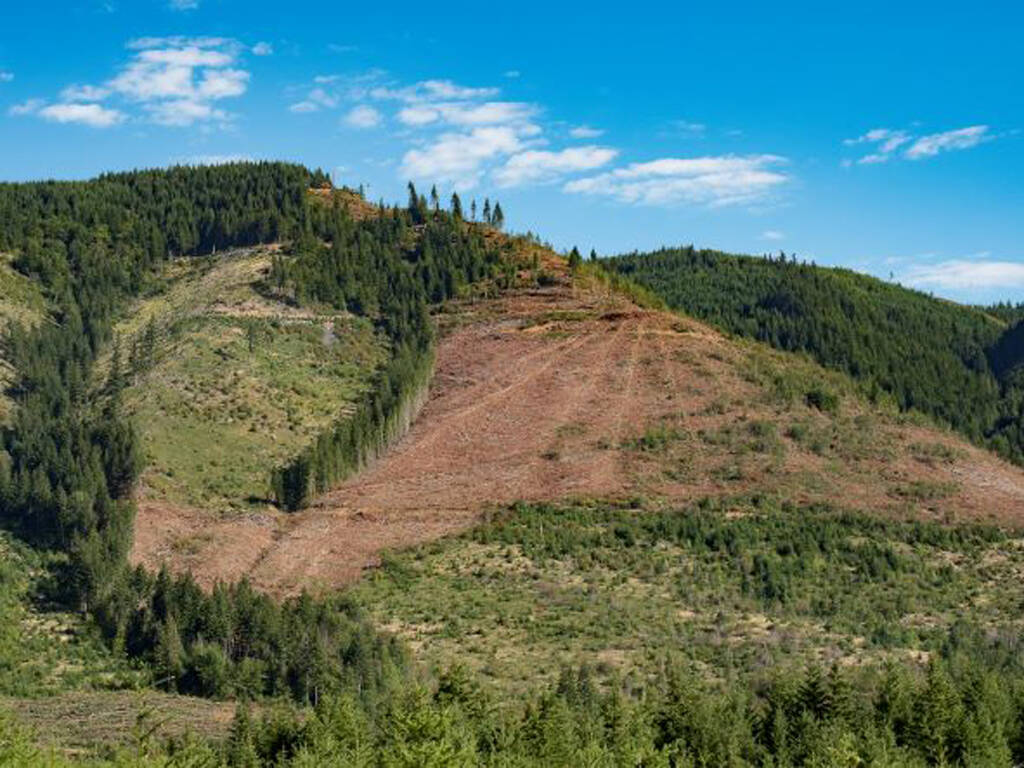
In August, Washington Public Lands Commissioner Dave Upthegrove announced “the largest forest conservation action in Washington in a generation.”
At a press conference attended by environmental group leaders, Upthegrove said the Department of Natural Resources will conserve 77,000 acres of old forests on state lands.
To many in the audience, it sounded like the positive culmination of a long effort.
The movement to protect “legacy forests,” or maturing forests that were lightly logged early last century and are beginning to take on some old-growth characteristics, has gained momentum in recent years. It became a defining issue in last year’s Lands Commissioner election, which Upthegrove won.
On the campaign trail, Upthegrove pledged to protect most remaining legacy forests from logging. His August announcement seemed to fulfill that promise.
It didn’t take long, however, for criticism to surface both inside and outside the environmental community.
DNR maps purporting to show the 77,000 acres to be conserved are, according to some environmental groups, full of errors and leave out many of the most valuable legacy forests.
“There are serious concerns about how these maps were developed, what criteria were used to identify areas for protection and whether they are the same areas Upthegrove promised to protect when he ran for election,” says Stephen Kropp, founder of the Tacoma-based Legacy Forest Defense Coalition.
DNR communications director Michael Kelly, responding to an inquiry directed to Upthegrove’s office, told Columbia Insight the agency has, “identified 77,000 of the best acres for ecological health, habitat connectivity and diversity of stand types across the landscape to conserve.”
Kelly also called Upthegrove’s August announcement “just a first step.” DNR says its initial maps of protected areas will be revised.
Still, environmental leaders who have now had time to thoroughly analyze Upthegrove’s order and the maps released with it worry DNR’s approach to forest management hasn’t changed nearly as much as the widely publicized announcement seemed to suggest.
“I don’t want to say there’s nothing good that came out of this order,” says Kropp. “But the way DNR has presented it is very misleading.”
What gets protected?
When Upthegrove pegged 77,000 as the acreage his new forest order would protect, he chose a figure very familiar to Kropp.
“That was my number, originally,” says Kropp.
Back in 2021, Kropp was trying to figure out how much unprotected legacy forest remained on state lands in western Washington. Using information from DNR and Lidar scanning data, he came up with an estimate: 77,000 acres.
The legacy forests movement converged around that figure as a rough target for how much land needed protecting. Upthegrove also embraced it.
Since then, the state has conducted its own analysis of where these forests are located.
“A team of DNR foresters, data scientists and forest ecologists developed an updated inventory of forest types across DNR lands using a detector model to identify structurally complex forests,” says Kelly.
Structural complexity is one measure of ecologically valuable, maturing forest ecosystems. Though structurally complex forests are not exactly synonymous with “legacy forests,” there’s enough overlap that the terms are sometimes used interchangeably.
DNR’s inventory of these forests informed the maps showing lands to be protected under Upthegrove’s August order.
However, environmental groups say the 77,000 acres shown on the maps are a very different set of lands from those they have in mind as high priorities for conservation.
“Tens of thousands of acres proposed by DNR for protection are actually mapping errors,” says Kropp. Largely, this means slivers of land along streams that aren’t captured in the agency’s official maps of legally preserved stream buffers.
Washington state and federal law prohibit logging along salmon-bearing streams, but human error during surveying means DNR’s maps of protected stream zones don’t perfectly match real-world conditions.
According to Kropp, small strips of land that abut streams but fall outside DNR’s official buffer maps account for a significant percentage of land the agency says it will protect.
“They wouldn’t be able to log these areas anyway, due to their proximity to streams,” says Kropp.
DNR’s maps also include small forest fragments with little conservation value, and lands transferred to local government agencies that are no longer at risk from logging.
All told, the Legacy Forest Defense Coalition estimates only about 19,000-28,000 acres of previously unprotected legacy forests were included.
“DNR has created the illusion they’re conserving 77,000 new acres of legacy forests, when in fact they’re not actually protecting a lot that hasn’t already been excluded from harvest,” says Kropp. “It’s smoke and mirrors.”
Industry perspective
While green groups urge DNR to protect more old forests, industry organizations largely want the opposite and have criticized the premise of Upthegrove’s August order.
“Removing these acres from sustainable harvest will mean less revenue for schools, fire districts, hospitals and libraries that depend on trust land funds, and fewer family-wage jobs in Washington’s forest sector,” says American Forest Resource Council President Travis Joseph.
Washington law requires most state forests be managed as trust lands that generate revenue for counties and other local beneficiaries. Historically, the state accomplished this primarily by holding timber sales.
Recent court cases state that while trust lands must generate revenue, that money does not have to come from logging.
“DNR has broad discretion to manage forests for a range of benefits for trust beneficiaries and the public, including recreation, clean water, carbon storage and biodiversity,” says Daniel Harm, communications director at the Center for Responsible Forestry. “These are the exact benefits gained by conserving legacy forests.”
One way ecosystem services could produce revenue is if DNR enrolled trust lands in carbon markets. This would require authorization from the legislature.
Counties that receive trust land revenue have different opinions about forest management. Historically, they’ve tended to support logging, and many still do. However, some like King and Thurston counties, have opposed timber sales in legacy forests, citing environmental concerns.
“Until the plan is more developed, it’s hard to say what we will or won’t like,” says Paul Jewell, government relations director for the Washington State Association of Counties (WSAC), referring to Upthegrove’s August order.
Jewell says that his organization is frustrated it was not consulted while plans for the August announcement were being drawn.
“We weren’t brought into the conversation,” he says. “We weren’t even made aware it was happening.”
On the other hand, WSAC is pleased timber sales in legacy forests not identified for protection can now move forward.
Upon taking office, Upthegrove announced a six-month moratorium on timber sales affecting structurally complex forests, to give DNR time to identify lands for permanent protection. This pause on logging was lifted after the August order.
“Some of our member counties are very focused on conservation where forests are concerned,” says Jewell. “Others strongly encourage harvesting those lands. But overall, as an organization, we like that these sales are at least back on the table.”
Entrenched mentality
The Legacy Forest Defense Coalition says that of 23 legacy forest timber sales halted under the recent moratorium, all but three are now poised to move forward. Additional sales are in the works.
This is in keeping with what critics say is an entrenched mentality at agencies like DNR, which regards most forests other than old-growth as a resource to convert into wood.
“It’s an antiquated approach that views the best way to manage forests as squeezing every last board foot you can out of every stand that’s available,” says Kropp. “That means basically converting everything you can to a Douglas-fir plantation and managing it as industrial forestland.”
Protecting legacy forests, as Upthegrove has said he wants to do, requires a different way of thinking. However, Upthegrove’s arrival in office wasn’t accompanied by a major shakeup of DNR staff.
“Upon taking office, Commissioner Upthegrove didn’t want to do what Donald Trump did at the federal level, by just firing everyone and replacing them with his own people,” says Harm of the Center for Responsible Forestry. “I understand this sentiment. Though, at the same time, he needs staff who genuinely support him if he is going to be successful in steering the DNR toward more robust ecological forest management practices.”
There has been at least one recent change in staffing at DNR.
At an Oct. 7 Board of Natural Resources meeting, Upthegrove announced Deputy for State Uplands Todd Welker will take on a new role as deputy chief operating officer of operations.
In his former job, Welker made decisions related to state forestlands and would have played a part developing the maps released with Upthegrove’s August order.
Upthegrove didn’t give a reason for the change, but said State Geologist Casey Hanell will fill Welker’s old position until a permanent replacement is found.
At its October meeting, the Board of Natural Resources approved five timber sales brought forward by DNR staff, including about 377 acres of structurally complex forest.
One affected area, the Sooey timber sale in Clallam County, is on land supposed to be included on DNR’s map of newly protected acreage, according to the group Elwha Legacy Forests.
In an email to supporters, Elwha Legacy Forests suggested the Sooey sale approval could be an oversight, but that if so, “it only serves to further underscore the incompetence and confusion at DNR.”
Environmental groups anticipate that in early 2026, DNR will release updated maps of the 77,000 acres Upthegrove’s August order will conserve. However, for those forests now on the chopping block, the opportunity to be considered for protection will likely come too late.
“DNR seems to be creating the illusion 77,000 acres are going to be newly protected, without affecting upcoming plans to harvest legacy forests,” says Kropp. “There are exceptions. But DNR has gone out of their way to ensure the order Upthegrove signed won’t affect plans to log legacy forests over the next five to ten years.”