Congresswoman Emily Randall visited the Aberdeen Fire Department’s Main Headquarters Station on Friday, gaining firsthand insight into the challenges faced by local firefighters who continue to provide 21st-century emergency services from a facility built nearly six decades ago.
Touring a station on the brink
Fire Chief Dave Golding and Senior Battalion Chief Kelly Niemi led the Congresswoman on a comprehensive tour of the station, pointing out the structural, operational, and safety challenges that have accumulated since the building’s construction in 1966.
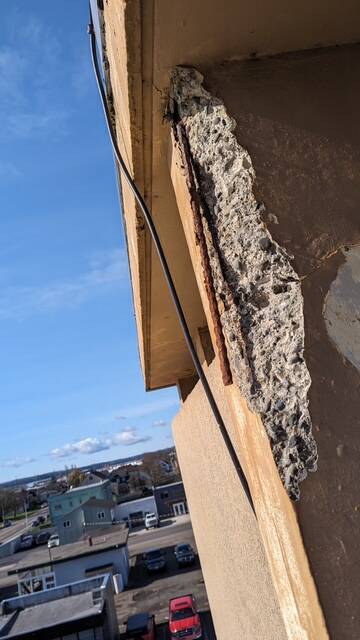
Originally constructed of masonry, the station experienced moisture issues early in its life. In the 1980s, stucco was applied to combat these problems, but instead of repelling coastal moisture, it trapped sea air in the walls. Over time, the internal rebar expanded and rusted, compromising the building’s structural integrity.
“Walking through the station today, you can see examples illustrating a number of issues that we are facing with this facility. You can see where moisture has penetrated the masonry walls and created areas where literally sections of brick have fallen off, exposing the rusting and deteriorating rebar that’s hiding within these walls,” Chief Golding said. “We’ve tried to address some of these issues over the past few years with temporary fixes just to keep the station functioning, but this is no longer sustainable. The building is literally falling down around the firefighters who call this place their second home.”
The station’s aging infrastructure also reflects the era in which it was built. Sleeping quarters and restroom facilities were designed long before women entered the fire service. Today, these spaces do not provide adequate privacy or decency, creating challenges for modern crews.
Captain Trevor Wheeler stated, “We’ve had to improvise privacy measures for female crew members for years. It’s not just inconvenient, it’s something no one should have to deal with while serving the public. We have personnel literally sleeping in closets with curtains serving as privacy doors.”
Firefighters say that every aspect of daily operations — from equipment storage to living accommodations — is affected by a building that was never designed for current demands.
A history of service and community commitment
The Aberdeen Fire Department has long been a cornerstone of the local community, responding to more than 80 percent of medical emergencies, as well as providing fire suppression, technical rescue, water rescue, and wildfire response. The department also serves as a regional hub for emergency management and disaster coordination, providing command and operational support to jurisdictions across the region.
Congresswoman Randall expressed deep appreciation for the service provided by Aberdeen firefighters, connecting her personal history to her legislative priorities. Her grandfather served as a firefighter in Bremerton into the 1980s, giving her a firsthand understanding of the profession’s risks and sacrifices.
“My grandfather wore the same uniform. He faced the same challenges, and he instilled in me a profound respect for firefighters and first responders,” Randall said. “This visit reinforced how critical it is to provide them with the facilities and resources they need to serve our communities safely and effectively.”
Emergency responders protection and coordination act
A central topic during the visit was Randall’s Emergency Responders Protection and Coordination Act (ERPCA), legislation she introduced in Congress to ensure law enforcement agencies coordinate with fire and emergency command systems during active incidents.
The legislation is designed to protect the integrity of emergency operations and prevent interference from external agencies, which could endanger both responders and the public.
The Act builds on a local ordinance first introduced in Thurston County by Wayne Fournier, an Aberdeen firefighter and IAFF Local 315 Political Action Director, who also serves on the Washington State Emergency Management Council and as a Thurston County Commissioner. Fournier’s ordinance was prompted by an incident in which uncoordinated law enforcement activity disrupted firefighting operations.
“Coordination is not optional during emergencies. It is literally a matter of life and death,” Fournier said. “When agencies fail to work together under a unified incident command structure, it creates chaos and puts both responders and the public at risk. The ERPCA ensures that safety comes first.”
The measure has gained traction at multiple levels of government. At the state level, Rep. Lisa Parshley, D-22nd District, has sponsored complementary legislation. At the federal level, Congresswoman Randall has championed ERPCA as part of a broader effort to strengthen emergency response protocols nationwide.
“This is about more than politics; it’s about ensuring that when people call 911, help arrives efficiently and without interference,” Randall said. “We need to protect the system that saves lives.”
Apparatus and industry challenges
Another key issue raised during the visit was the escalating cost and delayed delivery of fire apparatus. Chief Golding explained that the department is in the process of purchasing a replacement fire engine, essentially the same model purchased in 2019 for $735,000. Today, the same engine costs over $1.2 million, with delivery delays of up to four years due to consolidation among the three major manufacturers dominating the market.
“Every fire department in the country is feeling the same pressure,” Golding said. “It’s not just about money; these delays put communities at risk because we can’t replace aging, unreliable engines fast enough. We’re asking Congresswoman Randall to help ensure fair competition in this industry and support policies that make equipment affordable and accessible for all communities.”
Union members from IAFF Local 315 emphasized that rising costs, combined with outdated facilities, create a dual challenge for frontline responders. Aberdeen firefighters are essentially providing modern, all-hazards services from infrastructure that cannot safely support today’s operations.
Community and economic impact
The need for a new station is about more than firefighter safety. A modern, resilient facility would serve as a regional emergency operations hub, improving disaster response, reducing response times, and supporting broader community resilience.
The proposed facility would also represent a significant economic investment in Aberdeen, supporting construction jobs and long-term operational stability. The Union estimates the project’s funding strategy will include a combination of federal earmarks, state capital budget requests, and local bond measures, totaling $20 million to $30 million. Congresswoman Randall expressed strong support for the effort.
“Communities like Aberdeen deserve infrastructure that reflects the professionalism and dedication of their firefighters,” Randall said. “This project is an investment in safety, community resilience, and the economic well-being of the region.”
Looking ahead
The visit concluded with a roundtable discussion between Congresswoman Randall, department leadership, and IAFF Local 315 members. Topics ranged from structural improvements to legislative priorities and funding strategies. The Congresswoman committed to carrying their concerns to Washington, D.C., and exploring policy and oversight measures to address industry consolidation and ensure equitable access to federal funding programs such as AFG and SAFER grants.
“This visit highlighted the dedication, professionalism, and courage of Aberdeen’s firefighters,” Randall said. “They are providing 21st-century emergency services from 1960s infrastructure. It’s our responsibility to give them the tools, facilities, and support they need to continue saving lives safely and effectively.”
With Congresswoman Randall’s support, Aberdeen’s firefighters hope to secure the resources necessary to modernize their facilities, maintain high operational standards, and ensure the safety of both responders and the community.
“Every firefighter here is committed to serving this community, no matter what challenges we face,” Chief Golding said. “With the support of our elected officials, we can finally match our facilities to the level of service our community deserves.”