
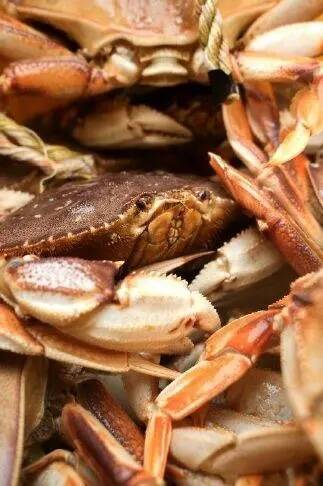
The typical crew of a Willapa Bay crab boat consists of three people: a puller who fishes each crab pot’s line and buoy out of the water, a baiter who switches out the bait, and a driver who pilots the boat in between pots and lines of pots.
Of these roles, the touchiest belongs to the driver, whose read of the wind and the waves keeps the boat from running over the gear or capsizing. Driving takes a practiced hand and an experienced eye, and as such, is usually the skipper’s responsibility.
The distinction between baiter and puller, on the other hand, is a loose one, as both are working to achieve the same immediate goal: to get crab onboard and pots back overboard as quickly and smoothly as possible. On bigger boats that have the need and the budget, there may even be a fourth deckhand sorting crab, preparing bait, stacking pots and performing other miscellaneous tasks. But ultimately, any deckhand is prepared to trade places with any other — to step in wherever needed.
And then there are the crews of two, for whom job distinctions all but disappear and multitasking is nonnegotiable. These days, veteran fishermen Andy Mitby and Eric Hopfer hire a third deckhand. But for most of their 30-year crabbing careers, the lifelong friends went out as a pair. Besides, Mitby’s boat, the Ragnarok, is small enough that the pot hauler is situated next to the driver. The entire starboard-side wall of the enclosed bridge slides away to make room for the sorting table. The driver is the puller. No number of extra bodies they pack into the stern changes this arrangement.
The resulting choreography, while compact and efficient, affords little room for error. And on a brisk, uncharacteristically clear day in late January, the crew of the Ragnarok makes it all look easy. Mitby stands at the helm, plucks the line out of the water with the buoy stick — a thin metal hook attached to the end of a bamboo pole — and loops the line around the pot hauler’s spinning wheel. The second he lets go of the stick, Hopfer, who is standing across the sorting table, grabs and thrusts it out of the way. Mitby keeps one hand on the steering lever and one knee on the buttons that control the hauler’s hydraulic boom. His eyes dart between the hauler’s pulley block and the next pot’s buoy, bobbing somewhere up ahead in the waves.
There are two bait cans in each pot — a plastic oyster jar and a wooden bait box. Mitby dumps and refills the former out of a bucket of bait at his knees, and Hopfer does likewise with the latter. When the fishing is good, the bait of choice here on Willapa Bay is razor clam. But this season has been a bad one — possibly the worst ever, as far as Mitby can recall — and the cost of clams isn’t worth the amount of crab coming up in the pots. So today, sardines are going back down. Unlike firm-bodied clams or squid, the fish will turn to mush in a day or two.
After the bait is switched out, Hopfer slides the pot aft along the gunwale and lays the buoy stick on the corner of the sorting table where Mitby can reach it. The second Mitby hooks the next pot’s line and buoy, Hopfer shoves the previous pot back overboard, and the cycle starts all over again.
Teamwork in tune
To grasp the urgency with which crabbers operate, it helps to understand what’s at stake economically.
To start, the Dungeness crab fishery is Washington state’s most valuable, single-species fishery by a wide margin, routinely exceeding an annual harvest value of $80 million. In the 2024-25 season, it was $83.3 million, according to the Washington Department of Fish and Wildlife. The next most valuable fishery — geoduck — trails at about $22 million.
Furthermore, the Dungeness fishery is what Mitby calls a “shotgun fishery,” meaning that the vast majority of the total catch is landed at the start of the season. According to the department’s 2025-26 Coastal Dungeness Crab Fishery Newsletter, 78% of the previous season’s coastal catch was harvested within two months of opening day.
Those first few weeks are nothing short of a feeding frenzy. Every single pot counts, and fishermen will run themselves ragged to make sure that they pull as many as they can. “We usually don’t miss a day in the first 30 days,” Mitby said.
If a pot comes up smoothly, he and Hopfer can get it back in the water in under a minute. But if a pot is buried in the bay’s ever-shifting bottom, they have to wait for the hauler to do battle with it. When that happens, Hopfer loops the line around a hook attached to the block assembly to reduce slippage while Mitby extends the hydraulic boom in an attempt to wrestle the pot free with brute force. The whole rig stalls and groans and the boat lists starboard.
If that still doesn’t work — a run of minus tides can bury pots meters deep, killing the crab in the process — then they are forced to pump the pot out. An enormous, perforated, metal needle of sorts is sunk to the bottom at the end of a hose, injecting a jet of water straight into the muck. The slowest pots require five to 10 minutes of pumping to come loose. The slowest days require the pump every couple of pots.
What impresses about this choreography is not that it is backbreaking, but that it is sustained. Pulling a few pots is easy. Pulling hundreds over the course of anywhere from eight to 16 hours is not. An effective baiter-puller team is automatic and relentless across that entire time period. Rain, cold and exhaustion are minor inconveniences to be shrugged off. Muscle memory takes over.
Communication happens wordlessly. At this point, both Mitby and Hopfer know what the other man is going to do before he even does it.
“A million times probably isn’t too short of what we’ve done, honestly,” Mitby said, estimating the number of pots he thinks he and Hopfer have pulled over three decades.
As repetitive as the job may be, crabbers have to remain constantly present and aware, for the simple reason that even if they are doing the same thing over and over again, nature is not. Conditions can and do change abruptly. And as Mitby pointed out, the cost of even momentarily losing focus can be catastrophic: “You don’t get to daydream. You have to be in tune, otherwise somebody’s gonna get hurt.”
“When we’re pulling on those stuck pots,” he continued, “if you’re not paying attention and you get caught in the current sideways, and that rope’s pulling out, that can roll your boat over. You don’t get to not pay attention.”
The pair certainly weren’t always as dialed as they are now. When they bought the Ragnarok and became their own skippers thirty years ago, each man had a single crab season under his belt. “We had no idea what we were doing,” Mitby said of that time. Once, while yarding on a stuck pot, they got blindsided by the current and ripped the hauler clean off the side of the boat. All in all, Mitby estimates it took at least five years before he and Hopfer settled into any kind of rhythm.
Pluck and luck
As with logging, mining and other natural resource-based occupations, fishing arouses a special kind of curiosity in society’s collective imagination. A part of that curiosity is technical: How does one do this job?
This question can be uninteresting — even nonsensical — to the people doing the work. The most straightforward answer, at any rate, is also the most boring one: with time and practice. Do anything for as long as Mitby’s been fishing, and it will become routine. There is no magic. There is no numbing the discomfort. What sucks during the first year still sucks during the thirtieth. You just get used to it.
The subtler question is about motivation: What drives someone to pull a million crab pots out of the sea over the course of 30 years, and show little sign of slowing down?
Again, there is a straightforward answer to this question: money. Sheer financial necessity. It took Mitby a little more than a decade to pay off the boat, gear and permit. But these costs of entry have exploded in the decades since he bought in, which is partly why the industry has been having such a hard time recruiting new, young skippers and permit-holders: the risk has become prohibitive.
Besides, aren’t there less strenuous, less volatile ways of making a living? Of course. But that’s also partly why fishermen aren’t doing those things. See, it isn’t just money. When they rhapsodize about hitting the jackpot, they aren’t actually talking about getting rich. What excites them even more than the exact dollar figure they’ll net after debts and overhead is the possibility of landing a huge catch through a combination of pluck and luck.
Of course, the numbers do have to add up. And nowadays, that means diversifying into multiple fisheries. Mitby goes up to Bristol Bay, Alaska, in the summertime while Hopfer fishes the Pacific Ocean for albacore. They dig for clams in the spring and gillnet in Willapa Bay for fall chum. Whatever the fish, the price still has to be right, and fishermen are more than willing to wage legal and regulatory battles if they feel they’re somehow getting unfairly squeezed.
Still, temperamentally, they do not hanker for comfort and predictability. If they did, they would have taken what Mitby calls “real jobs,” by which he means salaried, nine-to-five jobs. In fishing, it’s the uncertainty that excites — the waiting to see what’s in the nets and the pots, the hoping that this year might be the year, the thrill of the chase. And as much as fishermen desire to feel limited only by how hard they are willing to push their luck, they also want the freedom to tie up their troubles alongside their boats and go duck hunting instead.
On that January day, the Ragnarok is one of two boats pulling pots in the waters surrounding the Tokeland Marina, and it hasn’t even been a month since opening day. During a strong season, there can be 15 boats out here, stepping all over each other, seven days a week. This season, crews are heading out every other day at best. It’s beautiful out in the bay, but also forlorn.
Compare this lifestyle to that of Dean Antich, general manager at seafood processing company South Bend Products, and another lifelong friend of Mitby’s. Whether the fishing is good or bad, he has orders to fill, inventory to move, facilities to keep running and employees to keep working. Antich shows up at his desk for the same reason air traffic controllers show up at theirs: the show must go on.
The job is suited to Antich’s methodical personality. “I like the discipline,” he said. “I like knowing that good times or bad times, or whatever it may be, I’m here, and we’re doing our best to keep this company going. My abilities are probably better for this side of the industry.”
Still, he can’t help but imagine, sometimes, when the seafood world seems to be crashing all around him and his phone is ringing off the hook, what it would be like to be out on the water instead. No emails, no spreadsheets, no endless refreshing of browser tabs. Sometimes, he finds himself wondering what his life might have been like if he had chosen the same path as his old friend.
But not always. Sometimes, the grass is green enough on his own side of the fence.
“(Mitby) called me a week ago, and he said, ‘Aren’t you glad you got the office job now?’ It’s an east wind, it’s blowing, it’s cold. They’re out on the water, catching just a pittance amount of crab. It’s just miserable. And he’s like, ‘Now, who’s got the life of Riley?’”
Weathering the times It isn’t unheard of for newcomers — perhaps eager to roll the dice, or just taken by the romance of it all — to come to town and try their hand at fishing. They usually last a season or two before the high vanishes and they sell out. There’s a reason why so many commercial skippers fishing this coastline are straight-talking, middle-aged locals who come from families of fishermen and have been working on boats since they were children.
There’s a reason why fishermen don’t boast or proselytize. There’s a reason why they don’t try to force their own children to follow in their footsteps, even if their company is warmly and proudly welcomed. They know that the job isn’t for everyone, and that ultimately, it isn’t enough to be in it for the thrill, let alone for the money. They know that you have to be wired in a very specific way if you intend on weathering the times when you are no longer fishing for a living, but making a living so that you can fish. “You don’t fish for a season. You fish for a career,” Mitby said.
One thing that always helped Mitby subsidize his own worst fishing seasons was substitute teaching. And he always gave his students the same piece of advice: “I tell the local kids here, ‘You can always come back home, but go see something first. Go do something, go to school, go join the Coast Guard, Navy, whatever, just get away for a while.”
It’s what Mitby did himself when he went to college at the University of Washington to study fishery sciences. The education certainly helped his career, especially the political and economic aspects of it. But the simple change in perspective inherent in the act of leaving home was just as valuable. It allowed him to realize beyond a shadow of a doubt where he really belonged. To whom he would make his promises. What he really loved.
At day’s end taciturn as he may be, this love permeates everything that a fisherman does. To watch him work is to watch him keep his promises. You just have to know what you’re looking at.
Tucked away in a wooded corner of Naselle, gillnetter and crabber Aaron Miller’s deckhands are repairing crab pots and repainting buoys in his backyard workshop. The ceiling is high. Rows of antler sheds are mounted on the beams. The air smells of cedar and vinyl and a heat lamp glows invitingly in the corner.
An hour west and north up the arm of the Long Beach Peninsula, Warren Cowell of Willapa Bay Shellfish, clad in a Seattle Seahawks jersey, welcomes the crabbers back with their pittance. Gary Walters offloads barely a single tote, as does Ross Kary. But everyone is still smiling and laughing in the back of the cluttered little shed out of which Cowell and his wife, Yoko, write fishermen their receipts and offer them — depending on mood and need — coffee, beer or whiskey.
At the north end of Willapa Bay, Mitby and Hopfer are heading back to the marina. They have barely broken even for the day, but it’s hardly worth continuing. Besides, there’s a Seahawks game to catch. Hopfer’s phone buzzes. It’s a text from his daughter. She has sent him a picture of the aftermath of the blizzard that just slammed New York City, where she now lives. The city streets have turned into a uniform, grey-white canvas of ice, snow and concrete.
Hopfer glances at the picture and smiles. The sun is floating in a million pieces on the surface of the water. The gulls are wheeling overhead.
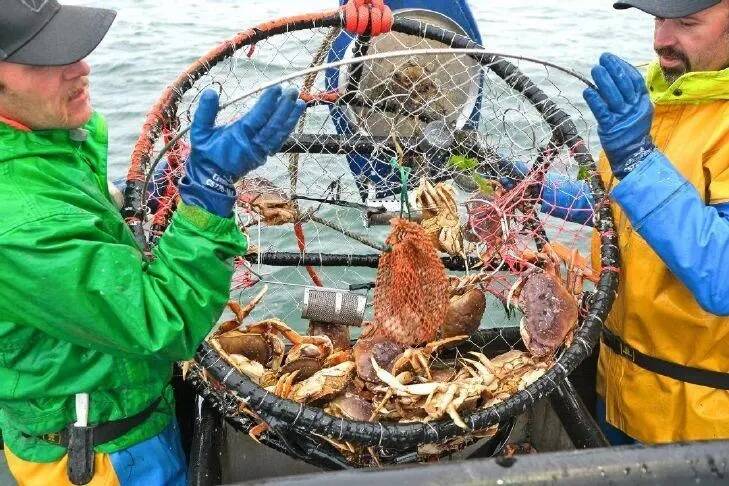
Deckhands Cody Luman, left, and Nick Kato dump a crab pot aboard the Marcus David, skippered by Aaron Miller.
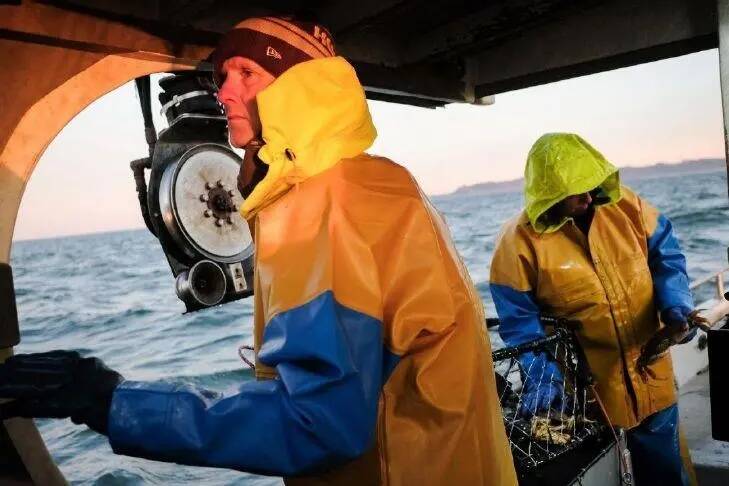
Andy Mitby nudges the steering lever of the fishing vessel Ragnarok while Eric Hopfer measures and sorts crab.