
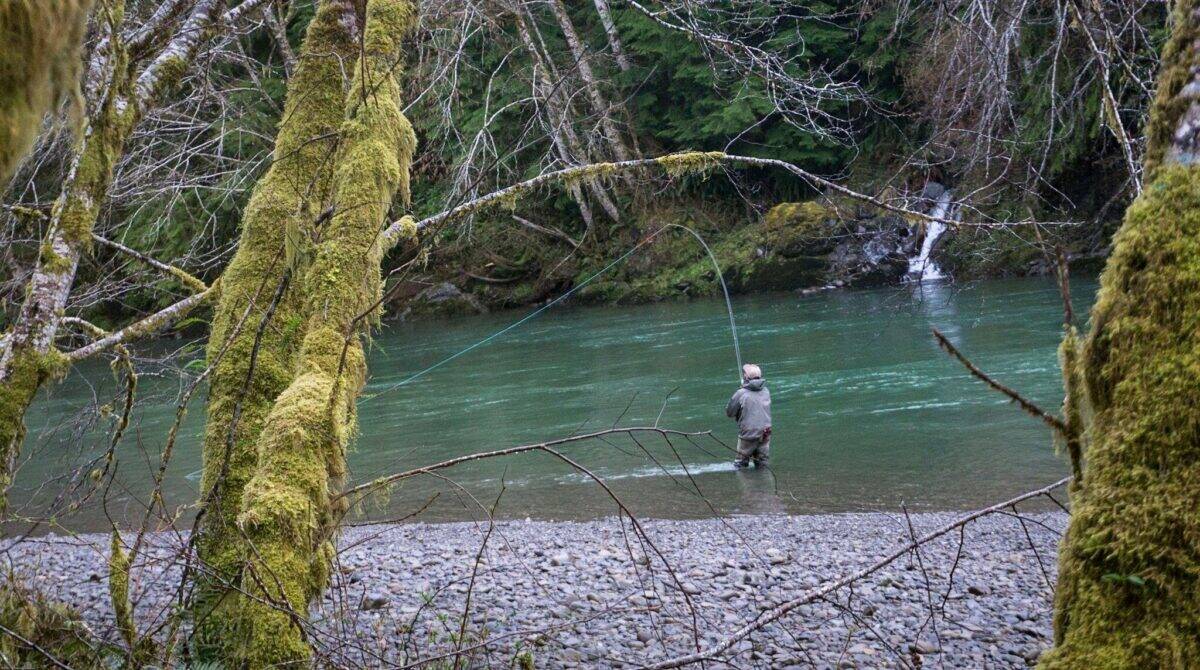
State and tribal co-managers and steelhead anglers can all breathe a little easier after this week’s final federal determination that an Olympic Peninsula steelhead Endangered Species Act listing isn’t warranted at this time.
ESA listings don’t necessarily eliminate fisheries, there wouldn’t be chinook seasons off of Neah Bay if they did. But with hatchery production limited and steelhead in such dire straits in southwestern stretches of the state, a listing of the state fish would have been a black eye for all involved.
It’s a victory for the state Department of Fish and Wildlife and treaty tribes, which worked together to produce an August 2025 assessment that the federal Endangered Species Act review process that led a specially convened National Marine Fisheries Service team to conclude in November 2024 that Olympic Peninsula steelhead were at moderate risk of extinction fell “woefully short” of Congressional standards for listing a population — and failed on government-to-government and tribal trust responsibility, ESA implementation, and scientific analysis integrity levels as well.
“Rather than saddling the co-managers and coastal communities with the regulatory burden of the Act, NOAA Fisheries can and should explore how it can support the co-managers in our current and ongoing adaptive management approach and address the seminal causes responsible for declines in productivity and abundance of OP Steelhead,” the state-tribal assessment recommended.
The co-managers will continue to work together, Fish and Wildlife confirmed in a statement about this week’s Federal Register notice filed by NMFS on its 12-month finding on the population, which included all steelhead runs from the Lyre River near Joyce to the Moclips River by Ocean Shores.
“WDFW will continue working with tribal co-managers to prioritize steelhead conservation on the Olympic Peninsula, including efforts to rebuild runs while offering sustainable fishing opportunities,” said Fish Program Director Kelly Cunningham.
Environmental advocates from the Wild Fish Conservancy and The Conservation Angler were less than thrilled. The Conservation Angler, which petitioned in August 2022 for an ESA listing and reached a $20,000 federal court settlement last year that prompted NMFS to make this call after dragging their feet for well beyond the official/unofficial 12-month window to do so, said they are now “conducting a thorough review of the decision and the underlying status review to evaluate whether NOAA’s finding is consistent with the best available science and the requirements of the Endangered Species Act.”
“We are assessing all available options to ensure that Olympic Peninsula steelhead receive the protections necessary to prevent further decline and secure a path toward recovery,” they added.
The prefiling on the Federal Register revealed a Fish and Wildlife plan to start a new “local early winter-run steelhead program” on the Quillayute River that would replace the out-of-basin Chambers Creek program there.
The three-phase plan would start with the collection of 40 natural-origin winter steelhead in January through mid-February with the eventual goal of releasing 50,000 smolts annually from the Bogachiel Hatchery. It comes at the recommendation of NMFS to either replace or eliminate the current program, which otherwise stocks 150,000 smolts into the Bogachiel and Calawah Rivers.
Quilcene’s Ward Norden once served on a federal oversight commission at the NMFS overseeing ESA projects such as the petition to list Puget Sound coho and Oregon coastal coho.
Norden said Olympic Peninsula steelhead have never met the ESA-requirement to be genetically distinct.
“Most anadromous fish in Western Washington don’t meet the genetic distinction criteria with only a very few exceptions such as Hood Canal summer chum (already listed) and summer coho should be listed in my opinion,” Norden said.
The mix and match nature of steelhead’s gene pool over the last century also makes an impact.