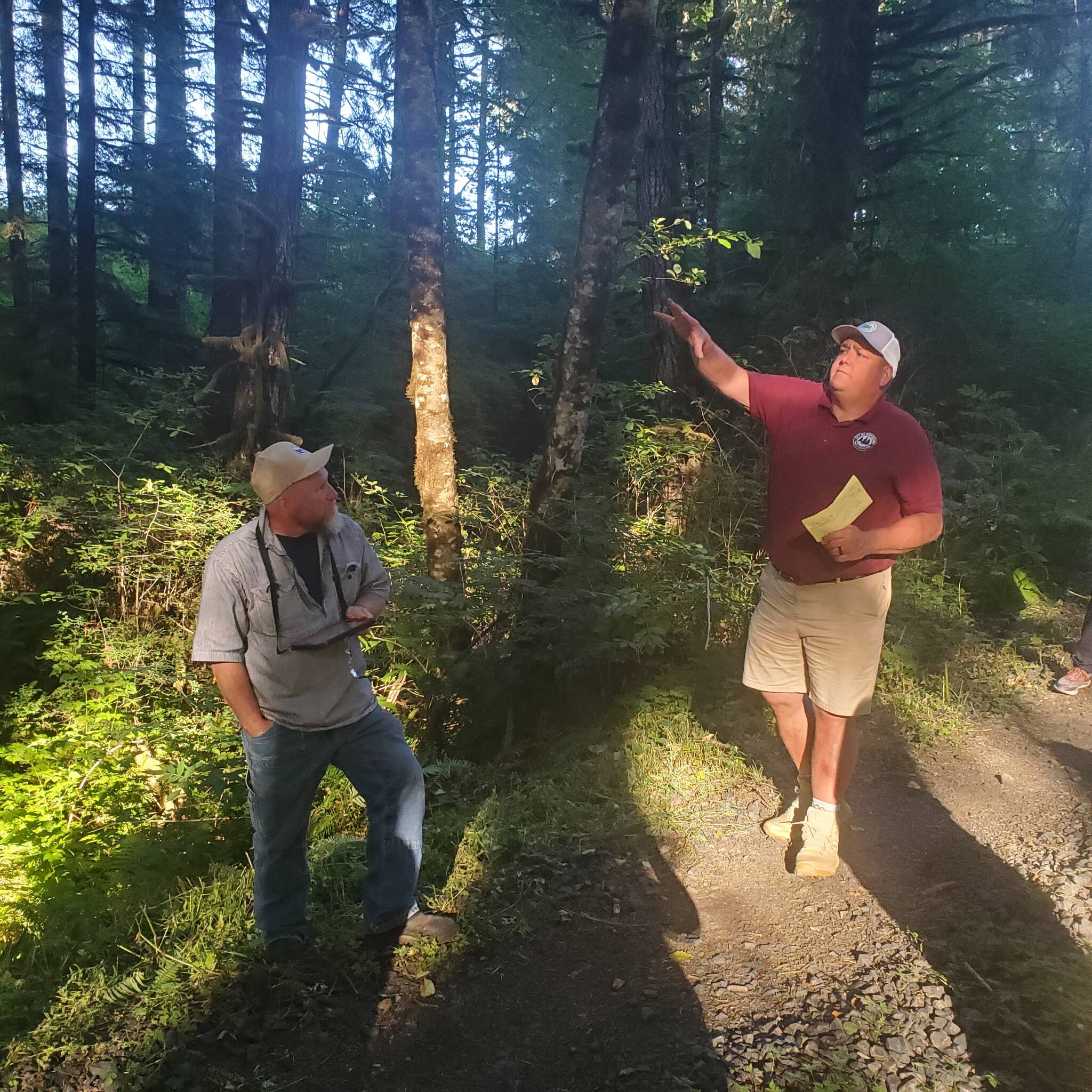
With their city forest accessible via an extensive road and trail network, Montesano residents and visitors can see the year-round management activities undertaken by the city’s forestry department.
During the Montesano City Forest Tour held on July 15, attendees had the opportunity to go behind-the-scenes with City Forester John Bull to learn about the decisions underpinning those management activities. With several other forestry professionals in attendance, attendees were privy to discussions that usually occur during networking events at conferences or with small forest landowners considering their first timber harvest.
This is the third annual tour that Bull has led since becoming forester; Loren Hiner, the previous city forester, also offered tours but not annually. Bull is also just the fourth forester in 50 years.
A caravan of vans and private vehicles took the group to the first site, 60 acres that had been cut earlier this year. Following a round of introductions, Bull gave a brief history of the City Forest, explaining that it was established in 1931 with the purchase of 5,493 acres.
“At the time, we bought it for $12,000,” Bull said. “I did the math yesterday, that’s equivalent to $354,000, which is equivalent to today’s prices [of] $50 dollars an acre. … Even at today’s prices, it’s an incredible deal.”
The City Forest is managed for multiple uses, Bull explained.
“We’re doing it for recreation. We’re doing it for environmental, and we’re doing it for revenue,” Bull said. “And it’s truly working.”
Now spanning 5,638 acres, 4,368 acres is in active management with the rest classified as set-aside, which includes riparian zones, trails, roads and forested areas not producing timber.
“We grow a little over 3 million board feet so I cut a little less than 3 million board feet and that will work for perpetuity,” Bull said.
To this comment, Helen Hepp, an emeritus board member with Friends of Schafer and Lake Sylvia State Parks, said, “Nice.”
Merrill & Ring purchased the timber sale. Bull said the sale generated nearly $700,000 for the city: 10% went to the general fund and 90% to the water fund.
The future forest on these 60 acres will be 40 acres of Douglas fir and 20 acres of an experimental red alder planting that Bull is partnering with the University of Washington and Oregon State University on. A portion of the 20 acres will be planted in native red alder and the other 20 acres will be planted with enhanced red alder sourced from British Columbia.
To the question of whether he will consider longer rotations — the rotation age averages 50 years — Bull explained the goal of the City Forest is to support the city with income. Moving to longer rotations would require purchasing more land.
“That’s why my whole goal is to buy more land,” Bull said, which he’s been successful in accomplishing in recent years.
Through the Washington State Recreation and Conservation Office (RCO), the city was awarded a $2 million grant for the purchase of 90 acres, and 150 acres had been bought earlier. (Karen Edwards, an assistant section manager with RCO was in attendance on the tour.)
With an anticipated future purchase of 240 acres, Bull said “we’ll be right at that verge of 6,000 acres.”
Bull credits the passage of a bill during the 2023-2024 legislative session, “Concerning the exclusion of compensating tax when land is sold to a governmental entity intending to manage the land similarly to designated forestland or timberland” for enabling the city to purchase the 90 acres of forestland without having to pay back taxes of $80,000. (This legislation was sponsored by Rep. Steve Tharinger, D-District 24, Position 2 and co-sponsored by then-Rep. Mike Chapman, D-District 24; both Rep. Tharinger and Sen. Chapman were in attendance on the tour, as was Rep. Ed Orcutt, R-District 20, and April Messenger, a field representative for U.S. Rep. Emily Randall, D-District 6).
“We’re thankful for representatives like yourself that understand forestry because this is all for the public good,” Bull said. “There’s one thing about community forestry, it’s very pro-side. Republican, Democrat, it doesn’t matter.”
Wrapping up the discussion, Bull highlighted the jobs that resulted from this sale and future work: loggers, cutters, truckers, tree planters, precommercial thinners and road builders. “All salaries and payments that are going to these people off these lands that we support,” Bull said.
To which Bryan McMeekin, a timber buyer with Merrill & Ring who purchased the 60-acre sale, added, “It’s all local people in the community too, that are working out here.”
Harvesting in 2026
For the next site, Bull took the group to a Douglas fir stand that would be harvested in 2026 and discussed the management considerations and education role of his job. Bull again circled back to the question of longer rotations or reducing harvest levels, explaining that acquiring more land is an option, as well as carbon credits.
Bull also highlighted that the City Forest is American Tree Farm Certified, which requires having a management plan and being inspected. Additionally, Washington State’s Forest Practices rules “are some of the most stringent in the nation.”
Bull shared a conversation he recently had with a couple from Bellingham who were hiking in the City Forest, with them commenting about the beautiful forest and that “we don’t want any of this cut.”
“Well, this has all been cut,” Bull recalled telling them. “I try to just educate. Yeah, it doesn’t look great when clearcut, but it comes back, and we manage the clearcuts for wildlife and everything else.”
As a follow-up to the question of when the stand was commercially thinned and if there was economic value, Bull walked the group through the economic and biological considerations that he weighs when deciding to conduct a pre-commercial or commercial thinning, such as what the markets are paying, wood quality, and trucking costs.
To the question of conducting harvests where trails are located, Bull discussed the outreach he conducts to the mountain biker groups and their rebuilding the trails where needed after the harvest is finished. Harvests also present an opportunity to enhance the existing system, Bull added.
Sylvia Creek
The third stop, on a section of the east fork of Sylvia Creek, focused on riparian management and was a stop on last year’s tour too because “it’s a conversation piece,” Bull said.
Forest practices require leaving riparian trees in the riparian zone of stream type F (F is for fish), of which the east fork of Sylvia Creek has, and having 130-foot buffers on both sides; in the City Forest, buffers are about 150 feet. (The three other stream types are Shoreline, non-fish-bearing perennial (Nperennial), and non-fish-bearing seasonal (Nseasonal).
When this piece was harvested in 2002, the remaining riparian buffer was between five to six acres. A benefit of having “good, strong buffers” results in less blowdown, healthier buffers, and bigger, stronger trees.
“As a manager, I’m willing to give up a little bit to have better buffers,” Bull said.
By his calculations, including more acreage in this buffer meant earning $81,000 less in harvest revenue.
These comments led to a larger group discussion of the efforts underway to determine whether the buffers of Nperennial streams need to be increased. (As per the Forest Practices Illustrated Manual, Nperennial streams “flow year-round either on the surface of the streambed or sometimes below the surface for some distance. Buffers on these waters provide habitat for amphibians, protect downstream fish habitat and water quality.”)
Currently, there needs to be 50-foot-wide buffers for 50% of the length of the stream when harvesting. The Forest Practices Board is proposing that, depending on site conditions, widths be increased to 50-75 feet, and there would continue to be flexibility in developing timber harvesting plans when harvesting around these buffers.
The conversation pivoted to wildfire mitigations that the city has taken. Bull’s immediate answer was, “Typically, just well-managed forests with thinning.” He acknowledges that wildfire can happen on the westside, however, westside forests are different from the eastside forests in that eastside forests are fire-adapted and historically burned regularly.
“Over here, we’re pretty safe,” Bull said.
However, one reason he is planting red alder is because some studies from Oregon State University found that when wildfire hit the red alder, the fire was suppressed.
For fire protection, the city’s forestry department and fire department purchased a brush truck, with a backup vehicle also available.
With the City Forest residing within the city limits, the fire department will respond, and the extensive and maintained road system also allows access anywhere in the City Forest should a wildfire start. Mayor Tyler Trimble added that the council has given authority to Bull to close the City Forest if the wildfire threat warrants a closure.
Precommercial thinning
For the fourth stop, attendees visited a 120-acre Douglas fir and western redcedar stand that had been pre-commercial thinned last year to learn about this forest management activity. Bull’s prescription was precommercial thinning to 300 trees per acre and removing western hemlock, cascara, and alder.
“The reason we precommercially thin, we want the biggest and best Doug fir is what we’re trying to grow, along with cedar,” Bull said.
Not having a larger deer or elk population in the City Forest means western redcedar can be planted without protective tubing. As to why he plants western redcedar, Bull explained, “It’s the highest value wood. It’s good for diversity, because it’s shade tolerant so it will grow in areas where Doug fir won’t and so we spread it throughout.”
Bull shared that this stand had sustained some bear damage, with the bears seeking out the cambium layer because of its sugars. The stand will continue growing for another 10-15 years, at which point it will be ready for a commercial thin. Bull also pointed out a nearby stand that had been thinned 10 years earlier and will be harvested in 2035 as an example of what the young stand will mature into.
Councilor Dawn Thomas commented, “Our forest looks pretty healthy. Are you worried about disease issues or something down the road that we need to look at?”
Bull said he can see some climate change effects but there aren’t beetle issues, some Swiss needle cast, and a little bit of root rot to manage. What bothers him are future storms that may cause damage comparable to the Columbus Day storm or the storm in 2007 because the resulting damage means salvaging the blowdown and finding buyers for the timber when other landowners are also salvaging their blowdown.
With a view of the Satsop Development Park in the distance, the fifth site afforded the group the chance to mingle and share thoughts on the tour.
Sen. Chapman, who attended a City Forest tour four years ago, shared that he attended to get an update and that this tour was much more robust.
“They do a great job of managing,” Chapman said. “It’s amazing to me that more cities haven’t figured out this model of managing a community forest for revenue, for recreation.”
Daniel Wear, a senior forest program manager with Sustainable Northwest, provided an overview of the Northwest Community Forest Coalition.
“[It’s] a group across Oregon and Washington that convenes quarterly and annually to discuss the different approaches to managing a community forest,” Wear said. “We’ve seen a great example here with the city of Montesano, managing for harvest, managing for community access, managing for riparian benefits and health. And it’s been incredibly helpful having John’s perspective in these meetings because Montesano, you’re one of the more active tour managers and you’re able to highlight those economic benefits.”
Mayor Timble said being “one of the most coveted committee assignments is to get on the Forestry Committee.”
Councilor Ian Cope, who has been on the forestry committee for 10 years, added, “It’s been one of the best learning experiences that I’ve ever had. … [John] what you’re doing to protect this resource is amazing.”
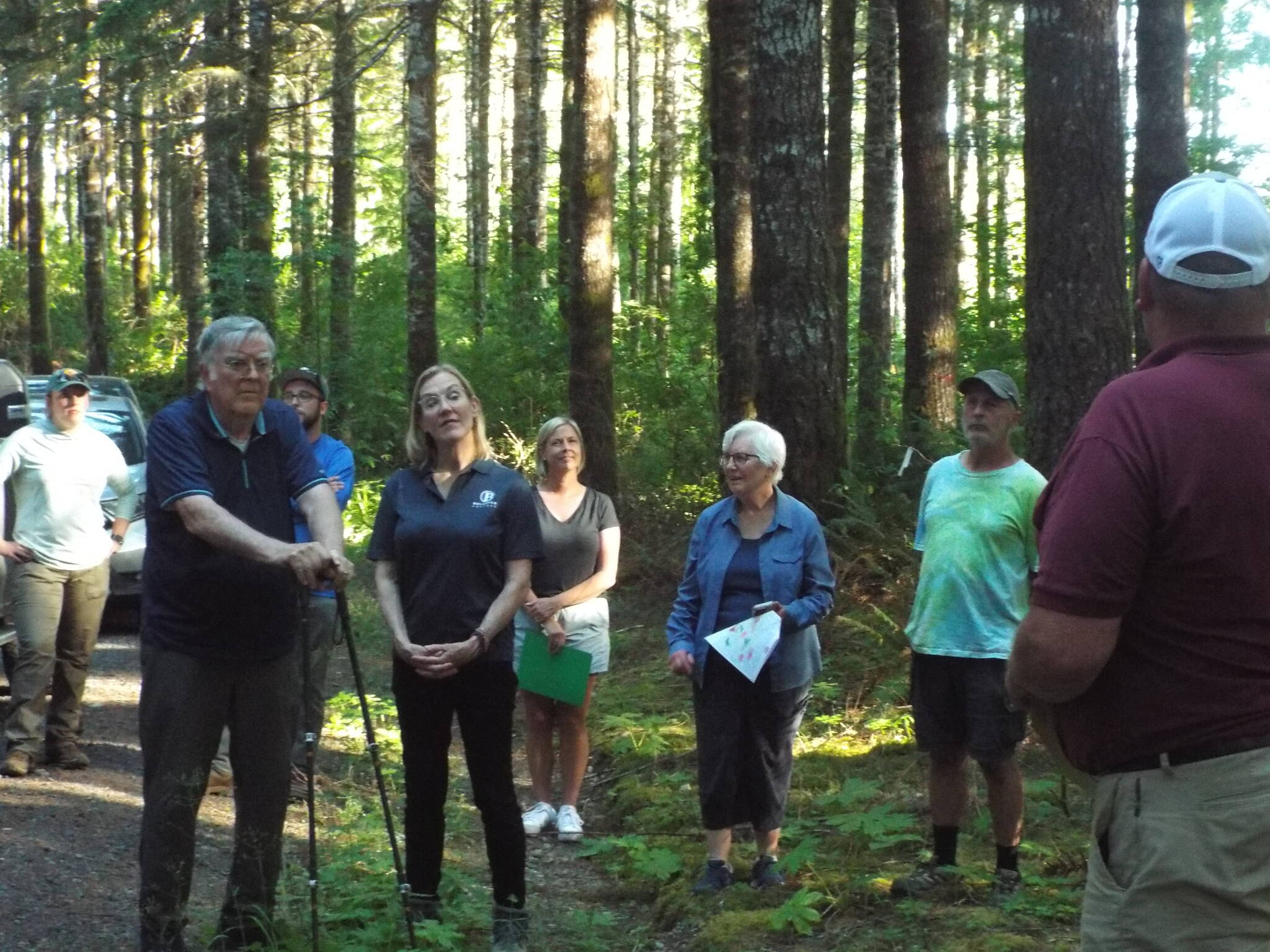
Montesano City Forester John Bull structured the tour to take attendees through forest stand stages and management activities that occur within those stages. The second site was of a mature Douglas fir stand that will be harvested in 2026.