
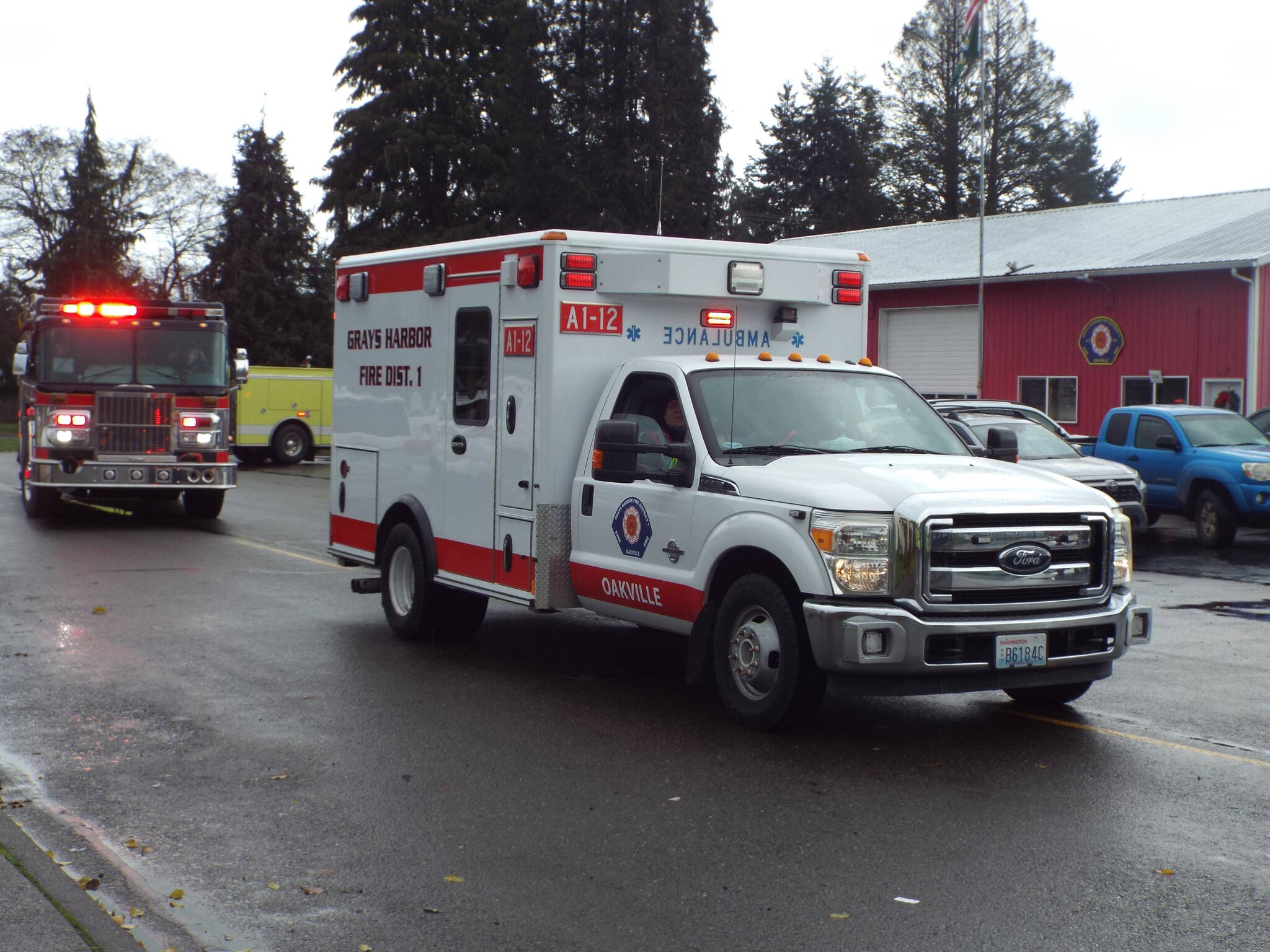
When the Grays Harbor Fire District #1 held its annual Santa Food Drive earlier this month, the caravan of emergency vehicles escorting Santa through town included two ambulances sporting brand-new District decals.
These ambulances represent the District’s investment in reducing transportation costs and improving patient care for the Oakville community
Since the late ’70s, the District has had an ambulance but it was used as an aid vehicle, said Fire Chief Carlton Rhoades, and in 2001, they purchased another ambulance that had been a demonstration unit.
When patients requiring basic life services (BLS) or advanced life support (ALS) needed transported to the hospital, the District contracted with an ambulance consortium based in Lewis County to provide this service. (The distinction between these designations is based upon who can provide the services: emergency medical technicians provide BLS services and paramedics provide ALS services.)
Since the 1980s, this contract was a cost-effective approach to ensure that Oakville residents had access to BLS and ALS transportation services. However, in recent years, “the cost started growing exponentially,” Chief Rhoades said.
What used to be $1,200 per transport increased to $2,500. And in July 2024, they received word that new contract set to take effect on June 1, 2025, would increase the transport cost to $4,600 — which the patient would be billed for.
The District considered the costs of remaining with the ambulance consortium and decided to bring the BLS transportation in-house.
“We weren’t willing to go to our citizens and say, ‘Hey, now you got this massive bill,’” Chief Rhoades said.
Concurrently, the District needed to purchase a newer ambulance since their three older ambulances weren’t meeting their needs. Now that timeline to purchase and outfit a new ambulance was shortened since they needed it in place before the contract expired.
However, “there was no way we could afford to go buy a new ambulance because a new ambulance right now is $350,000,” Chief Rhoades said, and the grant funding they applied for didn’t come through.
The District worked with a local lending institution to secure funding for purchasing a used ambulance for $60,000 from a Texas-based company.
“We found one that we really liked and made a pretty good deal with the guy,” he said.
In November 2024, the new (used) ambulance was delivered, and the District gave notice that they wouldn’t renew the contract. And on June 1, 2025, they began providing BLS transport services. Due to the call volume — “we were stacking up calls left and right now” — Chief Rhoades said they looked at replacing their second ambulance that, while reliable, had high mileage.
They found a former military 2015 ambulance with low mileage and only cost $38,000.
“They get new rigs constantly so that they’re able to retire rigs sooner and with less miles on them,” said Chief Rhoades.
With the two ambulances often on calls at the same time, the District asked if Confederated Tribes of the Chehalis Reservation could assist in purchasing another cardiac monitor (Lifepak 15 monitor); the District had already purchased a cardiac monitor for one of the ambulances.
“They purchased the entire thing for us and donated it to us,” Chief Rhoades said.
By providing in-house BLS transport, the District is keeping the rate at $1,200 plus $28/mile for residents and $1,400 plus $28/mile for non-residents. For ALS transport services, the District contracts with private company, which also serves as a backup for BLS transport.
“Fortunately, the amount of ALS calls is significantly lower than the BLS calls,” Chief Rhoades said.
To the question of what is driving the increased cost of BLS and ALS transport services, Chief Rhoades said that “we’ve seen across the board, for the fire service in general, the cost of everything is increasing at an alarming rate … payroll costs are through the roof. Luckily, we don’t have a huge payroll budget because we only have one full-time employee, but these agencies that are staffed completely, the payroll’s going through the roof right now.”
As for how the District volunteers are liking the new ambulances, “all this new equipment is very exciting to them,” Chief Rhoades said. “It’s something different [and] it allows them to use their skills more, so they’re extremely happy about it. … And the fact that we can now take patients from our community and get them to the medical care that they need, it helps tremendously.”