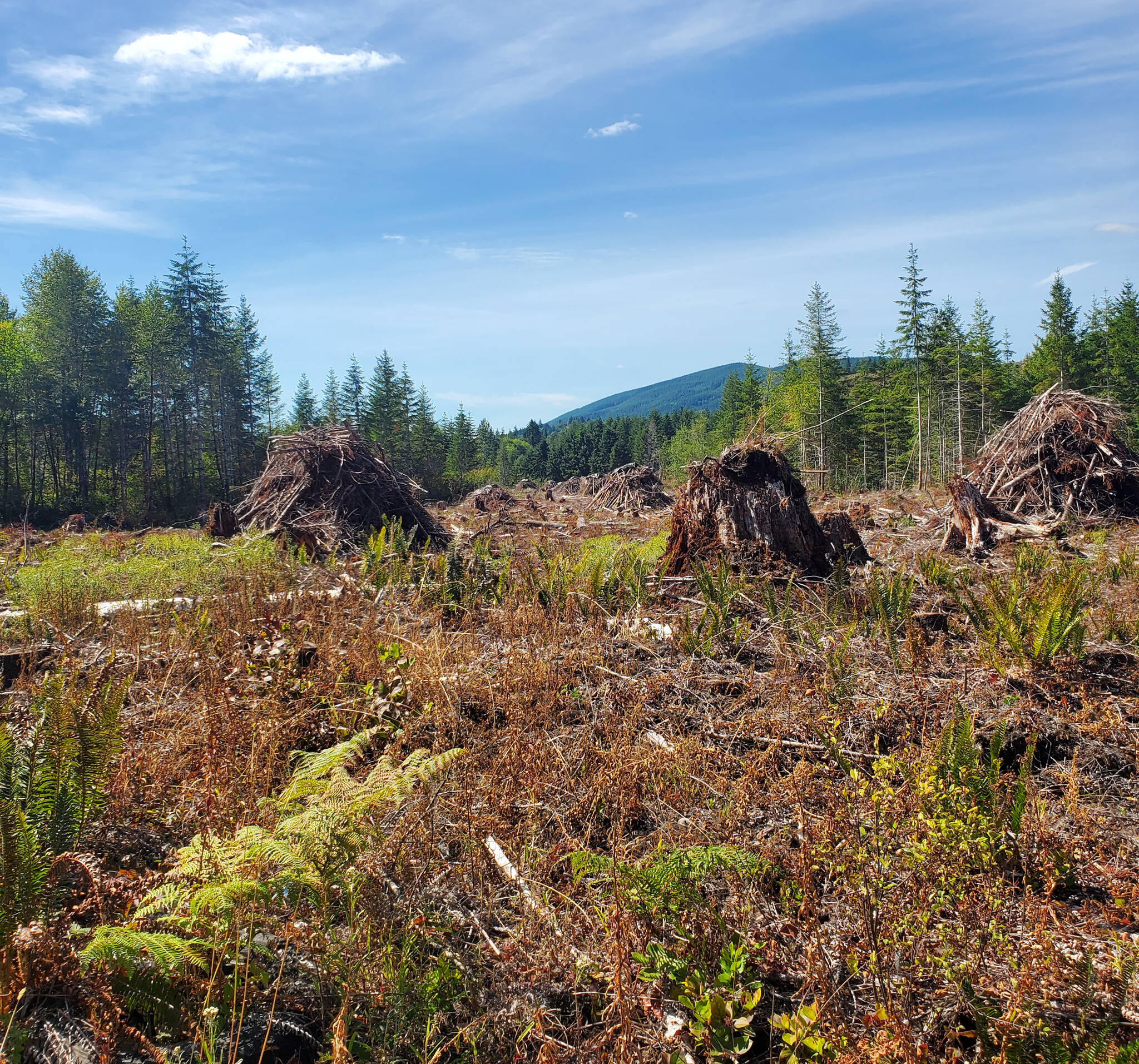
On the first stop of the Montesano City Forest tour last month, several 15 to 20 foot-high slash piles served as the backdrop.
These piles are comprised of treetops, small diameter trees and branches, the byproducts of a timber harvest that don’t have marketable value. This material is considered forest biomass, and come winter, it will be burned.
The small diameter trees that are thinned during precommercial thinning or wildfire mitigation activities are also regarded as forest biomass when they don’t have marketable value. Finding a market for this forest biomass, particularly as a bioenergy product, has long been a goal for the forest sector to further offset the costs of managing forestland.
“Since I got here in 2001 to do my master’s, we’ve been looking at ways to use more biomass, to deal with low-value material, and we haven’t cracked the nut yet,” said Elaine Oneil, PhD, executive director of the Washington Farm Forestry Association. “Any effort that can turn over another rock to address an emerging situation, that’s a good thing.”
The latest attempt to crack the nut is being undertaken by the Pacific Northwest National Laboratory (PNNL) through a U.S. Department of Energy (DOE) Bioenergy Technologies Office-funded study that complements the Billion-Ton Reports the agency has published since 2005. These Billion-Ton Reports assess the “potential biomass resources available in the United States” — the latest report published in 2023 is the fourth assessment.
Francesca Pierobon, a chemical engineer with PNNL, who is leading this study shared via email that “Our study is related to the Billion-Ton Reports, but we are refining the analysis for biomass availability and mobilization pathways in different U.S. regions. In the first year, we are focusing on U.S. Pacific Northwest [Washington and Oregon].”
The study overview describes this three-year study as to “play a critical role in unlocking biomass potential that is currently being underutilized. Additionally, by connecting biomass feedstock producers with bioenergy producers, the proposed project will support the creation of jobs for workers and stakeholders.” A deliverable is Regional Bioenergy Guidelines, “which will incorporate key take-away messages and recommendations about how to enable deployment.”
Throughout August, the research team is holding virtual listening sessions for forest landowners, forestry professionals, agencies and Tribes to learn about the technical, economic and environmental barriers to getting forest biomass to market.
“The target of the listening sessions or outreach really has to be the harvesting and logging community because they need to know where to send stuff,” Oneil said. “And it has to be economical to do it.”
The Daily World spoke with Pierobon to learn more about the reason for this study and its deliverables; Pierobon also has joint appointments with the University of Washington School of Environmental and Forest Sciences as an affiliate assistant professor and the Washington State University-PNNL Bioproducts Institute as a research assistant professor.
What follows is our conversation edited for length and clarity.
Question: There have been other projects that have studied forest biomass for use as bioenergy in the Pacific Northwest. How does this project fit in with this other research?
Pierobon: The goal of this project is to bridge the gap between bioenergy research, community engagement, and policy analysis to understand the perspectives of the different stakeholders. These stakeholders include forestland owners, but also potentially farmers, policy makers, and industry. Their perspectives are very important to understand what are the main drivers and the barriers to bioenergy system adoption in order to identify potential solutions.
We are looking specifically at forest biomass to see how much could be available for integrating into the potential pathways that we are looking at.
Q: What are these pathways?
P: Both existing pathways and those with near-future potential that we have economic and environmental impact assessment on. Existing pathways are mainly for energy production: electricity, steam and pellet, or also biochar production. And then we’re looking at sustainable aviation fuel production; there is a lot of interest from the Department of Energy on sustainable aviation fuel production.
Q: Specifically for forest biomass, what outstanding questions are you trying to answer?
P: We’re trying to understand the perspectives of different groups regarding economic factors, as well as potentially forest health and wildfires. We also want to understand their values; for example, what could be the benefit for community development or what is most important to the different groups and if this project can fit well within that framework.
In terms of economic factors, understanding the issues with potential environmental incentive schemes and carbon payments, logistics, and what prices would actually make a difference for the different stakeholder groups when considering the cost of biomass based on different harvest options, as well as the access to the harvest sites. There is also the training and equipping staff or contractors who do the work and understanding the landowner needs, in terms of management and technical assistance.
There has been a lot of research that analyzed economic, environmental, and social impacts separately, and this study tries to bridge that gap. DOE has invested a lot on figuring out different pathways for bioenergy production and sustainable aviation fuel production but the missing part is the stakeholder perspective and they’re interested in that right now.
Q: What is the role of Washington State University (WSU) in this project?
P: The partnership with WSU is because of their forest extension program. We want as much participation from all the different stakeholders as possible. Our role is to lead the research on the economic and environmental impact assessments and partner with WSU on the outreach.
Q: For the listening sessions, what do you want each respective stakeholder to bring to the discussion?
P: For each of the sessions, there are targeted specific groups — forest landowners versus industry or agency — and there is one session where everyone is invited. There will be an initial presentation, giving a quick overview of the project and what we’re trying to achieve and then there will be a list of open-ended questions regarding different topics where we want to hear from the groups. We would like to capture as many points of view as possible and get a discussion around the most important factors of the project.
Q: From these listening sessions, what will you report back to the Bioenergy Technologies Office?
P: We would like to create a list of different perspectives from each one of the listening sessions where we understand the major concern and things to focus on as the next steps for each of the regions. And for each of the groups, what are the most important things for them and how can we address the current barriers.
Schedule of listening sessions and meeting link
The following days and times are set for virtual listening sessions. Anyone is welcome to participate in any session, but the priority groups for each session are listed below.
Forest Landowners
Aug. 18 — 11 a.m. to 12:30 p.m.
Agency Tribal
Aug. 13 — 8 to 9:30 a.m.
Open to everyone
Aug. 14 — 10:30 a.m. to noon
The virtual listening sessions will held in Microsoft Teams
Join the meeting now
Meeting ID: 227 136 163 112 1
Passcode: Fh9v3NU9
Questions?
Contact Francesca Pierobono at francesca.pierobon@pnnl.gov