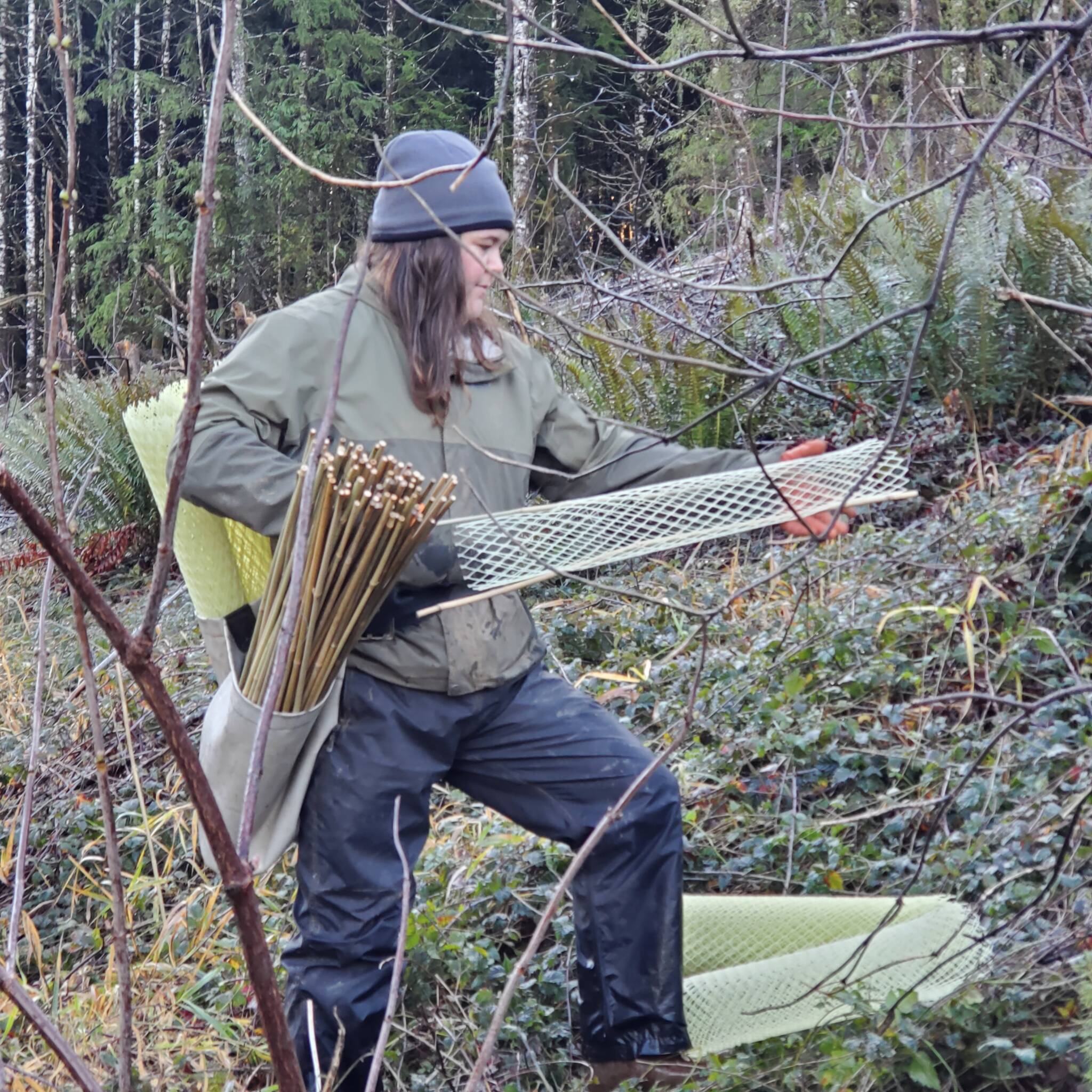
On the Satsop Business Park, where Keys Road intersects Lambert Road, brand-new yellow Vexar tubing dots the hillside amongst the sword fern and logging slash. Protected within these mesh tubs are Douglas-fir, western redcedar, and western white pine seedlings. Over a portion of their winter break, and through the downpours, students in the Forest Resources Management program at Grays Harbor College gained field experience planting what will be a future forest.
For Emma Stohrer, who is in her second year of the associate’s degree program, this is the second year she has participated in the fall planting. “I have a grasp on what we’re doing [and] came out with a bit of confidence,” Stohrer said. “It’s rough work, but it’s fun. The camaraderie is worth crawling through the mud floor. Kind of feels good to replant after doing a bunch of harvest-type stuff.”
Another member of the seven-student planting crew is Kit Decker, who is in her first year of an associate’s degree. “It’s a lot of cool stuff to learn about, [and we] get to see the whole process.”
Today, Stohrer and Decker are paired together, with Decker planting and Stohrer placing the Vexar tubing around the seedlings. The area is within the winter range of the elk that are in the area, and the tubes will, hopefully, provide protection until the seedlings are above browse height.
The Douglas-fir and western white pine seedlings being planted were grown by the students from seeds collected from trees adjacent to where they are planting. The western redcedar seedlings were grown at Webster Nursery, which is run by the Washington Department of Natural Resources.
Whether the white pine will survive to maturity is iffy because of blister rust, a fungal disease that affects white and five-needle pines. The western white pine trees were planted by Washington Department of Fish and Wildlife when the area was under that agency’s custodial management
“There’s quite a few of them that succumbed to [blister rust], but these trees hadn’t been showing any signs and they were planted back in the ’90s,” said Todd Bates, one of two faculty members with the Forest Resources Management program.
The five-acre unit being replanted was harvested last year. Some of the slash is piled for later burning, and the remaining slash scattered across the ground isn’t dense so the students can plant through and around it.
“It’s better to get [the seedlings] in the ground as quickly as we can to get ahead of the inevitable blackberry,” Bates said.
And there is quite a bit of trailing blackberry on the site, which Decker had to fight through to clear a spot for a seedling.
Seven students comprise the planting crew this year, and they are being paid by the Port of Grays Harbor. “We spent most of last week developing the crew mentality. You just don’t go on your own,” Bates said.
Of the students planting on Monday morning, Stohrer and Eric Maki are finishing their associate’s degree, and Decker and Anthony Player are in the middle of their first year. Rounding out the planting crew is C.J. Emerson and Flint Largent, who are also enrolled in the associate’s degree program.
Several factors determine where the seedlings are planted, ideally 12 feet from the previously planted seedlings, in a somewhat clear area amongst the slash and sword fern, and also away from the slash piles that will be burned at a later date.
And you’ve got to pay attention because if there’s already a naturally growing tree there, we let that one grow and don’t plant another tree, said Maki.
As Bates plants a western redcedar seedling, he observed that “now this is really soft material, nice soil. It’s going to be great for these cedar.”
Maki places Vexar tubes around the western redcedar Bates is planting. After working in carpentry for a number of years, Maki pivoted to studying forestry and will graduate this spring.
The western redcedar is being planted further up on the ridge line, which has a north shadow, and the Douglas-fir will be planted further down the slope where there’s more sun throughout the day. The long-term vision of the site is an uneven-aged stand.
Over the last few years, students have planted around 4,000 seedlings, which is what Bates estimates they will plant this year.
“I like the planting better, but the Vexar is a little bit of a break,” said Player. “[I] don’t get as hot and sweaty, but I like the planting especially.”
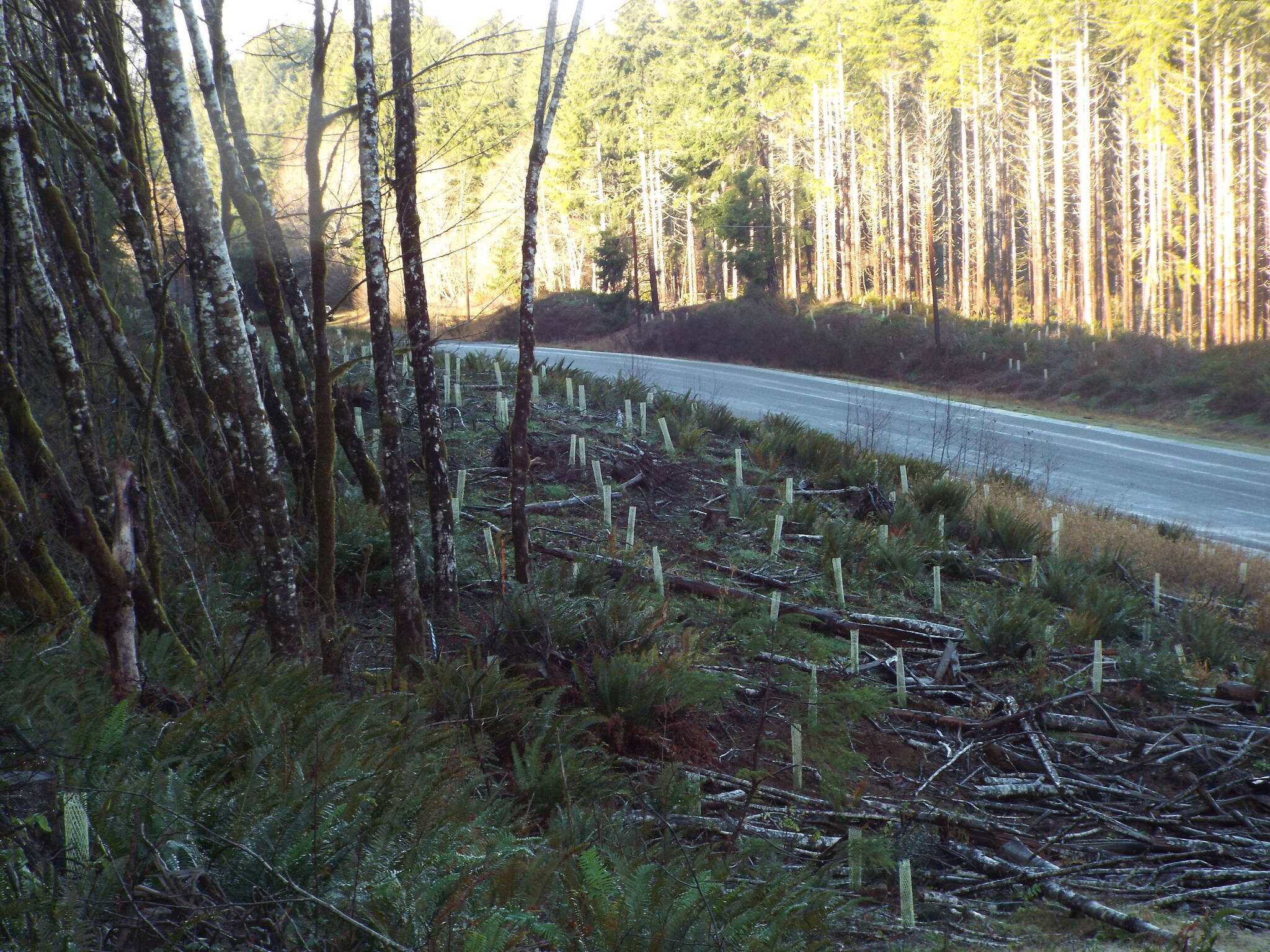
Andrea Watts / The Daily World In the area that was harvested last year, it is being replanted with Douglas-fir, western redcedar, and western white pine.