Calling all sea otters, but they may not defeat Willapa’s green crab invasion
Published 1:30 am Monday, March 2, 2026

“We are watching the end of Willapa Bay’s ecosystem in real time,” says shellfish farmer Warren Cowell, just after tallying the 59,829 European green crab caught in the Port of Peninsula in Nahcotta in January.
“The population of European green crab has exploded,” he added. “I believe European green crab are the dominant crab species in Willapa Bay now.”
The first confirmed European green crab (EGC) sightings on the U.S. West Coast were in Bodega Bay and San Francisco Bay in 1989. With these discoveries, scientists knew it was not a matter of if, but of when, EGC would arrive in Willapa Bay.
Early in the summer of 1998, the first confirmed EGC in Washington state was captured north of Oysterville by a state employee while he was working on control of spartina, an invasive cord grass.
The capture of this one, single EGC in Willapa Bay was a big deal. KIRO 7 News of Seattle immediately sent a news van to Oysterville to get interviews and pictures. They aired a story announcing the arrival of EGC in Washington that very night. Many more EGC were captured in the state that summer. By the end of 1998, 363 more EGC were caught in Willapa Bay.
Eventually, the Washington Department of Fish and Wildlife (WDFW), local shellfish growers and the Shoalwater Bay Indian Tribe coordinated trapping efforts in an attempt to control EGC in Willapa Bay. The Shoalwaters declared the EGC crisis a state of emergency in 2021. Their department of natural resources has trapped and removed over 329,000 EGC between 2021–2025, freezing the crabs to be used as fertilizer for tribal gardens.
Then-Gov. Jay Inslee’s EGC crisis emergency declaration was issued on Jan. 19, 2022. This was followed by massive EGC removal operations from Nahcotta to Oysterville that captured hundreds of thousands of EGC. Several million EGC have been captured and removed in the state since the emergency order was issued, but despite valiant efforts by many, Washington’s EGC population expanded from no known EGC to millions in less than three decades.
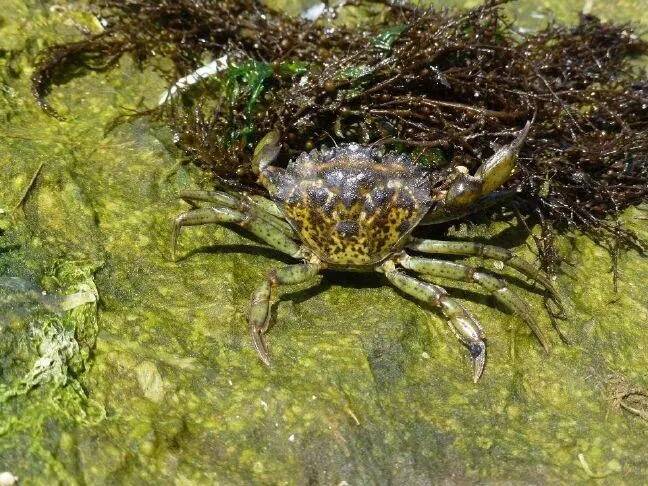
Individually, a single EGC can be as cute as any crab can be, but as hoards of marauding invaders, these mean, green, eating machines essentially become “Cockroaches of the Sea.” Their dominant presence is often difficult to see. At any sign of danger, they scurry into any crevice, crack or hole. When the coast is clear, they re-emerge to gorge on both native and non-native species.
In Willapa Bay, EGC primarily consume a varied, opportunistic diet with high consumption of native hairy shore crabs, sand shrimp and Pacific sculpin. EGC’s exponentially booming population will certainly have dire effects on Willapa Bay’s biodiversity.
While the speed with which EGC became a dominant species in Willapa Bay is astonishing, it is not surprising. They are essentially a perfect invasive species. Female EGCs can lay about 185,000 eggs in their first year of life. Each female is likely to release over half a million larvae if she survives to full maturity.
Even if traps could remove 99% of the males from a given area, the population will still grow. Females can store sperm and fertilize multiple broods. Just like any weed, EGC are tolerant to vast changes in their environment. They can withstand extreme salinity and temperature variations. Their high reproductive rates, rapid growth rates, ability to eat most anything, and even to withstand starvation are characteristics that allow them to rapidly disperse and invade new areas.
Andrew N. Carlton, director of the Center for Research on Aquatic Bioinvasions, asserted in his Jan. 31, 2022 Observer guest column that “Green crab intervention won’t succeed.” His column was published shortly after Inslee issued his emergency order to combat the “imminent danger” posed by EGC. Carlton cited other successful EGC invasions of ecosystems outside their native range, including South Africa, Brazil, Australia, Japan and both coasts of North America, and stated, “No one has ever eradicated a green crab population anywhere in the world, although many have tried.”
Warren Cowell and his crew have not given up trying to control EGC. Cowell is doing what he can to make people aware of the magnitude of the EGC invasion. He is calling out for help and more traps.
“We need a forest fire-type response now,” he said. “I’ve done what I can. The amount of traps being run in Willapa Bay have never been enough. The state has never treated this with the urgency it needed. The Willapa Green Crab Disaster Facebook page was intended to raise awareness to get people to realize we need to do more. Now it looks like this page will be a historic account of the end of Willapa Bay.”
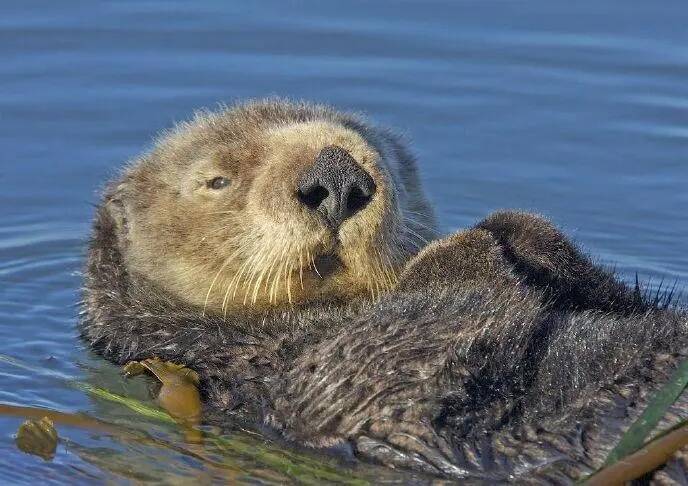
Sea otter solution?
Headlines from national news outlets would lead one to believe the EGC problem has already been solved: “California Sea Otters Lowered Invasive Green Crab Population by Eating Them,” (Washington Post, Dec. 26, 2024); “Hungry Sea Otters Are Taking a Bite Out of California’s Invasive Crab Problem, New Study Finds,” (Smithsonian Magazine, Dec. 30, 2024); ”Invasive Crabs Threatened West Coast Ecosystems For Decades. One Solution? Otters,” (NPR, Jan. 13, 2025).
A study published in December 2024 in the journal Biological Invasions, by lead scientist Rikke Jeppesen and her team, are the source cited in these articles. Her study found that Elkhorn Slough is the only estuary in California where ECG populations have remained low, directly correlating with the return of sea otters. This study estimated that otters in the slough consume between 52,000 and 120,000 green crabs annually.
“That is really a win-win if you can help protect those native species,” said Jeppesen, an ecologist at the Elkhorn Slough Reserve, to the Washington Post’s Kyle Melnick. “It may benefit your ecosystem in multiple ways, including protecting against invaders. No one loses out in that case.”
Since EGC larvae almost always travel north with the currents, anything that controls EGC in California is a tremendous help in controlling EGC in Oregon, Washington, British Columbia and Alaska. However, replicating the sea otter control of EGC in Elkhorn Slough in Willapa Bay would be enormously challenging. There are currently 100-120 sea otters living in Elkhorn Slough. It might take 1,000 or even 2,000 sea otters in Willapa Bay to achieve similar results of crab consumption. Additionally, reintroducing sea otters would be a slow, expensive process.
Newly introduced otter populations could not consume EGC quickly enough to curb the current rapid expansion of EGC in Willapa Bay.
Another factor is that sea otters introduced to Willapa Bay might not stay. The bay’s tidal currents are extremely strong, and the bay doesn’t provide much to hang on to (like kelp), which otters require. Like many species, they could decide to make only seasonal visits to Willapa Bay.
Sea otters visiting Willapa Bay would most likely be wandering juveniles that got kicked out of better spots north and south along the coast that have kelp beds. The habitat in Willapa Bay, with its vast mudflats, contrasts with the calmer, more sheltered and smaller estuary of Elkhorn Slough. Sea otters also tend to stay away from the shore and very shallow areas, which are the main EGC hangouts.
And, perhaps most importantly, if otters stayed in Willapa Bay, they would likely start eating Dungeness and red rock crabs, then cockles and clams, before eating green crab. And if they figure out how to get into oyster flip bags, they would likely eat those oysters. (They are, however, unlikely to eat bottom-grown Pacific oysters, some oyster farmers believe.)
While sea otters might be a solution in some environments, they may not be the answer to the EGC problem in Willapa Bay.