More gray whales found dead along the coast
Published 1:30 am Friday, June 5, 2026
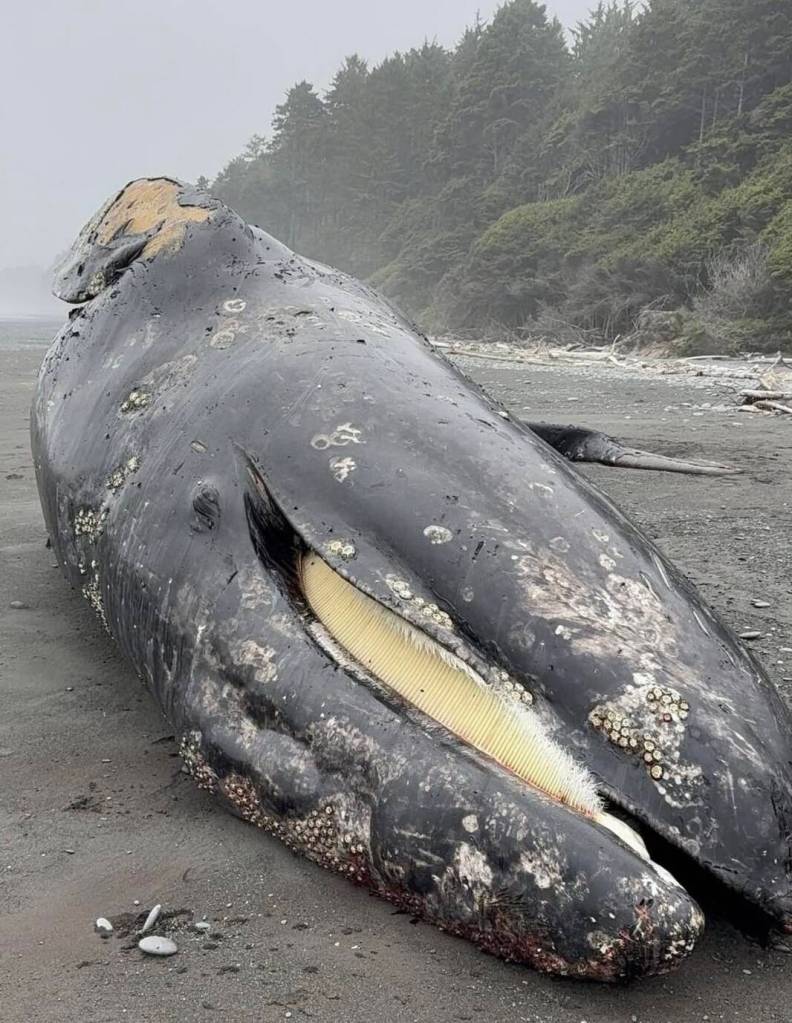
According to Cascadia Research, 26 whales have died along the Washington coast already this year, with many of them landing on the shores of Grays Harbor County.
In the past week and a half, four have washed up at Olympic National Park, near Strawberry Point on May 24, Olympic National Park near Kalaloch (initially floating off Ruby Beach) also on May 24, at Ocean Park on the Long Beach Peninsula on May 29 and at Point Grenville a few miles south of Taholah on June 1.
Several of the dead whales were in poor nutritional condition, likely because warming in the Arctic is changing the ecosystem where some of the species feed. Some have died from ship strikes.
At least 51 whales have died along the West Coast already this year, according to an analysis of public data and media reports by the Center for Biological Diversity. If whale deaths continue at this rate, 2026 could rank among the deadliest years for West Coast whales — second only to 2019, when a record-setting 122 whales died.
Gray whales make up most of the documented cases, and many of the whale deaths have been in Washington and the San Francisco Bay area.
“Far too many whales are dying along the West Coast, and ship strikes and other human activities are contributing to this deadly surge,” said Miyoko Sakashita, oceans director at the Center for Biological Diversity. “We know we can save whales by slowing ships down in whale hot spots, so federal officials need to make it happen. It’s truly tragic to see dead whales washing up on the beach, and we need these magnificent creatures to keep the ocean healthy.”
Eleven of the gray whales died in the San Francisco Bay Area, and two of those deaths are suspected to have been caused by ship strikes. Another two, a gray whale and an endangered fin whale, died on the California coast. In Washington, 26 gray whales and one fin whale were confirmed dead by early May, and seven gray whales were found dead off Vancouver, British Columbia. At least another seven dead whales have been found off Oregon coasts — six gray whales and one sperm whale.
Several of the dead gray whales were in poor nutritional condition, likely because warming in the Arctic is changing the ecosystem where they feed. The whales normally eat small animals such as amphipods, little shrimp-like crustaceans, that live on the seafloor. Those prey depend on a food chain that begins with sea ice, and when sea ice melts earlier and forms later, less of the algae that amphipods eat reaches the seafloor, so there are fewer amphipods and small animals for gray whales to eat before migration. The eastern north Pacific gray whale population has declined by 50% in the past decade.
The Center for Biological Diversity’s analysis of federal data shows that between 2020 and 2025, a total of 521 whales “stranded,” meaning they were found dead or alive on the beach and unable to return to the water. The highest annual total was 120 in 2025, which was an increase compared with the rest of the period.
A total of 82 stranded whales during this period were documented as ship strike cases, with the most occurring in 2025, at 24 cases. Gray whales accounted for most ship-strike strandings (46), followed by humpback whales (14) and fin whales (9). Scientists regard documented cases as an undercount, because most whales struck by ships sink to the bottom of the ocean. In addition, 97 stranded whales were documented as entangled in fishing gear.
Gray whales migrate north every spring from warm Mexican waters to their primary feeding grounds in the Arctic/Bering Sea.
— Cascadia Research and Center for Biological Diversity contributed to this report.