Another dead gray whale washes up on the Ocean Shores beach
Published 1:30 am Tuesday, April 28, 2026
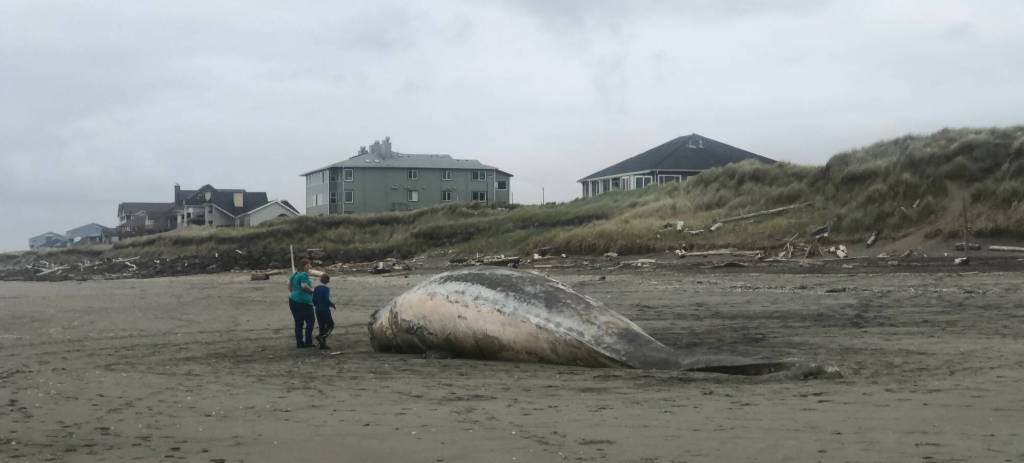
From Oregon to Washington, gray whales migrating north are stranding dead at higher-than-usual rates this spring, according to the National Oceanic and Atmospheric Administration Fisheries. The agency has recorded two whale deaths in Oregon and a dozen or more in Washington so far this year — those numbers exceed typical counts for this point in the migration season.
In Willapa Bay, a gray whale swam up the Willapa River before expiring. That same week two more dead gray whales washed up in Ocean Shores. Last week another gray whale washed up on the beach in front of the Quinault casino. This past weekend another gray whale washed up just north of the Ocean Shores jetty.
“This is the time when gray whales begin migrating north along the West Coast from lagoons in Baja Mexico to their summer feeding grounds in the Arctic near Alaska,” said Michael Milstein, a public affairs officer for NOAA’s West Coast region.
For gray whales, the journey is one of the longest migrations of any mammal, spanning thousands of miles along the Pacific coast. They travel using energy stored during months of summer feeding — reserves that must sustain them through the long trip.
This year, for some, those reserves appear to be running out.
A journey fueled by a vanishing food source
Gray whales depend on a fragile Arctic food web that begins with sea ice.
Algae grows along the underside of the ice, eventually sinking to the ocean floor as the ice melts. There, it feeds small crustaceans like amphipods — the primary food source for gray whales.
But as climate change accelerates and Arctic ice melts earlier and more extensively, that system begins to break down, Milstein said.
Less ice means less algae. Less algae means fewer crustaceans. And fewer crustaceans can leave whales underfed before they even begin their migration.
Milstein said shifting ocean conditions are likely contributing to the strandings, pointing to ongoing research by NOAA and Oregon State University scientists. Studies, including work by marine ecologist Joshua Stewart, have linked gray whale deaths to warming Arctic waters and disrupted feeding grounds.
“It’s a complex ecosystem shift,” Milstein said.
Necropsies conducted on stranded whales in 2026 show many were adult males and severely malnourished. Some also had signs of trauma, including possible ship strikes, suggesting multiple factors may be contributing to the deaths.
A population still struggling to recover
The recent strandings come after a period of steep population decline.Between 2019 and 2023, gray whale populations dropped from roughly 27,000 to about 13,000 animals during what federal officials classified as an Unusual Mortality Event. The designation is used when unexpected die-offs demand urgent investigation.
While scientists saw signs of a modest rebound in 2023; the latest strandings raise new questions about the species’ recovery.
The northbound migration typically continues through May, a critical window when researchers track whale numbers, including mothers and calves. Calf counts, in particular, offer clues about whether the population is stabilizing.
So far, the signs are uncertain.
Scientists say more strandings could occur in the coming weeks as the migration continues.
Officials at NOAA are urging the public to report any dead or stranded whales by calling the West Coast Stranding Hotline at 1-866-767-6114 and to keep a safe distance.
“Only trained teams authorized by NOAA Fisheries should approach stranded wildlife,” Milstein said.
Calls to the hotline activate the West Coast Marine Mammal Stranding Network, a coalition that includes groups like Portland State University and the Seaside Aquarium. Responders assess live animals when possible and conduct examinations to determine causes of death.
Advocates say the issue extends beyond individual strandings.
Catie Cryar, a spokesperson for People for the Ethical Treatment of Animals, linked the deaths to broader environmental pressures driven by climate change and human activity.
“How many tragedies like this do we have to witness before we acknowledge our role in them?” Cryar said. “If we want to save the whales, you have to first save the chickens, the cows, the pigs and the fish.”
West winds and a beachside perspective
Tiffany Boothe, assistant manager at Seaside Aquarium, said what is unfolding on the beaches may not be driven by a single cause.
“You know, that’s one of the reasons we do what we do and what NOAA does — to figure out if there is a pattern,” Boothe said.
She pointed to strong, sustained west winds as a possible factor influencing what ends up onshore.
“We’ve had almost directly westerly winds for a solid month now,” she said. “No one’s really talking about that.”
Boothe said that those winds don’t just affect whales, but everything floating offshore.
“When we get winds out of the west consistently, anything that’s floating in the ocean — if it’s dead — gets pushed onshore,” she said. “We’ve been seeing a lot of Valella Valellas, kelp, fishing floats from Asia, and all kinds of debris.”
She said the same conditions can bring stranded whales ashore, especially as decomposition changes buoyancy.
“When these guys die, they bloat, so they can catch that wind too,” Boothe said.
While malnutrition has been observed in many of the whales examined, she cautioned against drawing a single conclusion too quickly.
“If everybody was coming in in the exact same body condition, fresh, the same state, then we could talk more about what’s really going on,” she said. “But that’s not what we’re seeing.”
Boothe said documenting each case is still critical, even if answers remain uncertain.
“We’re just trying to build the bigger story over time,” she said.