A cure for a most frequent and subtle malady
Published 1:30 am Monday, December 29, 2025
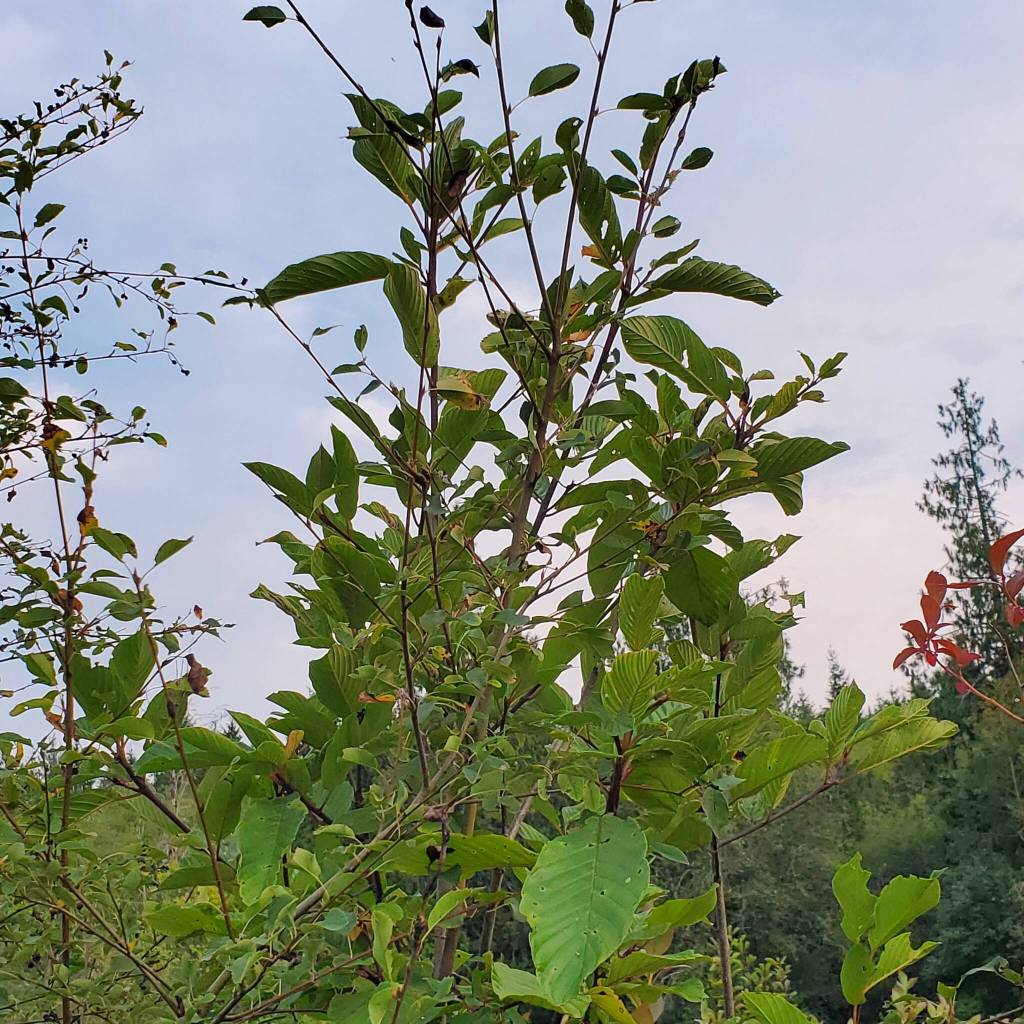

Cascara may not be as eye-catching or valuable for timber as other notable Pacific Northwest trees, such as Douglas-fir and western redcedar, but at the height of its popularity, this was a sought-after tree species because of the relief it provided to sufferers around the world.
On June 10, 1806 , William Clark noted cascara in his journal, describing it “a Growth which resembles the poppaw in it’s leaf and which bears a berry with five valves of a deep perple colour.” Of the Pacific Northwest tree species noted in his and Lewis’ journal entries, cascara is only noted once.
In 1814, German American botanist Frederick Pursh originally classified cascara as Rhamnus purshiana but its scientific name was later changed to Frangula purshiana. This deciduous tree is a member of the Buckthrorn family and is found throughout the Pacific Northwest on the westside of the Cascades, with a range spanning from British Columbia and into northern California. Its habitats are swampy to well-drained, open sunlight to the intermittent shady conditions in the forest understory.
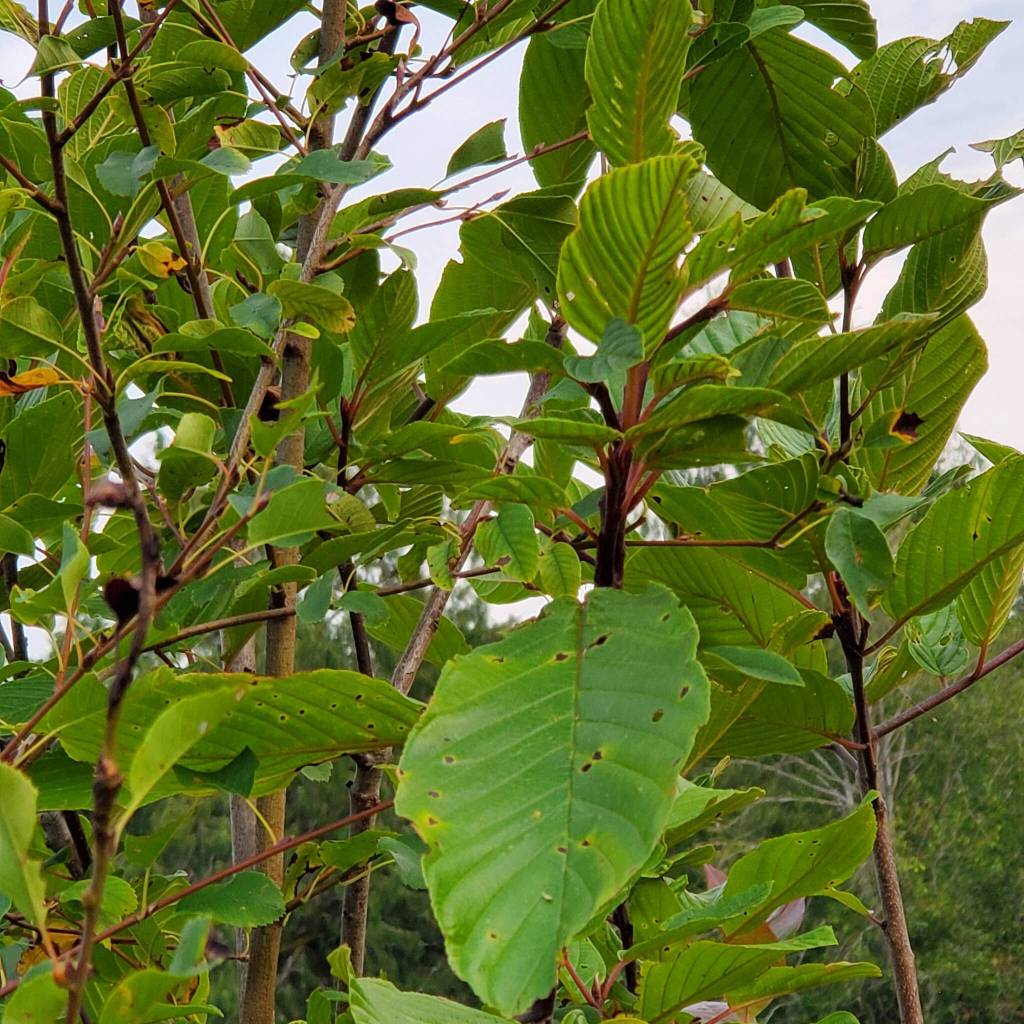
In forests with a closed canopy, which reduces the amount of sunlight reaching the forest floor, a cascara tree will likely die unless it has managed to find a patch of sunlight. With a height of 15-36 feet, cascara are easily overtopped by the Douglas-fir and red alder they grow alongside. Their form can be as a tree or shrubby, and its bright leaves may be elliptical or oblong shaped with prominent parallel veins.
Several Native American tribes, including the Nuxalk, Quileute, and Coast Salish, knew of the laxative properties of cascara’s bark and boiled the bark into a tea. Spanish priests in California learned of the plant’s medicinal properties and named the tree cascara sagrada, which is Spanish for “sacred bark,” as its wood was thought to resemble the wood used in the Arc of the Covenant. This California connection is likely why the European discovery of cascara bark having laxative properties happened in California.
Dr. J. H. Bundy of Colusa, California, (although some publications spell the town as Calusa) is credited with introducing cascara sagrada to the medical community. Not a formal doctor, he was a practicing physician and had success treating patients with remedies created from local plants. His success using Yerba santa to relive respiratory conditions, such as tuberculosis, caught the attention of Parke, Davis & Co., a pharmaceutical firm located in Detroit, Michigan, and they marketed this new remedy to great success. (Yerbva santa (Eriodictyon sp. Benth) belongs to the waterleaf family. A species found in California, the California Yerba santa grows as an evergreen shrub and is found in California and Oregon.)
Because of the marketing success of Yerba santa, Dr. Bundy turned his attention to discovering new remedies and passing them along to Parke, Davis & Co. In the October 1877 of their New Preparations newsletter, Parke-Davis & Company introduced cascara sagrada as a remedy for “that most frequent and subtle malady,” as Dr. Bundy described constipation. Dr. Bundy admitted in his report that he didn’t know the correct classification of cascara sagrada, resulting in confusion as to what plant he was describing until J. U. Lloyd identified Rhamnus purshiana based upon samples he received from Dr. C. H Adair, also from Colusa, California and a partner of Dr. Bundy.
The introduction of cascara sagrada occurred during Parke Davis & Company’s botanical research period when they were actively seeking new medicines to market and promote in their working bulletins and pamphlets. In the July 14, 1883, edition of The British Medical Journal, British physician R. A. Douglas Lithgow L.L.D, M.R.C.P.Ed., etc. (Member of the Royal College of Physicians of Education) published an account of his successful use of cascara sagrada with his patients. He noted that this medicine was brought to his attention by an American pamphlet and manufactured by Messrs. Parke, Davis and Co. The only negative response to cascara sagrada resulted from a patient taking a dosage not medically sanctioned.
Another physician, C. Emilius Thompson M. R. C. S etc, tested the drug on “strong men” in Her Majesty’s Labor Prison near Adelaide, South Australia in 1884. Not everyone could tolerate the remedy. In some men, a “ten-minim dose of the fluid extract” resulted in “immediate vomiting and another man “produced such griping as to render the administration of an opiate” And in Thompson’s private practice, a dose of ten minims three times a day resulted in a 65-year-old man experiencing exhaustive diarrhea. A 25-year-old woman who took “two does of ten minutes at an interval of not less than four hours” resulted in “exhaustive diarrhea with vomiting, violent twisting pains around the umbilicus, cramps in the legs, a pinched countenance, and clammy perspiration.”
As if to reassure physicians of cascara sagrada’s benefit, Thompson noted “the effects in this case were fortunately, of not long duration (four or five hours), and seemed to pass as suddenly as they set in.”
In 1878, a patient treated by S. E. Pease, M.D. in Oakland, California, requested “another bottle of that medicine [cascara sagrada]; there is more money in it than in the mine.” His prediction proved accurate. The praise of this drug resulted in cascara peelers searching Oregon and Washington forests for cascara trees. Harvesting occurred from April through August, usually the Pacific Northwest’s dry season. Depending upon the tree’s height, the tree was felled and peeled or peeled standing. At the tree’s base, the peeler used an ax to make a notch and run the blade lengthwise up the trunk and then strip the branches. As the bark dried, it couldn’t be exposed to moisture nor could its underside be exposed to the sunlight. After drying for one to three years, the bark was chipped, sacked, and sold to drug firms. In 1928, a good peeler could earn over $250 dollars (adjusted for inflation) for a day’s work.
Several other species of the Buckthorn family found in Europe had laxative properties but none as successful as the Pacific Northwest’s cascara. Scientists sought to identify the active ingredient responsible for its laxative properties. Dr. Jowett, with The Wellcome Research Laboratories in Snow Hill London, presented “Chemical Examination of Cascara Bark” to the 52nd Annual Scientific Section of the American Pharmaceutical Association in September 1904, detailing the failures of earlier efforts to identify the laxative’s chemistry. The next breakthrough in cascara sagrada research occurred in 1923 when Kenneth Beresford Gillie, for his master’s thesis from the University of British Columbia, found the wood of the cascara tree could also be utilized to manufacture cascara sagrada, thereby adding an additional source to the demand.
The active ingredients in cascara sagrada are glycosides, a molecule formed by the bonding of a sugar and non-sugar molecule. Once split, the non-sugar portion chemically affects the body. Another well-known glycoside is digitalis. Cascara is labeled as a laxative anthraquinone; these are found in organic plant pigments and are thought to relax the large intestine to allow for easier passage of fecal matter.
Based upon the historical demand for cascara, it appears that constipation was a common ailment. The Parke-Davis Blue Book, A Reference Catalog of Selected Scientific Preparations, published in 1938, detailed the preparation and administration of Cas-Evac, and among the drug’s selling points was that it “[is] palatable and is particularly suited for use by women and children” when the bitter glucosides were removed.
The demand for cascara outstripped the supply capacity of Washington and Oregon so the buyers turned their attention to British Columbia. In 1914, John Davidson, Botanist of the University of British Columbia Botanical Gardens and Herbarium, warned that efforts were needed to ensure a sustainable harvest of cascara. Rather than cutting the tree at the ground or stripping the bark, effectively killing the tree, he recommended leaving a stump at least 6” off the ground so that the cascara would resprout from the roots.
The demand for cascara experienced another uptick with the outbreak of World War II. The January-March 1941 Bulletin of the Imperial Institute identified plants and animal products that could be cultivated within the British Empire, as the current sources coming from North America were cut-off due to war and occupation of the source countries. Cascara was identified as one of these plants, with cultivation attempted in Kenya and the Royal Botanic Gardens.
The Canadian government also responded in a similar manner; the British Columbia Provincial Department of Agriculture created an Agricultural Production Committee to identify how British Columbia could supplement imported products in short supply due to the war; cascara was identified as a necessary product and that its conservation should be addressed to ensure a sustainable supply.
Likely in response to the wartime demand of cascara, governments in British Columbia and Washington State passed laws regarding the cutting of cascara. Order-in-Council #224 enacted on February 28, 1942, regulated the cutting of cascara bark. It stipulated that stumps at least 6” should be left and trees less than 4” shouldn’t be peeled. Similar legislation governing cascara bark peeling in Washington State was approved by Governor Arthur B. Langlie on March 18, 1943.
The following year, at a conference addressing the cultivation of drug and plants having economic value, Albert Arnest of the Soil Conservation Service delivered the American version of John Davidson’s The Cascara Tree in British Columbia in a paper entitled “Cascara – A Crop from West Coast Tree Farms.” Arnest didn’t share the Canadian’s fear of the American supply nearing depletion, but he recognized the need to create a sustainable supply of cascara bark and for peelers to follow correct peeling procedures. “[T]he bark thief may be branded publicly in the same class as a horse thief,” Arnest stated, addressing the mentality of peelers considering any cascara tree fair game and not private property.
Despite the call for creating plantations of cascara, this tree again became overlooked after the war. Even at cascara’s height of demand, calls for experimental plantings were scrapped. In 1914, a cascara experiment started on Vancouver Island, but by 1928, the trees were destroyed as the land was needed for other purposes. There are references to plantings in Oregon State College’s Forest Arboretum, but it appears the land was also converted to other uses. Synthetic sources were developed to replace natural cascara sagrada, and consequentially the pressure on overharvesting cascara lessened. A Canadian Cascara Bark Regulation was passed in 1958 but later repealed in 1981 and absorbed into the Forest Act. The Washington State law governing the harvesting of cascara was repealed in 1979 and absorbed into Specialized Wood Products legislation, as was also the case for Oregon State.
Dr. J. W. Bundy didn’t fare too well after his announcement of cascara sagrada. By Parke-Davis & Company’s own admission, Dr. Bundy was eclectic, and not of the “regular” school of medicine, and his successful attempt at introducing a marketable drug sparked jealous of Dr. Gibbons, a neighboring physician in Alameda whose alternative remedy for constipation didn’t gain the popularity of cascara sagrada. Their feud eventually became documented in a publication titled Professional Court W.P. Gibbons et al. vs. J. H. Bundy. Parke-Davis and Co existed for over a century before being acquired by Warner-Lambert in 1979, which was then bought by Pfizer in 2000.
On Nov. 5, 2002 , the Food and Drug Administration issued a final ruling that “cascara sagrada (including casanthranol, cascara fluidextract aromatic, cascara sagrada bark, cascara sagrada extract, and cascara sagrada fluidextract) in over-the-counter (OTC) drug products are not generally recognized as safe and effective or are misbranded.” Despite this ruling, supplements containing cascara sagrada can still be found online.