Public Health offers free diabetes workshops
Published 10:30 am Wednesday, November 12, 2025
Roughly 10% of the population of Grays Harbor County is diabetic. That’s nearly 8,000 people.
The National Institute of Diabetes and Digestive and Kidney Diseases defines it this way: “Diabetes is a disease that occurs when your blood glucose, also called blood sugar, is too high. Glucose is your body’s main source of energy. Your body can make glucose, but glucose also comes from the food you eat. Insulin is a hormone made by the pancreas that helps glucose get into your cells to be used for energy. If you have diabetes, your body doesn’t make enough — or any — insulin, or doesn’t use insulin properly. Glucose then stays in your blood and doesn’t reach your cells.”
According to the American Diabetes Association, “Diabetes can affect almost every part of your body, including your brain, heart, skin, kidneys, nerves and ears.”
The National Institutes of Health also state that as of 2022, healthcare costs attributable to diagnosed diabetes in the United States is $413 billion, including $307 billion in direct medical costs and $106 billion in indirect costs, and according to the Washington State Department of Health, $6.7 billion for Washington state during the 2021–2023 biennium.
Grays Harbor County Health’s diabetes coordinator Lena Stoddard and Gray Harbor County public nurse Lisa Lietz were given the opportunity to help launch the diabetes education, support and prevention initiative in 2024. The Self-Management Resource Center’s Diabetes Self-Management Program was selected as the core of the initiative. This program was developed at Stanford University in Palo Alto, California. It is a free six-week workshop series designed to help individuals and their caregivers manage symptoms, improve quality of life and reduce healthcare costs. The classes are held at Grays Harbor County Health’s Pearsall Building meeting room.
Stoddard has also been part of the Public Health Emergency Preparedness events that have utilized the mobile health van to travel around the county and spread the word at various Timberland Regional Library locations. Free A1C screenings are part of the outreach.
“As far as the medical side of it, with the A1C and blood pressure screenings, the more education we can provide our community with these types of chronic conditions, helping them access resources, longer life expectancy is always a great thing,” Stoddard said at the Montesano event back in February.
According to Lizette Cuevas, a community health worker with Grays Harbor County Public Health, the classes also help foster a sense of community and teamwork.
“They are super important for our community,” Cuevas said. “When these individuals get together, it’s very important for them. They’re able to bounce off each other’s stories and each other’s knowledge and help each other out and keep them motivated to continue pushing it.”
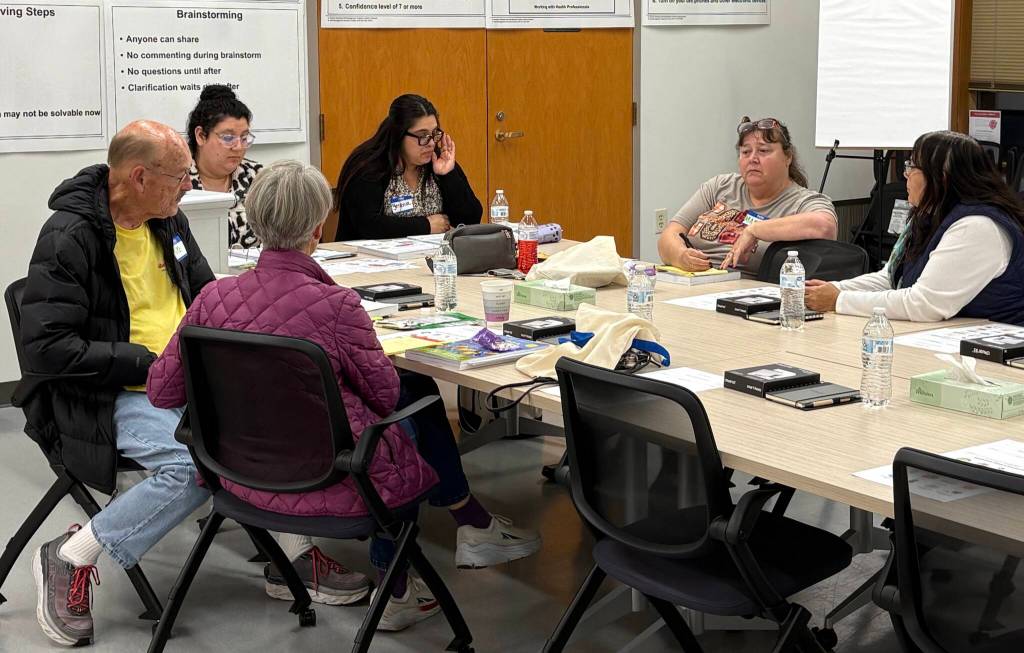
During the fourth session, participants reported back on the previous week’s action plan, their goals and accomplishments, progress with learning how to read food labels, exercise and weight loss goals, physical activity and meal planning and discussed food choices. The workshops are highly interactive. Cuevas says that element helps people learn.
“Personally, I am more hands on, and I think that that’s super important in learning,” Cuevas said. “Having them to be able to go ahead and try some of these techniques out here in person and then they are able to answer or we are able to answer any of the questions that they might have, I think that’s very important.”
Other topics and issues are discussed at each workshop besides the condition itself. Causes of negative emotions surrounding the condition were on the table Monday night. Cuevas said these issues are important to talk about and manage in addition to the disease’s symptoms and how to mitigate them.
“We also talk about managing stress and sleep patterns as well,” Cuevas said. “This workshop is open to family members too. If they want to join, they can come with their family members. spouses — we recommend it for anybody.”
Cuevas added that Public Health would like to hold these workshop series on a quarterly basis and add a Spanish language version.
“Hopefully next year we’re going to do a Spanish one for the first time,” Cuevas said. “I think that’s going to be super beneficial, especially for our community and especially because Hispanics, we are at much higher risk for diabetes just because of our culture, the foods that we eat. I think that it would be super beneficial for our community.”
Before class was dismissed, the attendees also discussed meal planning and an action plan for the coming week and they all said that they have learned quite a bit and found the workshops to be beneficial.
Although the classes are free, you must register in advance. Enrollment is closed for the current series of workshops, but you can contact Grays Harbor County Public Health to find out how to sign up for the next. https://www.healthygh.org/