Blue Zones provide foundation to increase life expectancy, quality of life
Published 1:30 am Thursday, October 2, 2025


Safe spaces, green spaces, third spaces, workspaces, outer space, time zones, temperate zones, altitudinal zones, subduction zones, intertidal zones … never mind parks, playgrounds, and trails.
All this nomenclature and jargon can make your head spin. In July 2019, Summit Pacific Medical Center introduced a new term and a new type of “space” to Grays Harbor County — Blue Zones.
“It started with Summit’s vision, which is that through Summit Care we would build the healthiest community in the nation. Our vision is about how we build a community where a healthcare system is a place to go and be well. Statistically Grays Harbor County is one of the unhealthiest counties in the state of Washington,” said Josh Martin, CEO of Summit Pacific Medical Center. “Blue Zones came to be with an idea that we, Summit, wanted to step outside the walls of the hospital into the environment. Grays Harbor County didn’t become the unhealthiest community overnight, it’s been multigenerational, and it’s about the environment. Our current environment is lacking. We are below average for all sectors. Summit Pacific spent years looking at change agents in the industry that had a track record. … So Summit adopted Blue Zones with the intent that we were going to use this as our vehicle to accelerate our community transformation. I believe we were successful.”
In 2024, the website Stacker reported that Grays Harbor County had the second worst life expectancy (75½ years) of all the counties in Washington state. According to the Community Health Needs Assessment compiled for Grays Harbor County Public Hospital District #1 from 2023 – 2025, “Grays Harbor County ranks 37 out of 39 counties for overall health outcomes. There are many factors contributing to this overall ranking, including health behaviors, nutrition, clinical care, social and economic factors, and physical environment. Grays Harbor County has higher rates of smoking and obesity and lower rates of physical activity compared to other counties.”
Access to healthcare, mental health, prevention and management of chronic diseases such as diabetes, lack of exercise, substance use/abuse and diet and nutrition have all been listed as major factors or causes for negative health outcomes for the residents of Grays Harbor County in the most recent health assessments.
Grays Harbor County Public Health has partnered with Harbor Regional Health, the Community Wellness Center and Summit Pacific Medical Center, and has contracted with Rural Health Innovations, to conduct a comprehensive county-wide health assessment and create a Community Health Improvement Plan. The first draft of the assessment will be presented at the upcoming health symposium on Oct. 10.
“That will be presented to the community, the Board of Health, the Board of County Commissioners, and all of our stakeholders. Those things that we own that are our wheelhouse and we have some say or control over, we’ll start working on and then those other things we’ll leverage our partners to see if they can start doing those things as well,” said Mike McNickle, Grays Harbor County Public Health director when the assessment was launched. “We’ll develop an outreach plan and then follow up quarterly or yearly. Not everything is going to work, but those that do work, we need to celebrate those.”
If you’re like most people, when you hear the term Blue Zones, your mind may jump to any number of documentaries narrated by Sir David Attenborough. You’d be half right. Instead of wildlife living in the various regions of the world, Blue Zones characterize the generational health and well-being of people residing in five specific geographic regions around the globe. Founded by journalist Dan Buettner, a National Geographic explorer and fellow, what became the Blue Zones initiative identified nine specific lifestyle habits: “move naturally, purpose, downshift, 80% rule, plant slant, wine @ 5, belong, loved ones first, right tribe.”
These lifestyle habits may very well be the key to living longer, healthy lives, however, the Netflix documentary series focusing on each Blue Zone — Barbagia region of Sardinia; Ikaria, Greece; Nicoya Peninsula, Costa Rica; Seventh Day Adventists in Loma Linda, California; and Okinawa, Japan — leads to a sobering conclusion. The habits and lifestyles that have led to positive health outcomes and longevity in these specific communities have evolved over decades, and in some cases centuries, and maybe even a millennium.
With the exception of Loma Linda, the towns and neighborhoods within Blue Zones were not designed with cars in mind, which increases and necessitates walkability. The pace is slower, seniors are cherished for their knowledge and wisdom and continue to work at a purposeful vocation long after “retirement,” regular communal family meals are the norm … and technology such as computers and smartphones seems to be non-existent. You might say Blue Zones are devoid of blue screens. However, it would be nearly impossible to replicate all of the socio-economic, demographic, geographic, and nutritional conditions that have led to disproportionately longer life expectancy.
Enter Blue Zones, the company. Drawing on the research conducted in the original five regions, the company endeavors to develop Blue Zones communities while focusing on small changes to “help people live better, longer through community transformation programs that lower healthcare costs, improve productivity, and boost national recognition as great places to live, work, and play.” According to the official website, fully fledged “Blue Zones Project Communities benefit from better health, significant medical cost savings, productivity improvements, increased economic vitality, and lowered obesity and smoking rates.”
In 2020, a Blue Zones study and assessment of Grays Harbor County was commissioned and conducted and in late 2023, led by the executive director for Blue Zones Activate Grays Harbor County, Chris Frye, a kickoff event was held and a list of potential projects was unveiled. Blue Zones Activate partnered with CHOICE Regional Health Network and added Lewis and Mason counties to the initiative.
According to the Blue Zones Activate Grays Harbor County Year 1 Report, “Grays Harbor County, as well as Mason and Lewis counties, were selected for the Blue Zones Activate initiatives based on readiness, feasibility, and overall community need. … This event showcased the past and upcoming work of Blue Zones Activate Grays Harbor County and served as an educational event for all community members. The event invited health and wellness-related community organizations, provided activities that highlighted Blue Zones founding principles, and included speeches from Summit Pacific CEO Josh Martin; Blue Zones Co-Founder Nick Buettner; and Executive Director Chris Frye.”
Grays Harbor County is 1,902 square miles and contains 29 cities and is home to a population of 77,893 (2024). An awfully big area if you want to create a Blue Zones Community. According to Martin, addressing the health and life expectancy of Grays Harbor County residents had to start somewhere.
“It’s probably been our biggest challenge. When we reached out to Blue Zones leadership, the challenge they had, and we had, there were no similar projects. Most of what they’ve done was in urban areas. They focused on big corridors with high population density. They picked a city to do a project where Grays Harbor County is very spread (out),” Martin said. “They proposed a solution where they identified what they called ‘halos.’ And the halo effect is when you pick these geographic locations or cities and you do projects that would have a halo effect. It would influence the surrounding areas through positive impact and change. It would create momentum for the rest of the county.”
Martin says the key to implementing some of the Blue Zones concepts involves getting people with a shared purpose to convene, for leaders to emerge to drive these communal gatherings, and to have the space for them to occur.
“It could be a cooking group, or a reading group, or a knitting club, but you have to have space but you also have to have individuals willing to lead or convene. We do not have enough of those groups or convenings. I think it is a determination of space,” Martin said. “There is a shortage of spaces for youth to gather safely outside of home and school per capita. We don’t have enough spaces for seniors or enough activities for them to gather in a community space to recreate or convene together. You can convene at the college, you can go to the community center in downtown Aberdeen. But who’s going to lead and which agency is going to devote their resources? Where do those groups happen naturally and organically? The Blue Zones model has to be done through directive, through an agency to get it up and running … and then turn it over to that community-led group or it would just fall apart.”
Martin says that the Blue Zones initiative has been a step-by-step process with measurable benchmarks without biting off more than stakeholders could chew.
“We have a high percentage of hopelessness. What the community needs to see is small incremental, sustainable changes led by the top. They need to see that there is positive change and that they’re willing to trust that something will happen and something will get done. Then they’re willing to participate and get on board,” Martin said. “Now we know where to start, but how are we going to pay for this? We didn’t have money as a community, we needed a grassroots effort. We were able to find the funding through CHOICE to fund an Activate project for three counties — Grays Harbor, Lewis and Mason.”
According to the Year 1 Report, the Activate program has led to the Grays Harbor Healthy Food Alliance, the Elma Discovery Trail project, Health Equity Grant Assistance for the Chehalis Tribe and Pedestrian Safety Week in Hoquiam.
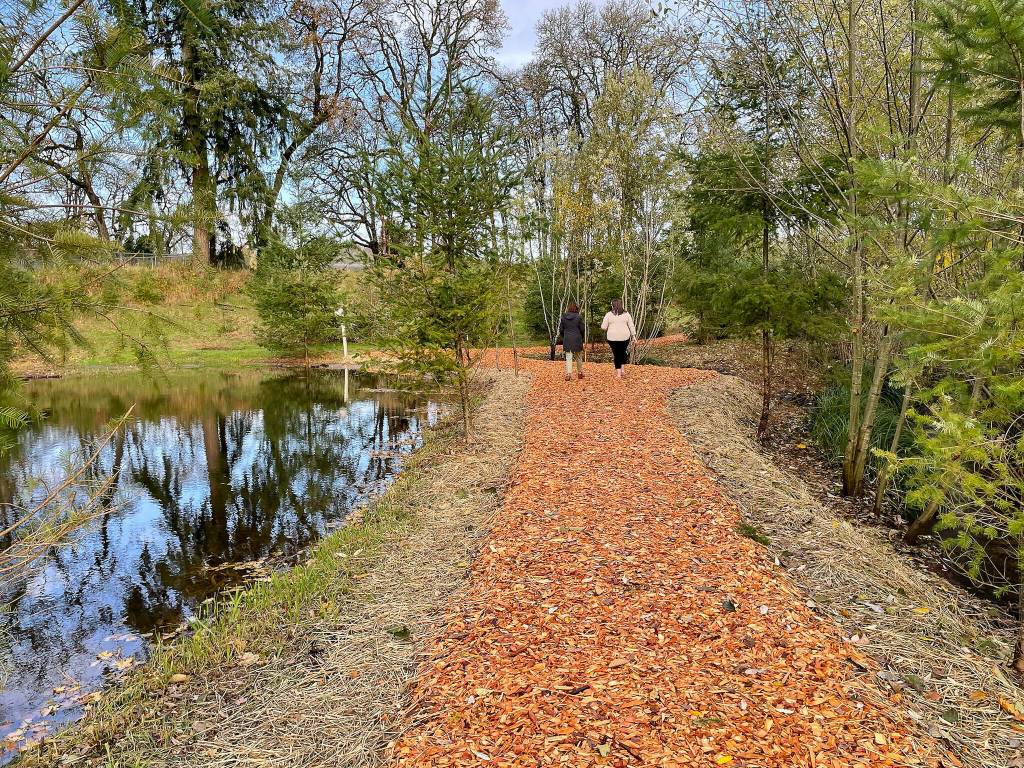
Martin is particularly proud of the Elma Discovery Trail project which exists on the grounds of Summit Pacific Medical Center and is open to the public.
“We created a discovery walking trail on our campus, that’s something we brought in Blue Zones architects for, that engages youth into early activity and ties into curriculum and school readiness, that’s pretty incredible,” Martin said. “Talk about creating an environment, leading by example and saying ‘let’s give our community something, an action, something they can do together,’ that’s creating a space, a destination, and a place to come and be well.”
Hoquiam City Administrator Brian Shay says that some of the Blue Zones concepts dovetail with many of Hoquiam’s ideas and plans, especially when it comes to getting people outside.
“The Blue Zones equation focuses on health and fitness and recreational opportunities and access to the outdoors which Hoquiam has been a big proponent of for many years,” Shay said. “That’s why we’ve consistently tried to renovate all of our parks, we’ve added parks, replaced our playground equipment, added bike trails, added new safe routes to schools, and the community forest falls in line with that as well.”
According to Shay, one of the proposed projects that excites him is the possibility of a major new public indoor sports complex.
“Chris (Frye) is still hoping to implement some of the things that were identified. I served on one of the committees and the multipurpose indoor sports complex is one of the top priority projects that was identified as a community need. I know that he believes we need that, I definitely know that we need that. He’s hoping to keep that effort alive and see it come to fruition somewhere in Grays Harbor County,” Shay said. “I have a kid who’s 10 years old who loves every sport. A 30-minute drive, it would be booked non-stop if we had that type of facility. The grants are there. You just have to get the right group of individuals together with the passion and dedication to make it happen.”
Blue Zones Activate Grays Harbor has since rebranded as Community Wellness Collaborative Grays Harbor County, and CHOICE has ended its participation in the initiative. According to Blue Zone’s official website, “Blue Zones Activate has sparked incredible momentum in Grays Harbor, Lewis and Mason counties, bringing people together to create healthier places to live, work, and play. While CHOICE’s formal partnership with Blue Zones (concluded) in May 2025, the work inspired by this initiative will continue to thrive under local leadership.”
That local leadership is spearheaded by Executive Director Frye. He said Blue Zones’ presence was never intended to be permanent.
“Blue Zones is never permanent,” Frye said. “They come into a community, they build awareness and momentum and fade away. They hope that the local community moves forward with these programs. We had two major things we were working on — walkability, bike trails, etc., and then food policy. Our major goal was to create a food policy council, which we did, the Grays Harbor Healthy Food Alliance.”
Frye said the major initiatives with the Food Alliance include fostering long-term community health, strengthening healthy food skills through cooking classes, strengthening the local food chain which would include establishing a food hub, making it easier for farmers to sell their products and residents to purchase that food.
“Making the healthy choice the easy choice. If you’re trying to eat healthy in a restaurant in Grays Harbor County it is very difficult. There are not a lot of opportunities,” Frye said. “How do we get easy-to-buy produce? Or you receive produce for free through SNAP or WIC, but then what do you do with that produce? We’re just trying to make it simple.”
Frye added that he is working with Hoquiam, Aberdeen, Elma and Ocean Shores to design bike or walking trails.
“We don’t have the funds to implement it, but we have the funds to design it, map it, engineer it, then we hand it off to either the city or a non-profit or a running group, or Summit Pacific Medical Center, and have them move forward to apply for grants,” Frye said. “But we do all the design work. I look at every community like I am hanging out with my daughter on a bike and we’re trying to get a Slurpee. My goal with these four communities is how do I make it so every kid can get to the key targets, all of these activity areas, on a bike safely. On top of that we’re sprinkling in walking trails.”
From the Grays Harbor County Board of Commissioners on down, including the two hospital districts, Public Health, chambers of commerce, and major employers, there has been a sea change in recent months regarding the definition of health. Mental and physical wellbeing, access to healthcare, proper nutrition, activity and exercise, workforce development, housing and other factors are now all being considered as part of the ecosystem in which we all live and work or attend school.
Blue Zones Activate served as a baseline and a launching point to help leadership and stakeholders start to make meaningful, measurable differences in the lives of residents of all ages throughout Grays Harbor County.