
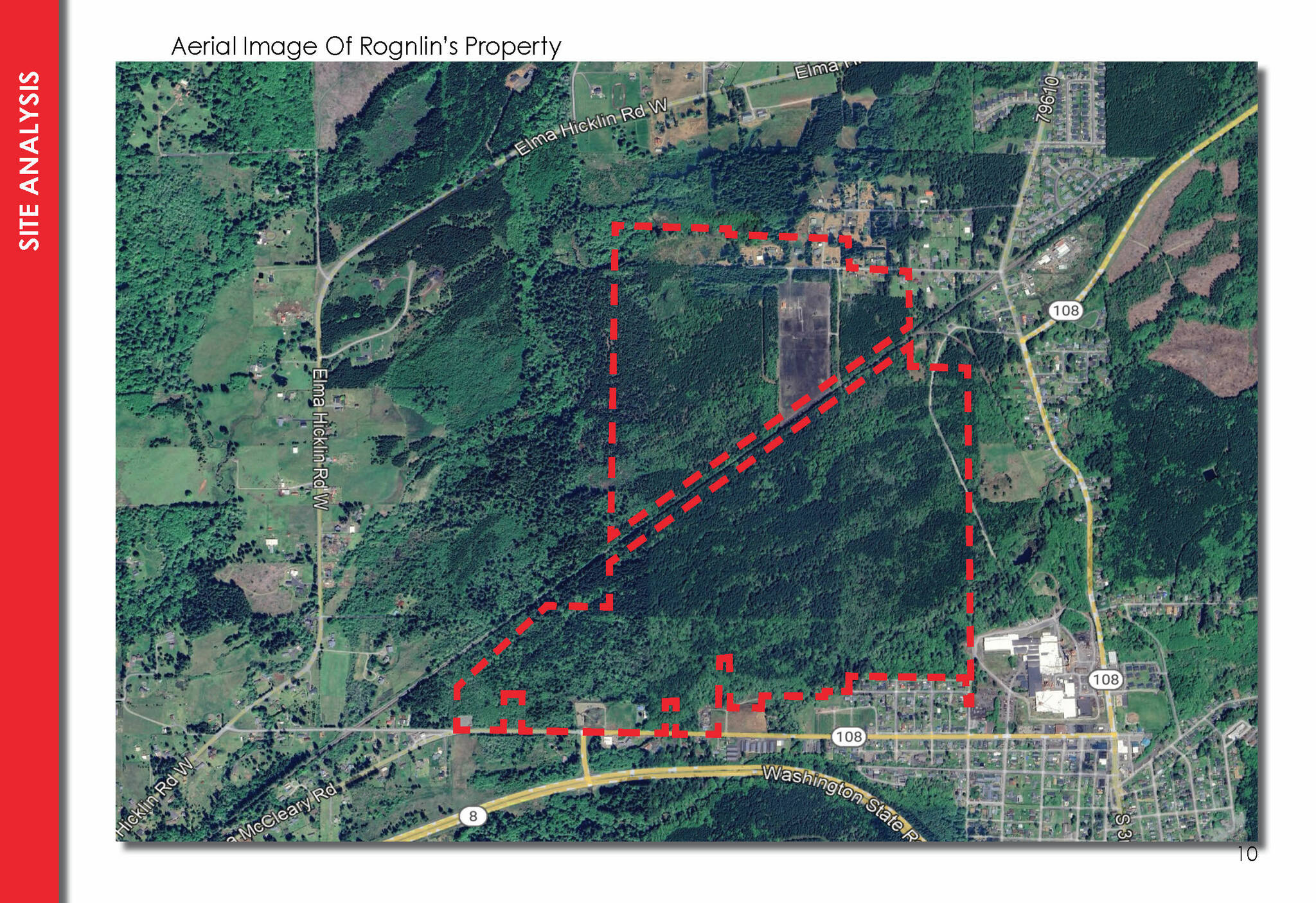
On Jan. 21, the city of McCleary held a development workshop meeting for community members to hear Rognlin’s, Inc.’s vision of the 450 acres the company owns within the city limits. This is the second work session that has been held; the earlier work session was with city council members and city staff.
The 450 acres, which is located in the northwest corner of the city, is a combination of parcels that Rognlin Properties LLC purchased from the Grays Harbor Drug Task Force, Green Diamond Resource Company and Larry and Stacy Birindelli. The governors of Rognlin’s, Inc. are Katie Snodgrass, Brian Thompson, Randy Rognlin and Nick Rognlin. For Rognlin Properties, LLC, Randy Rognlin is the sole governor.
Following a welcome and introduction by Mayor Brycen Huff, Ron Thomas, president of Olympia-based Thomas Architecture Studios, gave an overview of what would be presented: a brief history of the property, a review of the work accomplished to date, and what’s needed to incorporate a master plan development opportunity into the city’s zoning code.
In 2019, the Grays Harbor Drug Task Force seized 350 acres within the McCleary city limits for an illegal marijuana growing operation.
“The city had every intention of requiring that property,” Thomas said. “And just for whatever reason, financially or otherwise, they just couldn’t follow through with that.”
In 2023, SCJ Alliance worked with the city to update its comprehensive plan, which informs land use and zoning.
“It was all done. They had prepared an ordinance for its approval, and for whatever reason, council never voted on it,” Thomas said. “So we literally stopped one vote short of adopting all the work that they’ve done.”
Two years later, Dan Baskin, a consultant with Rognlin’s Inc. contacted Thomas Architecture Studios (TAS).
“Why our firm?” Thomas asked. “We do civic, we do housing, and we do urban planning.”
The firm has a history of designing large mixed-use, multi-family developments that have a range of housing types and price points.
“We enjoy doing this type of work and work that involves a lot of community consensus building,” said Thomas. “A meeting like tonight is very normal for our firm, and we’re very methodical about what we do, how we do it. And usually when we get involved, it’s a step-by step-by-step process that involves community.”
Last year, through the use of drones, Rognlin’s Inc conducted an aerial survey of the property. This year, a wetland survey will be conducted, with the results anticipated to be received before summer. Collectively, these data will inform the master plan to be developed, which may begin in summer 2026 if two action items are checked off: the city adopt a new comprehensive plan and update the zoning code to permit for master planning. Until these steps are accomplished, Rognlin won’t move forward.
“If you don’t have a master planning in your code, what’s the point?” Thomas said.
Then, Thomas walked through how a master plan district can be built.
“You can be very, very tight. Give them [the developer] all the details and say, ‘We’ll accept the master plan, but whoever develops that they have what’s called a development agreement,’” Thomas said. “The development agreement is an agreement with the city that commits the developer to doing certain, let’s say, infrastructure, roads, utilities. … If the city allows that developer to do what they want to do, there’s a quid pro quo. Then the developer has to promise to do certain things for the city. … And all of that detail is typically paid for by the developer. So this is the least expensive way for the city to come up with the master plan area of their code for very little money, very little money.”
One clarification that Thomas pointed out is that the Rognlin’s is a private company.
“To the degree that they want to be transparent, they will be transparent,” he said. “Our recommendation is to be quite transparent because it’s a master plan community. It’s all going to come back to the city eventually, and you’ll be right back here to go with a great deal of interest in what exactly is in this. … But it’s the developer’s choice what they actually want to do with it.”
He continued, “This is not the whole idea of a master plan, it’s an opportunity plan. This is not meant to displace your community. … It’s an opportunity. Take advantage of it.”
Jason Mirzayi, project manager with TAS, spoke next and provided an overview of the city demographics drawn from the U.S. Census Bureau, which included a high rate of home ownership, one school, and the Simpson Door Plant is a major employer.
Blue Zones
“As we’re doing that research and as we’re thinking with Summit Pacific Medical Center and Rognlin’s on how we can make this property into something that’s a boon, something that’s good for McCleary, we cast a wide net and we came across the idea of Blue Zones,” Mirzayi said. “Blue Zones are a sort of a sensation of how we live our lives directly affects our health outcomes in the long run, and how we live our lives is directly tied to where we live and how we build our environment around us.”
Josh Martin, chief executive officer of Summit Pacific Medical Center, provided an overview for why the hospital is partnering with Rognlin’s. In the audience were three Summit Pacific Board of Commissioners Georgette Hiles, Kevin Bossard and Andrew Hooper.
“We have a very bold vision, which is through Summit Pacific we want to build the healthiest community in the nation, and it’s a bold vision because Grays Harbor County is not healthy …,” Martin said. “So we want to start thinking about how do we build a healthier, more thriving community.”
Martin mentioned that health outcomes are only 20% genetic and 80% is the environment: “So we need to get outside the walls of the hospital and start to think about the environment of how our community lives.”
Housing
Additionally, Summit Pacific needs to grow its workforce to support the increase in population that East Grays Harbor is projected to experience. However, to grow the workforce means access to childcare and housing. The former Summit Pacific has addressed in Elma; as for the latter, 50% of Summit Pacific employees commute from Olympia, and “we do not have solutions for housing,” Martin said.
Developing the Rognlin’s property offers a solution to provide the housing and create a Blue Zone community that’s walkable and offers the services that community members have wanted.
“The interesting thing about the Rognlin’s, when they entered the picture, the reality was is it gave us an opportunity that we wouldn’t have at any other moment in time, that we’ve been trying for decades to find and we’ve failed,” said Martin. “And this opportunity presented itself that we have a local person invested in this community in Grays Harbor County that aligns with our understanding and knowledge of what growth means and how to be good stewards of that growth.”
In his closing remarks, Martin noted that East Grays Harbor is void of third places for youth to gather safely outside the home and school.
“Imagine if we could come together and say, what if that third space was here in McCleary?” he said.
Mirzayi continued by outlining the work that has already been done and what the next steps may be. He assured the audience that “I know it seems like we’ve done quite a bit of work here before we even came to you today, and in some ways that’s true, but in some ways we’re just getting started. … Really, the work we’ve done has been vision casting, has been trying to form partnerships and bring people all to align to this wonderful idea of a healthy community being here in McCleary.”
Mirzayi repeated what Thomas mentioned earlier, that imagery and topographic maps have been produced; these will help the team determine how much of the property is usable for housing or industrial, and how the new development can tie in with the existing roads and trails.
Prior to the night’s public workshop, Mirzayi said that they already had two work sessions with some of the council members, “and they’ve already come to us with some fantastic ideas as well as concerns and maybe visions of things they’d like to see, things like can we have community gathering spaces? Can we use schools and churches as anchor points for a community to gather?”
Mirzayi highlighted that a benefit of master plan community is to think on a wider scale, which isn’t possible with individual developers.
“None of them are going to be beholden to one another,” he said. “They’re going to be developing, you know, potentially housing next to industrial, next to insert use here. Master planning gives us an opportunity to look forward to integrate housing, community services, bike trails, green spaces, all into one shared vision.”
Wetlands
He acknowledged that the property contains wetlands and said, “And one of the great things about master-planned communities is we can integrate green spaces and wetlands.”
Of the housing that would be built, it will be a mixture of attainable and right-sized housing.
“When we have people like Josh’s hospital staff who need somewhere to live but maybe they’re not ready to buy a 3,000-square-foot home with a yard, some of our master plan elements could be, ‘Hey, we’re doing duplexes,’” Mirzayi said. “We’re doing live-work units with apartments and maybe like a barber shop below. We’re giving us a lot of opportunity to integrate different housing types into the community to create a strong, resilient economic backbone.”
Thomas began his closing remarks by saying, “density drives municipal success,” and the benefits of offering multiple housing options. He also outlined the next steps, which include 1) update the comprehensive plan and approve proposal from SCJ Alliance; 2) approval of the comprehensive plan; and 3) approval of land-use code updates that allow for master plan developments.
Rognlin’s will complete wetlands and critical area studies before summer 2026. But after that, Thomas emphasized again that Rognlin’s won’t proceed until the land use codes are updated.
“[Randy’s] going to spend many tens of thousands, hundreds of thousands of dollars master planning 450 acres, that’s not a small thing. … That’s the way it works,” Thomas said.
In closing, Thomas said, “Transparency is actually our friend on this type of thing, and we will keep you informed along the way. And that’s how it gets done together.”
Mayor Huff thanked the team for their presentation and asked if people had questions. One attendee asked what is meant by affordable housing and what would it look like. A question was raised regarding the water availability. Thomas said they will review the aquifer studies that have been done regarding the water, as well as looking at how the other infrastructure and utilities would need sourced for the development.
Grays Harbor County Commissioner Rick Hole addressed the audience.
“I wanted you to know that housing is the number one priority for your Grays Harbor County commissioners,” he said. “We have a resolution that we passed that we’re going to do whatever we can to support housing. … It is so cool that you have an opportunity to be at the grassroots and to build this sustainably how you want it to be. I’m just really excited, so I wanted to come out here to share with you the support that you’re going to get from the county. If there’s infrastructure requirements, if you need to bring water in from someplace else that’s available, we’re here to help. And I just want you all to know that I speak for the other commissioners as well.”
During the city council meeting held the following Wednesday, Jan. 28, City Administrator Jon Martin said that he met with SCJ Alliance to determine what needs updated in the 2024 comprehensive plan. Additionally, they will help the city through other parts of the development process, such as development fees.
Martin estimates that it will take two to three months before bringing the plan forward for approval, “because we just want to make sure that we’ve got everything right, but we don’t have to start from scratch.”