

Grays Harbor County used to be home to the “Lumber Capital of the World.” Now that the timber industry has come and gone — and left a trail of environmental and economic damage in its wake — some of its residents are reimagining their local identity.
A significant amount of people are homeless in Grays Harbor, and the county leads the state in opioid overdose fatality and incarceration rates. In the predominantly white area, people of color are disproportionately impacted. Indigenous people make up a significant number of Grays Harbor’s homeless population. And Black people are overrepresented more than tenfold at the local prison.
Chaplains on the Harbor, self-appointed “Freedom Church of the Poor,” is fighting these cycles of poverty. Founded in 2013, Chaplains is a group of faith leaders and people with lived experience of financial insecurity working to provide spiritual care, physical support, and political advocacy to marginalized members of the Grays Harbor community.
“Our mission is that we walk with those in poverty,” said Barbara Weza, Chaplains’ current executive director.
Weza said that the group particularly aims to serve people who have experienced or are experiencing homelessness, incarceration and substance use disorder.
Unlike some traditional churches, Chaplains’ ministry extends beyond the walls of its sanctuary.
It extends to its resource center, where folks can find clothing, case management, showers, laundry facilities and hygiene items. It extends to its 24-acre Harbor Roots Farm, where farmers with lived experience of poverty cultivate the land to grow fruit and vegetables for the community. And it extends to the local prison and multiple homeless encampments across the county.
The origins
Chaplains leaders contextualize their ministry within local history.
Grays Harbor earned the nickname “Lumber Capital of the World” when the U.S. government seized the majority of the county’s land from Indigenous people and sold it to a timber corporation. The timber industry boomed at the turn of the twentieth century, becoming the bedrock of the local economy while simultaneously wreaking havoc on the environment.
Then it collapsed. Without alternative sources of employment, young people — some of whom were fourth-generation timber workers — had trouble finding work.
Unemployment in the county skyrocketed to double the state average and remained there throughout the end of the twentieth century. In 2000 a prison opened, filling the economic crater left by the timber industry with a handful of carceral dirt. For every person the prison employed, it incarcerated three.
“There were interests that had made tremendous profit off of the region, and then had left everyone to die,” said Chaplains co-founder Cedar Monroe, who grew up in Grays Harbor and spent almost a decade working as a chaplain doing street and prison ministry in the area.
Worse, these outside groups told the people of Grays Harbor it was their fault. In Monroe’s view, capitalist power structures sell a narrative to poor people that blames them for their own poverty using harmful tropes — that they are poor because they are too lazy, too stupid, or too uneducated.
Monroe detects a whiff of white supremacy in these narratives too, one that casts poor white people as “failed white people” under white supremacist logic wherein they “should” be superior.
He also detects a hint of toxic religious ideology that sends the message: “you’re poor because you don’t love Jesus enough,” as he put it. Ironic, Monroe pointed out, given that “Jesus was a poor person —who organized other poor people — and was targeted by a powerful and wealthy empire.”
The community
Chaplains was built in the shadow of the timber empire. It began with peanut butter sandwiches from a backpack, which Monroe passed out to folks once or twice a week in homeless encampments around Grays Harbor.
That’s how Monroe met James Petersen, now a farmer on Chaplains’ staff. Petersen was experiencing a period of homelessness when he met Monroe doing street ministry.
Petersen had grown up helping his father grow potatoes and squash in California before moving to Grays Harbor when he was 14. Like many young people in the county, he had trouble finding work after graduating high school and started living on the street.
One day, Monroe offered Petersen a job at Chaplains; he wanted him to help run Harbor Roots Farm. In an environment where employment was so difficult to find, the idea of being paid to farm, something Petersen grew up doing and already had a fondness for, seemed too good to be true.
“You’re joking, right?,” Petersen recounted thinking to himself. He took the Zoom call from the farm, taking a break from preparing the berries he had harvested to sell at the local farmer’s market that weekend.
Petersen is one of four staff members on the farm today, all of whom have lived experiences with poverty.
“It is these voices that have the experience and that are most impacted that need to be loudest heard,” said Weza. “Those are the people that we learn from.”
“They are the best equipped to understand the problem and to lead change,” echoed Monroe.
When Petersen is not at the farm, he helps with Chaplains’ outreach efforts. Mirroring his own origin story with the organization, he brings coffee, sandwiches, and casework resources to areas where homeless people congregate.
But Petersen doesn’t have to go far to do outreach in the community. There is a good chance he will run into someone he works with walking into his local Walmart. When this happens, Petersen appreciates the chance to check in and provide any assistance he can in the moment.
“In these smaller areas, I don’t think people have an option but to really know each other,” said Petersen. Rural poverty looks different from poverty in urban areas, where high rates of homelessness and addiction are usually accompanied by shelters and detox centers.
“We don’t have year-round shelters here,” said Petersen. “So it’s very community based. You got to know a few people in order to survive.”
A strong sense of community exists amongst people experiencing poverty in Grays Harbor. It’s a community marked by collective struggle, tremendous courage and resilience, and an understanding of the root causes of the hardships it faces.
The work that Chaplains does to provide additional support is grounded in faith. Not a proselytizing, church-every-Sunday faith. Chaplains isn’t there to push Christianity on anyone. It embraces interfaith connections and recognizes that many of the people it serves have been traumatized by the church in some way.
Rather, it’s a faith embodied by work.
“Everything that we do is spirit-led and is very much about worship,” Weza explained. “Whether that be land equity and land justice, whether that be food justice.”
“That’s more of what the commandments were,” said Petersen. “Loving your neighbor, clothing them, and feeding them and all that stuff.”
The fight
Chaplains has also led the charge to fight poverty at the systemic level.
“Our communities understand what’s happening to them in a lot of ways,” said Monroe.
In 2018, members of Grays Harbor’s homeless community collaborated with Chaplains to sue the city of Aberdeen for a discriminatory city ordinance restricting the group’s ability to do outreach in a homeless encampment. They won. The next year, as a result of a second lawsuit, the city allocated funds for a sanctioned tent city with weatherized tents and paid damages for the eight plaintiffs living in the camp.
Petersen, who helped with the lawsuits, felt energized by these outcomes and continued advocating for change at city hall, attending county meetings and speaking with local officials. His approach: finding common ground.
“You care about Grays Harbor. I care about Grays Harbor,” Petersen said. “There’s a common goal here.”
While Petersen felt like he had been making progress with this approach at the local level in recent years, he fears new federal policies targeting impoverished communities will mitigate any positive change.
Chaplains has also taken action at the federal level, coordinating staff and impacted members of the Grays Harbor community to voice their demands before Congress. Their demands were clear: they wanted jobs, housing, healthcare and treatment centers.
Their testimony was in collaboration with the Poor People’s Campaign — a modern incarnation of Martin Luther King Jr.’s 1968 movement founded by Reverend William Barber II in 2018.
Barber visited a homeless encampment in Grays Harbor County the same year he founded the Poor People’s Campaign. He met with Chaplains leadership and people living in the camp, including a veteran of the Quinault Nation named Leon, who is homeless on his native land.
Leon told Barber that he had lost his brother that winter to treatable pneumonia after he was repeatedly denied access to healthcare. With the recent gutting of Medicaid, which rural hospitals in areas like Grays Harbor rely on heavily, tragic and unnecessary deaths like this may become more and more common in rural places.
Stories like the one Leon told Barber about his brother do not need to happen.
“There’s no reason why the richest country in the world can’t provide for its people,” said Monroe.
“Poor communities know what they want and need,” said Monroe. “It’s not a lack of imagination; it’s a lack of [outside] political will.”
This story was originally published in the Daily Yonder. For more rural reporting and small-town stories visit dailyyonder.com.
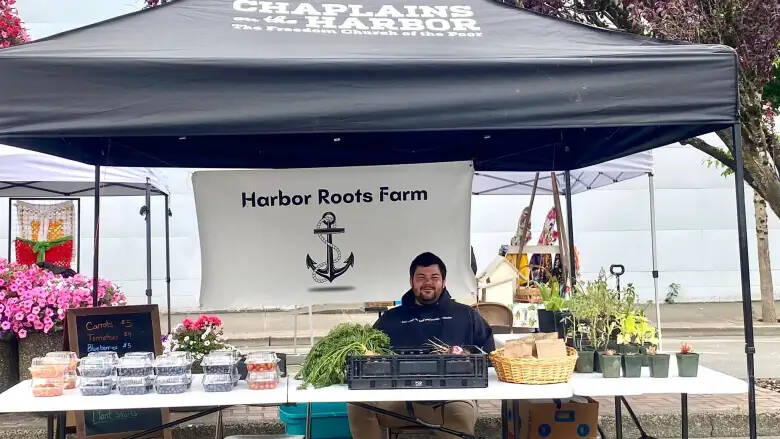
Photo by Barbara Weza James Petersen sells produce grown on Harbor Roots Farm at the local farmer’s market.
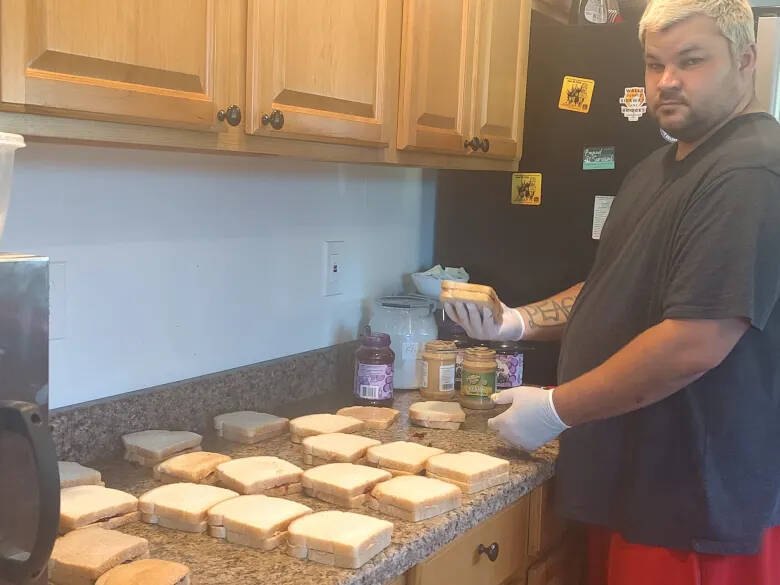
Photo by Barbara Weza James Petersen makes peanut butter and jelly sandwiches to give to people who need them in the Grays Harbor community.