Court rules against Quinault fishing takeover
Published 1:30 am Wednesday, June 3, 2026
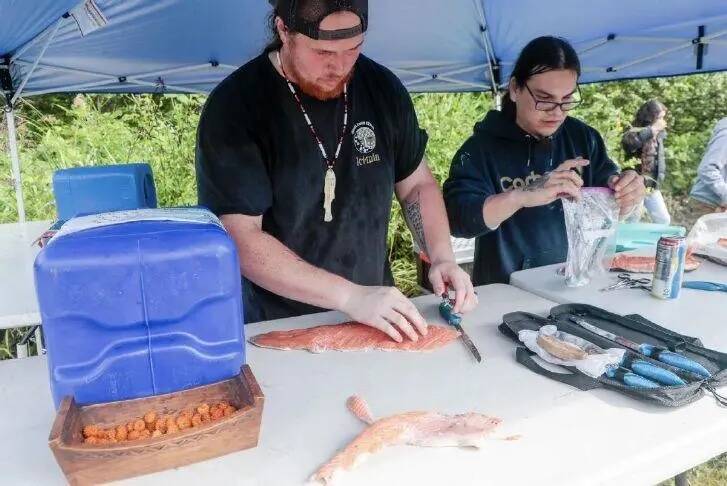
WILLAPA BAY — The Quinault Indian Nation’s initial effort to seize fishing rights from Willapa Bay to 60 miles east along the Lower Columbia River was shot down by a federal judge on June 2.
The Quinault, whose territory centers on Grays Harbor and the area immediately to its north, took preliminary steps earlier this spring to reopen the process of claiming treaty-protected “usual and accustomed” fishing and shellfishing grounds extend south into areas traditionally belonging to the Chinook Indian Nation and the Shoalwater Bay Indian Tribe.
The Quinault, Chinook and Shoalwater all reacted to the June 2 ruling with expectations that the fight is far from over.
U.S. District Court Judge Ricardo S. Martinez in Seattle made a prompt and unambiguous decision about the Quinaults’ May 28 request to consider the matter under provisions of the the legal framework of U.S. v. Washington — also known as the Boldt Decision — which recognized that Washington treaty tribes are entitled to half the fish and shellfish available for harvest in their hereditary areas.
If allowed, expansion of Quinault territory into the Columbia would also impact the U.S. v. Oregon guidelines that protect tribal fishing rights east of Bonneville Dam. A host of other bi-state and intertribal arrangements would also be affected, potentially including recreational fisheries, since returning salmon would need to be split to take account of a new share for the Quinault.
For now, the status quo will remain in place.
“The Quinault Nation’s U&A [usual and accustomed area] has been adjudicated with a clear southern boundary. Eight years ago, the Court set forth a marine U&A as a polygon with a southwestern point and a southeastern point and a line connecting the two — the southern boundary. Willapa Bay, Shoalwater Bay, and the mouth of the Columbia River are all more than 10 miles south of that boundary. To include them in the marine Q&A now would be to overrule the Court’s prior adjudication,” the judge concluded.
“The Quinault Nation fails to demonstrate that anything was left unadjudicated. To the contrary, the Motion states that the Court (back in Subproceeding 09-1) was presented with ‘evidence demonstrating that Quinault marine fishing practices were oriented southward and westward along the coast ‘between Cape Flattery and the Columbia River’ as well as ‘60 miles south of Quinault in Shoalwater Bay,’’ but nevertheless drew the line more than 10 miles north of Willapa Bay, Shoalwater Bay, and the Columbia River. There is no basis for the Court to amend its prior conclusions, or apparent logical reason to adjudicate a U&A in the freshwater of the Columbia River now after all of the previous determinations reached in this matter,” the judge decided.
In response, “Quinault knew when we filed this case that we would be in for a lengthy battle to prove the location of the usual and accustomed fishing areas guaranteed under our Treaty. We disagree with the ruling that our southern boundary has already been established, and plan to aggressively continue to pursue our claims through the court process,” Quinault President Guy Capoeman said Tuesday on social media.
The Chinook said on their Facebook page, “Today, the U.S. District Court for the Western District of Washington denied Quinault’s request to open a new subproceeding seeking treaty rights in Willapa Bay, and the lower Columbia River. In its order, the Court confirmed that Quinault’s southern treaty fishing boundary has already been determined and lies more than 10 miles north of Willapa Bay. We thank everyone who has stood with us and helped elevate our Nation’s voice.”
The Shoalwater, whose small reservation is at the northern side of Willapa Bay’s entrance, said on Facebook, “Although this may not be the final word on the matter, it is a decisive ruling from the Court at this time denying Quinault’s request to reopen their boundaries. We will continue to monitor the situation and will certainly take action if we feel it’s necessary to protect the interests of the Shoalwater Bay Indian Tribe.
“At this point, it’s enough for us to remain vigilant and stand strong. We recognize and respect the sovereignty, history, and treaty rights of all Tribal Nations surrounding us. However, we will also fight vigorously to defend Shoalwater Bay’s rights to our reservation, our tidelands, our resources, and future generations.”
The Quinault are represented by attorneys Rob Roy Smith and Derek Red Arrow of Kilpatrick Townsend & Stockton LLP, a major multinational law firm. The billable rate for its attorneys can exceed $950 an hour.